How much does a custom wall mural cost in Canada?
The price of a custom mural in Canada in 2026 depends on the ordered dimensions, the chosen substrate, and the work required to prepare and cover your wall. Compare the project total, not just the listed price for the wall covering: preparation, accessories, installation, delivery, and taxes are items to check separately.
- The price of a custom mural in Canada should be compared based on identical dimensions, substrate, and services.
- Décor Imprimé offers custom peel-and-stick and traditional murals: choose based on your wall and project.
- Separate the wall covering, preparation, accessories, and installation to understand your budget.
- Confirm the framing before ordering: a window changes the composition, not just the visible surface.
Why look at the complete budget?
A price for the wall covering alone does not answer the same question as a quote that includes installation. If you compare these two amounts directly, you are comparing different projects. Your first task is therefore to clarify what each proposal includes.
Décor Imprimé is suitable for homeowners looking for a custom mural made in Quebec. To clarify your project, send the wall dimensions, a photo, and the type of surface via the Contact page. Also describe the windows, doors, and furniture that will cover part of the mural.
How much does a custom mural cost in Canada?
To find out the price of your custom mural in Canada, get a quote for a specific configuration, then add the necessary items up to the completed installation. In 2026, your comparison must be based on the same format, the same substrate, and the same level of service.
Here is the breakdown to use when reading a product sheet or requesting a quote.
| Budget item | What you need to clarify | Why check it |
|---|---|---|
| Mural | Final dimensions, substrate, and ordered quantity | A price without a unit of sale does not allow you to compare projects |
| Preparation | Cleaning, repairs, and preparation required by the substrate | The wall covering does not replace the restoration of the wall |
| Accessories | Tools and supplies required for the chosen material | Your current equipment may not cover the entire installation |
| Installation | Personal installation or work entrusted to someone else | The material price does not describe the installation work |
| Delivery and taxes | Conditions applicable to your order and your address | The total amount to pay must be confirmed before purchase |
Always ask what the listed price corresponds to. Is it the selected format, a unit of surface area, or another calculation method? Do not multiply anything before getting this answer.
Then keep a copy of your configuration. A change in height, width, or material means you are no longer comparing exactly the same order.
Peel-and-stick mural: for installation without separate adhesive
Preferable if you want to apply a wall covering with its own adhesive, provided that your surface meets the product instructions. The practical benefit is clear: you do not add a separate gluing step.
The limitation lies with the wall. A peel-and-stick material does not make a friable, uneven, or poorly prepared surface ready to receive a mural. Check the preparation requirements before assuming this choice will save labor.
Décor Imprimé offers custom peel-and-stick murals. To evaluate this option, look at both the installation instructions and the visual: your comfort in aligning the panels and making the cutouts counts in your decision.
Traditional mural: for a project with gluing
Preferable if you prefer a method using glue and plan to purchase the corresponding supplies. A traditional mural separates the wall covering from the adhesive used during installation.
Its advantage is allowing this type of installation when that is your preference or the preference of the person who will perform the work. Its constraint is just as concrete: gluing requires organization and suitable materials. Confirm the recommended glue and method for the selected product.
Do not assume that traditional is automatically cheaper once installed. Compare the wall covering, supplies, and installation together, without attributing savings to just one of these elements.
| Option | Preferable for | Practical benefit | Point to watch |
|---|---|---|---|
| Peel-and-stick mural | Application without separate glue | The adhesive is part of the wall covering | Compatibility with the wall remains essential |
| Traditional mural | A project planning for gluing | An installation method distinct from peel-and-stick | The glue, tools, and method must be specified |
Why does the price of a mural vary?
The differences between two projects are not limited to the pattern. To understand a variation, check these factors before concluding that one proposal is more advantageous.
- Ordered dimensions. The width and height determine the format to be produced. Compare the same measurements, with the margins prescribed by the manufacturer.
- Chosen substrate. A peel-and-stick version and a traditional version are not the same configuration. Check the material selected in each proposal.
- Condition of the wall. Holes, peeling paint, or a pronounced texture require an assessment before installation. Separate this work from the wall covering.
- Cutouts and access. Outlets, openings, and hard-to-reach areas are part of the work to be described to the person who will install the mural.
- Scope of service. A supply-only option and an included installation cover different tasks. Have the inclusions specified rather than comparing the titles.
- Order destination. Check the delivery and taxes with your actual address. Keep the confirmed total for your order.
For your 2026 budget, keep this list with your quotes. It allows you to spot a difference in scope without assuming that one supplier is overcharging or that another includes everything.
How to get a comparable price before ordering?
Prepare the same information for each configuration. This method avoids changing several elements at once and losing track of the comparison.
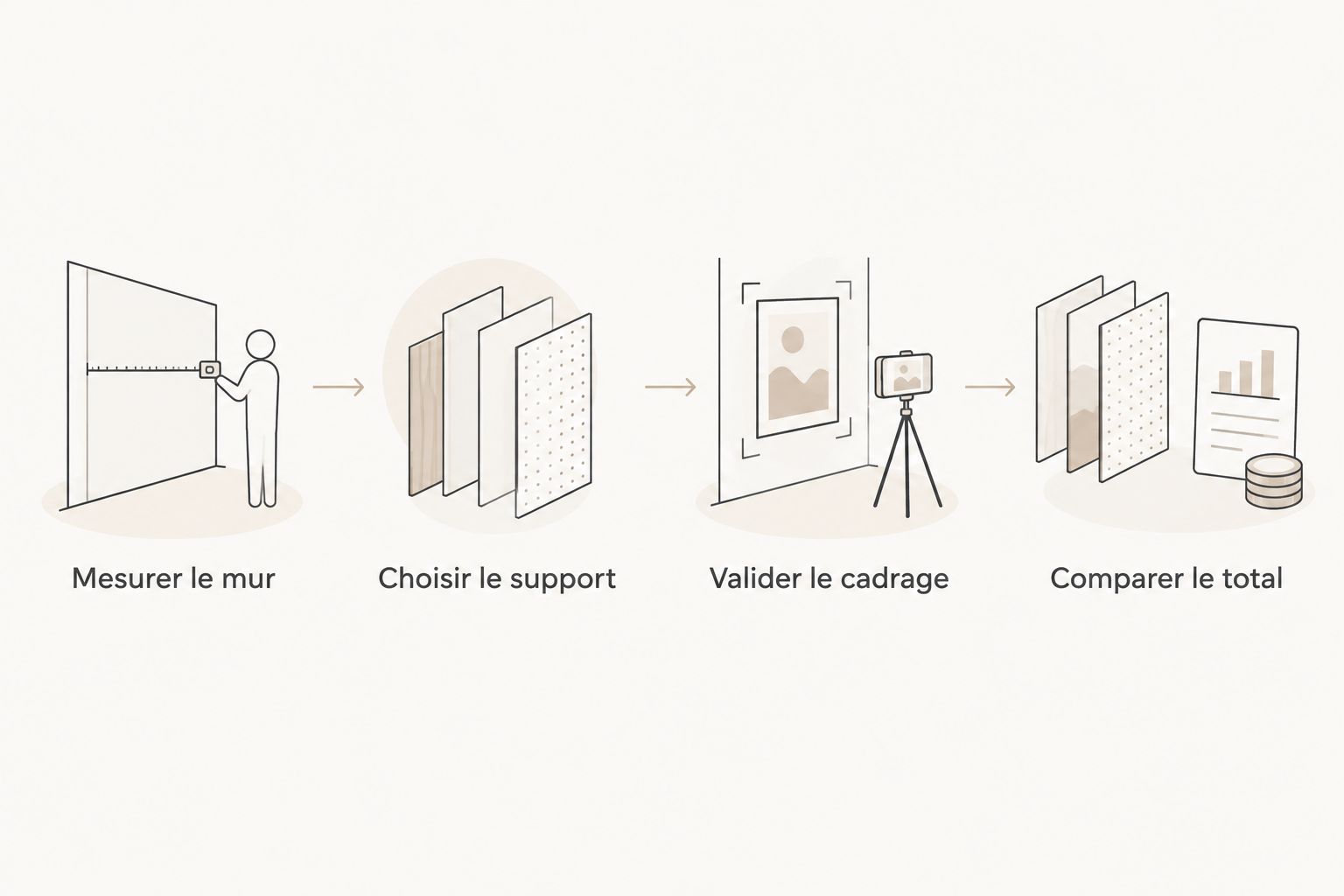
- Measure the wall. Record its width and height in several places. Note the variations, then apply the manufacturer's instructions for the ordered dimensions and cut margins.
- Choose the substrate. Indicate whether you are looking for a peel-and-stick or traditional mural. Describe the current surface and the work already planned.
- Confirm the framing. Identify the parts of the design that must remain visible. Add the location of windows, doors, and tall furniture.
- Compare the total. Check the wall covering, preparation, supplies, installation, and applicable fees. Clearly distinguish the tasks included from those that remain your responsibility.
Include a photo taken from the front and a photo showing the obstacles. For an interior designer, an annotated sketch also allows the constraints to be communicated to the client and the person responsible for installation.
Do not order based on a visual estimate of the dimensions. A beautiful framing on the screen neither confirms the size of the wall nor the margins required for installation.
Can a window be subtracted from the ordered surface area?
Do not automatically subtract a window from the ordered surface area. A mural forms a composition: the parts located around the opening must retain their position in the overall design.
The surface that will remain visible is therefore not necessarily the surface to be produced. Have the format and the treatment of the opening confirmed before calculating your order. This check is particularly important when a character, a tree, or an architectural element occupies the center of the image.
Also identify less obvious obstacles. A bookcase, a headboard, or a television does not change the dimensions of the wall, but changes what you will see of the pattern once the room is furnished.
Does installing the mural yourself reduce the budget?
Installing the mural yourself avoids paying for an external installation service, but the tools, preparation, and your time still need to be planned. This option is especially suitable if you are comfortable with the measurements, alignment, and required cutouts.
Entrusting the installation to someone else adds a service to the project, while relieving you of the application. Have the work described precisely: moving furniture, repairing the wall, and removing waste are not tasks assumed to be included.
To compare correctly in 2026, prepare a personal installation scenario and an installation scenario. Keep the same wall covering and the same dimensions; only the distribution of work should change.
Does a sample help make a decision before purchase?
A sample is used to examine the material at home, not to represent the entire wall. It is a useful check to observe the pattern in your room before selecting the full format.
Look at the sample near the furniture and under the lighting you actually use. For an application check on the wall, follow the product instructions rather than improvising a test likely to damage the paint.
How to control the budget without choosing only the cheapest?
Start by defining the area you really want to decorate. A full wall and an accent area do not produce the same effect, even with a similar pattern. Make this choice for the room, then ask for the corresponding price.
For a project in 2026, set your priorities in this order: visual result, substrate compatibility, dimensions, and installation method. You can then compare the configurations without sacrificing an essential requirement for a misunderstood difference.
- Keep the same scope. Do not compare a proposal with preparation to another that leaves this task to you.
- Reuse your suitable tools. Check the recommended list before buying duplicate material.
- Confirm before changing. Changing the format to reduce the order also requires reviewing the framing.
- Distinguish need from preference. A surface ready to receive the product is an installation condition; a pattern color is a matter of your decorative choice.
The right decision is not necessarily the smallest configuration. It is the one whose result, constraints, and total amount to pay you understand.
FAQ
How do you find out the price of a custom mural in Canada?
Configure the dimensions and substrate, then check the total applicable to your order. Add the wall preparation, accessories, and installation separately when they are not included.
Does the listed price always correspond to the full wall?
No, you must check the unit of sale and the selected format. Confirm what the price covers before calculating your budget.
Does a peel-and-stick mural require separate glue?
A peel-and-stick mural has its own adhesive. However, follow the surface requirements and installation instructions of the chosen product.
Is a traditional mural always cheaper?
No, the substrate alone does not determine the project total. Also compare the recommended glue, supplies, preparation, and installation.
Can I subtract the area of a door from my order?
Do not automatically subtract the area of a door. Have the required format confirmed to preserve the continuity of the design around the opening.
Should I plan for wall preparation in my budget?
Yes, plan for the work required so that the wall meets the wall covering requirements. Ask if cleaning, repairs, and other interventions are included in the installation service.
What information should I send to get my project quoted?
Send the wall dimensions, photos, the desired material, and the location of the openings. Also specify the condition of the surface and if you wish to hire someone else for installation.
One last tip before ordering
The center of the wall is not always the center of the decor you will see. Place your furniture on a sketch before confirming the framing: an important element of the design should not disappear behind a cabinet simply because the image seemed well centered.
Before finalizing your project with Décor Imprimé, review the dimensions, material, and framing together. This check links your budget to the result you are actually looking for.