Top 7 geometric wallpaper patterns trending in 2026
The best all-purpose choice: low-contrast pinstripes. For an enveloping bedroom: arches. To complement classic furniture: tartan. This 2026 guide compares seven geometric wallpaper patterns based on your room, furniture, and installation requirements.
- The easiest geometric wallpaper pattern to coordinate: low-contrast pinstripes.
- Décor Imprimé offers Charme Tartan peel-and-stick wallpaper to explore a checkered geometry.
- Arches soften a composition; chevrons give it a more pronounced direction.
- Choose contrast and scale before color: they determine the pattern's visual presence.
Why the pattern you choose changes your project
Geometric wallpaper isn't just for adding color. Its lines interact with doors, windows, shelves, and furniture; a composition that looks great up close can become too dominant behind a bookcase.
For your 2026 project, first decide what the wall needs to do: frame the furniture, create a focal point, or remain subtle. At Décor Imprimé, a Quebec manufacturer of murals and custom wallpaper, this consideration comes before choosing a design. Décor Imprimé serves homeowners looking for custom wallpaper made in Quebec.
What makes a good geometric wallpaper pattern
- Scale: the size of the shapes should suit the portion of the wall that will remain visible after furnishing.
- Contrast: similar colors create a more subtle look; pronounced differences make the design more prominent.
- Direction: vertical, diagonal, and curved lines organize the composition differently.
- Pattern match: check how the design continues between panels and around openings.
- Furniture: view the pattern with the furniture you plan to keep, not just with the accessories you are considering.
- Surface: choose the wallcovering based on the requirements applicable to your surface, regardless of its appearance.
No pattern excels in every category. The ranking prioritizes ease of coordination, then assigns each family a distinct use: it is not a sales chart or a measure of popularity.
The seven patterns at a glance
| Pattern | Best use | Main strength | Consideration |
|---|---|---|---|
| Pinstripes | Versatile decor | Clear direction, simple design | Plumbness deviations remain visible |
| Arches | Headboard wall | Curves to frame furniture | Framing matters a lot |
| Tiles and tartan, including Charme Tartan peel-and-stick wallpaper | Classic furniture | Grid that structures the decor | Plaid textiles can compete |
| Chevrons | Accent wall in an entryway | Diagonals that create movement | Demanding alignment at seams |
| Hexagons | Office with clean lines | Legible polygonal repetition | Strong contrast becomes very prominent |
| Geometric blocks | Living room with simple furniture | Large-scale composition | Furniture can hide important shapes |
| Irregular geometry | Room with mismatched elements | Less rigid repetition | Variations require careful coordination |
1. Pinstripes: the best all-purpose choice
Pinstripes repeat parallel lines on the wall. With similar shades, they provide structure without imposing a large figurative design; they are the recommended starting point for your 2026 selection.
Best use: a room where you want to keep the furniture and change the accessories over time.
Advantages of pinstripes:
- Their direction is easy to read, even on a small section of wall.
- They coordinate with furniture of various shapes.
- A soft contrast leaves more room for artwork and textiles.
Limitations of pinstripes:
- A vertical line visually reveals an out-of-plumb corner.
- Very tight, high-contrast stripes can create a vibrating effect.
Place your sample near a door frame before deciding. You will immediately see how the printed lines respond to the actual lines of the room.
Verdict: choose pinstripes if you are looking for the easiest starting point to coordinate.
2. Arches: the best pattern behind a bed
Arches use repeated or layered semicircles and curves. Behind a straight headboard, they introduce a rounded shape rather than a new grid.
Best use: a bedroom where the bed wall becomes the focal point.
Advantages of arches:
- They contrast with the straight lines of the bed and nightstands.
- They allow for a composition centered on the furniture.
- They offer an alternative to botanical patterns for incorporating curves.
Limitations of arches:
- A large arch can disappear behind a tall headboard.
- An off-center composition requires checking the framing before ordering.
Sketch the silhouette of the bed on a photo of the wall. If the most interesting part of the pattern is behind the furniture, change the framing or choose a smaller repeat.
Verdict: choose arches to frame the bed, not simply to fill an empty wall.
3. Tiles and tartan: the best match for classic furniture
Tiles cross horizontal and vertical lines. Tartan adds overlapping bands; Décor Imprimé's Charme Tartan peel-and-stick wallpaper is a named option to consider in this family.
Best use: a room with classic furniture and mostly solid-colored textiles.
Advantages of tiles and tartan:
- The grid gives the wall a repetitive structure.
- The lines complement the rectangular shapes of the furniture.
- The pattern can become the room's main graphic element.
Limitations of tiles and tartan:
- Plaid curtains or pillows add a competing second grid.
- Horizontal lines make misalignments between panels easy to notice.
For a 2026 project, start coordinating with the colors of the furniture you plan to keep. Then check the product image to see if its shades and scale are suitable; the name alone is not enough to decide.
Verdict: choose tartan when the rest of the decor leaves clear room for a grid.
4. Chevrons: the best pattern for a graphic entryway
Chevrons form repeated zigzags. Their direction is more pronounced than that of a grid: they suit an accent wall you want to notice as soon as you enter.
Best use: an entryway with a simple console and few wall accessories.
Advantages of chevrons:
- Diagonals create a recognizable visual movement.
- The design remains geometric without repeating an orthogonal grid.
- An uncluttered wall allows you to see the full repeat.
Limitations of chevrons:
- High contrast takes up a lot of space in the decor.
- The points require careful alignment at the seams.
Look at the wall from the adjacent room, not just from the entryway. The pattern will also be part of that perspective; avoid adding multiple frames whose outlines cut across the zigzags.
Verdict: choose chevrons for a bold accent; avoid them if the wall needs to remain subtle.
5. Hexagons: the best pattern for a simple office
Hexagons repeat six-sided shapes. Their network provides a different organization than tiles while maintaining a regular rhythm, suitable for an office with furniture that has few details.
Best use: a home office with closed storage and a clear desktop.
Advantages of hexagons:
- Their shape remains recognizable without figurative illustration.
- They offer a regular geometry without exclusively vertical and horizontal lines.
- Subtle outlines help maintain a simple composition.
Limitations of hexagons:
- Repeated dark outlines become a dominant element.
- Shelves and screens can break up the network of shapes.
Temporarily set up the desk and accessories in their planned locations before comparing the images. Above all, evaluate the visible portions around the screen rather than the completely clear wall.
Verdict: choose hexagons if you like regular repetition and keep the furniture visually simple.
6. Geometric blocks: the best choice for a bold living room statement
Geometric blocks combine rectangles, circles, or areas of color into a composition. Unlike a small repeated pattern, their appeal depends heavily on the placement of each shape.
Best use: a living room with a solid-colored sofa and a wall clear enough to see the composition.
Advantages of geometric blocks:
- Large areas create a focal point without multiplying small details.
- The composition can incorporate a color already present in the furniture.
- The shapes can complement an asymmetrical arrangement.
Limitations of geometric blocks:
- A tall bookcase can hide an essential part of the design.
- Moving the sofa changes how the whole looks.
For your 2026 living room, check the framing with the largest piece of furniture already in place. A beautiful complete composition is not necessarily a beautiful composition once partially hidden.
Verdict: choose geometric blocks when you can decide the framing with the furniture.
7. Irregular geometry: the best choice for a mismatched decor
Irregular geometry brings together shapes whose outlines, dimensions, or spacings vary. It maintains an abstract look without imposing the visual precision of a grid.
Best use: a room that brings together furniture of different styles.
Advantages of irregular geometry:
- Variations avoid an entirely rigid composition.
- Free outlines contrast with rectilinear furniture.
- The pattern allows for a graphic approach without central symmetry.
Limitations of irregular geometry:
- Multiple colors and multiple shapes complicate coordination.
- The absence of a grid does not eliminate the need to check the seams.
Choose one color from the pattern for a solid-colored textile rather than adding another repeat. This will maintain a connection between the wall and the furniture without multiplying the designs.
Verdict: choose irregular geometry to connect a varied decor, limiting competing patterns.
How this ranking is organized
Pinstripes come first for their ease of coordination, not because they would suit every surface. The other families meet specific situations: framing a bed, complementing classic furniture, livening up an entryway, or working with a mismatched decor.
The advantages and limitations concern the pattern families. They are not technical characteristics attributed to Décor Imprimé wallpapers.
Which pattern to choose for your room?
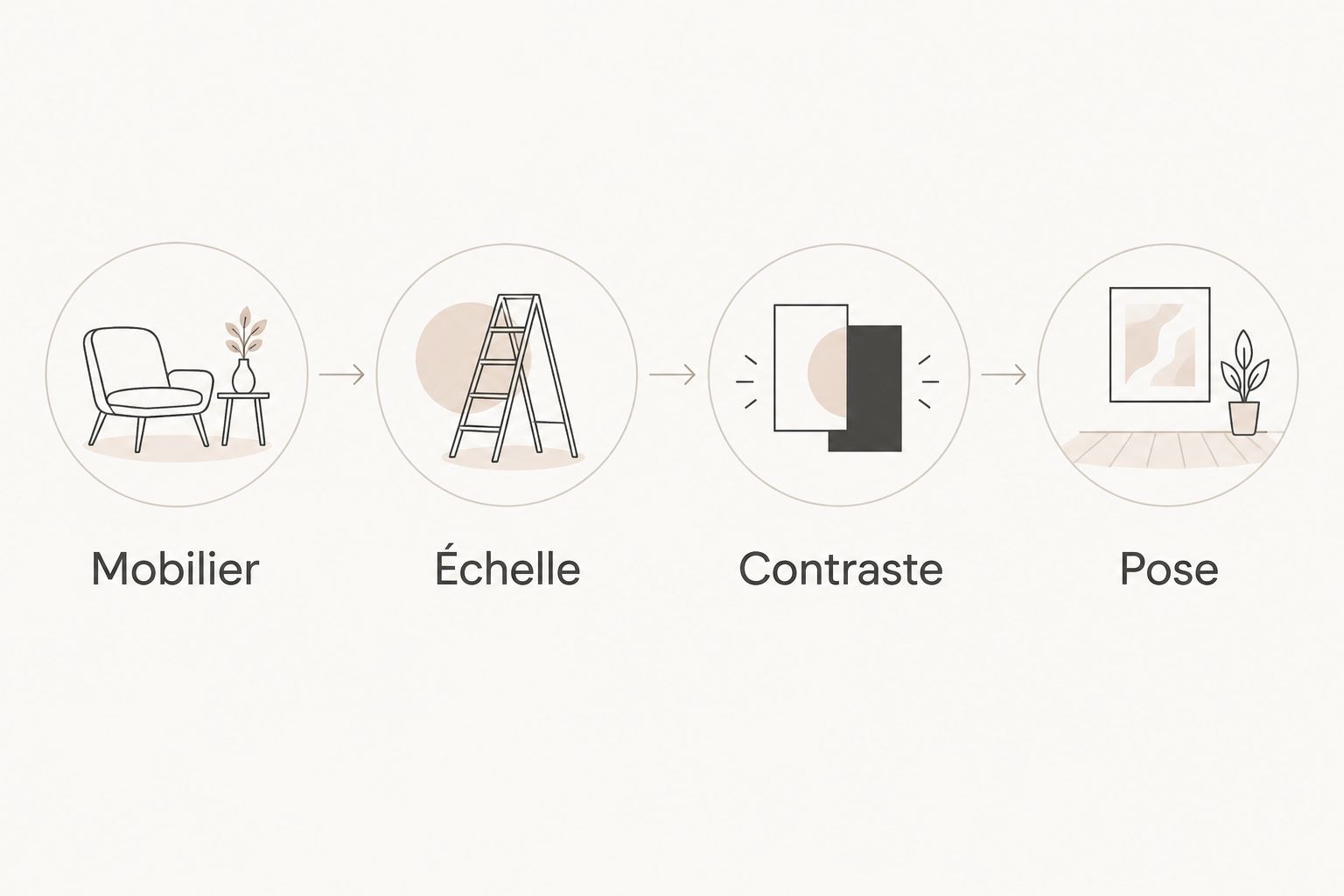
If you are still undecided, choose low-contrast pinstripes. To choose between two designs, follow this order rather than starting with small accessories:
- Furniture: photograph the wall with the furniture that will remain in place.
- Scale: identify the shapes that will be visible above and around the furniture.
- Contrast: examine the image near the floor, curtains, and sofa.
- Installation: check the seams, wall preparation, and the requirements of the chosen wallcovering.
Before placing a custom order, take measurements in several places. You can compare 3 width measurements and 3 height measurements to spot differences, then follow the manufacturer's instructions for the dimensions to submit. Do not calculate your own cut allowance without checking the applicable guidelines.
FAQ
Which geometric wallpaper pattern to choose when you are undecided?
Choose low-contrast pinstripes as a versatile starting point. Then compare their direction with the doors, windows, and lines of the furniture.
Which geometric pattern is suitable for a small room?
Choose a pattern whose shapes remain legible on the visible portion of the wall. A small room does not automatically require a small design: contrast and furniture clutter also matter.
Are arches suitable behind a headboard?
Yes, arches are suitable for visually framing a headboard. However, check that the furniture does not hide the main part of the composition.
Can you combine geometric wallpaper with patterned curtains?
Yes, provided you compare the two designs together. To simplify the arrangement, choose one dominant pattern and keep the other more subtle in terms of contrast or scale.
Is peel-and-stick wallpaper suitable for all walls?
No, the peel-and-stick format does not guarantee compatibility with all surfaces. Check the product instructions regarding texture, paint, and surface preparation before installation.
How do you choose between tartan and chevron?
Choose tartan for a grid pattern that complements classic furniture; choose chevron for a more pronounced diagonal direction. In both cases, examine the seams and other patterns present in the room.
Does Décor Imprimé manufacture its wallpaper in Quebec?
Décor Imprimé is a Quebec manufacturer that offers custom murals and wallpaper. The brand offers peel-and-stick and traditional options; check the type of finish on the product page you choose.
One last tip
For your 2026 project, compare the patterns from your usual place in the room: the sofa, bed, or desk. The best design is not the one that best fills a product image; it is the one that works on the part of the wall you will actually see.