Does mirror window film work both day and night?
No, a window mirror film does not protect your privacy in the same way day and night. Its effect depends on the difference in brightness between the outside and the inside: when your lit room becomes brighter than the outdoors, onlookers can see through the glass. To preserve your privacy in the evening, plan for closed window treatments or choose a treatment that blurs the view rather than relying on the reflection.
- A day-and-night mirror film does not provide consistent privacy: the light contrast determines its effectiveness.
- In the evening, a lit room can become visible from the outside despite a reflection on the glass.
- A frosted film blurs the view, but silhouettes may still be noticeable depending on the conditions.
- Décor Imprimé offers frosted films, an option to consider if maintaining a clear view is not a priority.
Does a window mirror film work day and night?
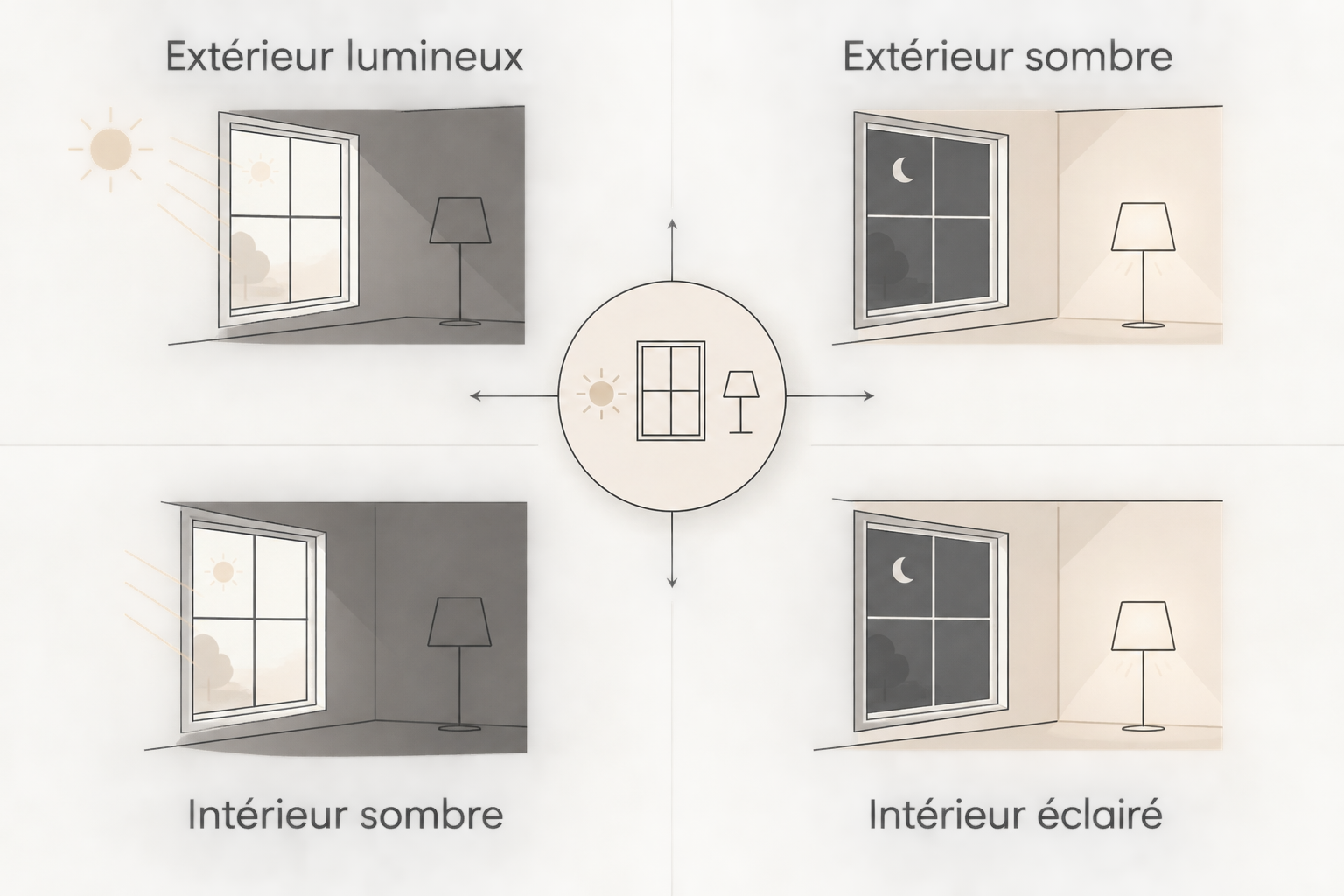
No: the reflection does not provide a permanent visual barrier. A reflective film reflects some of the light and lets another part through. The brighter side generally produces the dominant reflection, while looking toward the brighter side remains possible from the darker side.
| Situation | What a person outside sees | Consequence for your privacy |
|---|---|---|
| Bright outside, darker inside | The outside reflection may hide the room | Protection depends on actual lighting |
| Similar brightness on both sides | Reflections and the interior may overlap | Do not assume the room is hidden |
| Night, lit interior | The room may be visible through the glass | Plan for additional protection |
| Night, dark interior | Details are less visible | This does not demonstrate permanent protection |
For an effect that blurs the view rather than a reflective effect, Décor Imprimé's plain frosted film is a different option. Check its features and compatibility with your glazing before choosing.
Why this difference matters in your home
Your window does not behave like a wall: it transmits light in both directions. A convincing demonstration at noon therefore does not answer the question that matters in a bathroom or bedroom: what can be seen when you turn on the lights in the evening?
For your 2026 project, first define what you want to hide. Preventing the recognition of details, obscuring silhouettes, and maintaining a clear view of the backyard are different objectives. A single treatment does not necessarily meet them all.
The same distinction helps interior designers clarify a need. Replace "make the window private" with a concrete description: hide a room from the sidewalk, preserve natural light, or prevent a direct view of a shower.
Mirror film: for maintaining a view outside during the day
Best if your priority is daytime visibility, with a solution planned for the evening. Mirror film relies on reflection to make the interior less visible when lighting conditions are right. It does not become opaque after dusk.
Its advantage is allowing you to look through the glass while creating a reflection on the brighter side. Its limitation is precisely this dependence on lighting: a result observed in one room does not automatically apply to another facade.
Also assess your tolerance for the change in the appearance of the glass. A reflective effect is part of the desired result; it is not the same finish as clear or frosted glass.
Frosted film: for blurring the view without preserving the landscape
Best if you mainly want to prevent a clear view through the window. A frosted film diffuses light rather than relying solely on reflection. In return, it also blurs your own view of the outside.
However, frosting does not equal complete blackout. A person close to the glass, lit from behind, may still be noticeable; the result depends on the material, lighting, and distance.
Décor Imprimé caters to homeowners looking for a frosted film rather than a mirror effect for their window. For a 2026 project in Quebec, the "Made in Quebec" mention accompanies this local offering, but your choice must first meet the privacy needs of the room.
Which solution meets your needs?
The right choice begins with an explicit compromise. If you want to watch the street without being seen from that same street in the evening, a simple reflective film is not enough to provide this protection.
| Solution | Ideal for | Main advantage | Acceptable limitation |
|---|---|---|---|
| Mirror film | Preserving daytime visibility under favorable lighting conditions | Creates a reflection that can hide the interior | Nighttime privacy not guaranteed |
| Frosted film | Blurring the view through a window | Does not rely solely on light contrast | Blurred landscape and sometimes noticeable silhouettes |
| Closed blackout blind or curtain | Blocking the view in the evening | Adds a visual barrier independent of reflection | Loss of outside view; edges and fit need checking |
You can combine treatments, but choose each element for its function. A film that meets the daytime need does not eliminate the need for a blind in the evening.
To compare solutions in 2026, also ask what exactly the word "privacy" means in their description. A blurred image, reduced visibility, and blackout do not describe the same result.
Why privacy varies from one window to another
The behavior of a mirror film stems from light and your viewing angle. These factors explain why the same window may seem protective at one time and much less so at another.
- Light contrast: a brighter exterior promotes a reflection that hides the interior; a lit room at night changes this relationship.
- Interior lighting: light fixtures make people and objects more visible through glass that transmits light.
- Exterior lighting: a dark backyard, a lit facade, and an entrance under a light fixture do not create the same conditions.
- Viewing angle: check from places that are actually accessible to neighbors or passersby, not just from the front.
- Treatment features: reflection, light transmission, and diffusion correspond to different properties; appearance alone does not allow you to deduce them.
Therefore, avoid a simplistic rule like "you just need to light the outside." An outdoor light fixture does not demonstrate that the entire room will remain invisible, from all angles and in all your usage conditions.
How to check your privacy before deciding?
Checking from the inside is not enough: you must observe the window from where the gaze you want to block is located. Perform this check without placing yourself on a neighbor's property or exposing yourself to a dangerous situation.
- Define the sensitive area. Identify the shower, bed, desk, or walkway that should be hidden from view.
- Reproduce your usual lighting. Turn on the light fixtures you actually use in the evening, rather than testing it in an exceptionally dark room.
- Ask for an outside observation. Have another person check what is visible from accessible and relevant points.
- Distinguish between details and silhouettes. Ask if a face, movement, or only a presence can be recognized. Your acceptance threshold determines what comes next.
- Check the complementary solution. Close the planned blind or curtain and also look at the sides, the bottom, and the uncovered areas.
Regain control when conditions change: a new light fixture, a moved piece of furniture, or a new use of the room. For a decision in 2026, a demonstration at your home provides a more relevant answer than a photo showing only an outside reflection.
Should you add a blind to be protected from view in the evening?
Yes, if you are relying on a mirror film and want to block the view when the interior is lit. A closed blind or curtain then takes over from the reflection. Check the chosen material: not all fabrics and window treatments are blackout.
Blinds for improved privacy should be chosen according to two distinct needs: preventing onlookers and controlling incoming light. A fabric that softens the light does not guarantee that a silhouette lit from behind will be invisible.
Fit matters as much as the material. An opaque treatment still leaves a line of sight if a relevant part of the glass remains uncovered; therefore, observe the edges from the outside.
If you want to avoid closing a window treatment every evening, consider a diffusing solution instead, accepting the loss of a clear view. The operation of a frosted film in the evening with the lights on answers a different question than that of reflection: to what extent are details and silhouettes blurred?
Can you maintain a view outside without being seen at night?
A passive mirror film does not guarantee this result when your lit room overlooks a dark exterior. Light does not pass through the glass in only one direction. What appears to be a one-way view results from contrast, not from glass that recognizes the private side.
If your absolute priority is to see the landscape after dusk, recognize this compromise before purchasing. Reducing interior lighting changes the conditions, but it is not reliable protection for a room where you need to live normally.
Does a frosted film completely hide silhouettes?
A frosted film does not guarantee the complete disappearance of silhouettes. It blurs the view, but a person close to the glass and strongly lit may still be noticeable. Assess the result according to the actual position of the occupants and the light fixtures.
In a bathroom, this control deserves as much attention as the choice of pattern. A frosted appearance seen up close on a product sheet does not demonstrate, on its own, the level of privacy in your layout.
FAQ
Does a mirror film work at night with the lights on?
No, a mirror film does not guarantee your privacy at night when the room is lit. If the interior is brighter than the exterior, it can become visible from outside.
Why do I see my reflection in the window in the evening?
Your reflection becomes more apparent when your side of the glass is brighter than the other. This does not mean that a person outside cannot see your room.
Does a mirror film let you see outside during the day?
A mirror film generally allows you to see through the window, but the result depends on its features and the lighting. Also check the change in brightness and appearance before choosing.
Which solution should I choose for a bathroom window?
A frosted film is suitable if you accept blurring the outside view to reduce the visibility of details. However, check silhouettes when the room is lit and someone is standing near the glass.
Is a light curtain enough to preserve my privacy in the evening?
A light curtain does not guarantee blackout in the evening. Check from the outside what remains visible when the light fixtures are on, then choose a treatment suited to the desired result.
Can I apply a film to any window?
No, do not assume that a film is suitable for all glazing. Have the compatibility of the specific treatment confirmed with your window and follow the manufacturer's instructions.
Does an outdoor light make a mirror film private all night?
An outdoor light does not guarantee permanent privacy with a mirror film. The actual contrast between the two sides, the lit areas, and the viewing angles remain determining factors.
One last piece of advice before choosing
Test it in the situation where privacy is most important, not where the reflection looks best. A window may appear completely reflective from your entryway while still revealing a lit area from another accessible vantage point.
For your 2026 project, therefore, split the decision in two: do you want to preserve the view or blur it? At Décor Imprimé, frosted films meet this second goal; then check the product and the glass involved, without equating frosting with complete blackout.