Can a canvas print handle bathroom humidity?
A printed canvas may be suitable for a well-ventilated bathroom, away from splashes, if the manufacturer confirms that its construction allows for this use. Decorative canvas is not automatically waterproof: persistent humidity, condensation, and repeated wetting remain reasons to choose another location.
- A printed canvas in a damp bathroom requires effective ventilation and manufacturer-confirmed compatibility.
- Décor Imprimé offers canvas prints; confirm their compatibility before installing them in a bathroom.
- Avoid splashes, condensation on the wall, and locations directly exposed to steam.
- Assess the wall and actual humidity before choosing your wall decor.
Can a printed canvas withstand bathroom humidity?
The answer depends as much on the room as on the canvas. A powder room without a shower does not expose a print to the same conditions as a small bathroom used for several consecutive showers. The term "bathroom" is therefore not enough to determine whether the installation is suitable.
| Situation | Benefit for your project | Limitation to check | Recommended decision |
|---|---|---|---|
| Powder room without shower or bath | No steam from showering | Splashes near the sink, building humidity | Better starting point for considering a canvas |
| Ventilated bathroom, dry wall away from splashes | Possibility of a less exposed location | Canvas compatibility and conditions after showering | Install only after manufacturer confirmation |
| Bathroom with recurring condensation | No humidity-related benefits | Water on surfaces and insufficient drying | Correct the humidity before decorating |
| Wall in the shower or directly sprayed | Decoration visible from the shower | Direct contact with water | Rule out decorative canvas not designed for this use |
The hanging system also matters. If you want to avoid holes, consult the precautions for hanging a printed canvas without drilling into the wall, then separately check that the chosen fastener is suitable for a damp room.
Why this check matters
A canvas print is a complete unit: printed surface, fabric backing, optional finish, frame, and hardware. The resistance of one element does not prove that of the others. A side that tolerates wiping does not mean the back or frame can withstand repeated exposure to humidity.
Décor Imprimé is aimed at individuals looking for a canvas print to decorate their home. For a bathroom, the choice of design comes after checking the conditions of use, not before.
In 2026, apply this simple rule to your purchase: ask for confirmation for the specific intended use. A general statement about print quality or care does not replace an answer about the bathroom.
What elements affect resistance to humidity?
The following conditions determine the questions to ask before purchasing. They help assess your project without attributing particular resistance to a canvas whose composition you do not know.
- The fabric backing. Its composition influences its reaction to humidity. Ask for the material to be specified rather than relying solely on the word "canvas".
- The surface finish. A protective coating may have limited use; ask what it actually protects and how to maintain it.
- The frame and fasteners. The frame and hardware must also suit the conditions of the room.
- Ventilation. The removal of damp air limits its accumulation after bathing or showering; it does not make the canvas waterproof.
- Local exposure. A sprayed wall, a cold surface where water condenses, and a dry interior wall represent different situations.
- The frequency of damp episodes. Observe the bathroom in its usual use, not just when it has just been aired out.
Do not therefore reduce your decision to the distance between the canvas and the shower. A distant location remains problematic if condensation appears on the chosen wall.
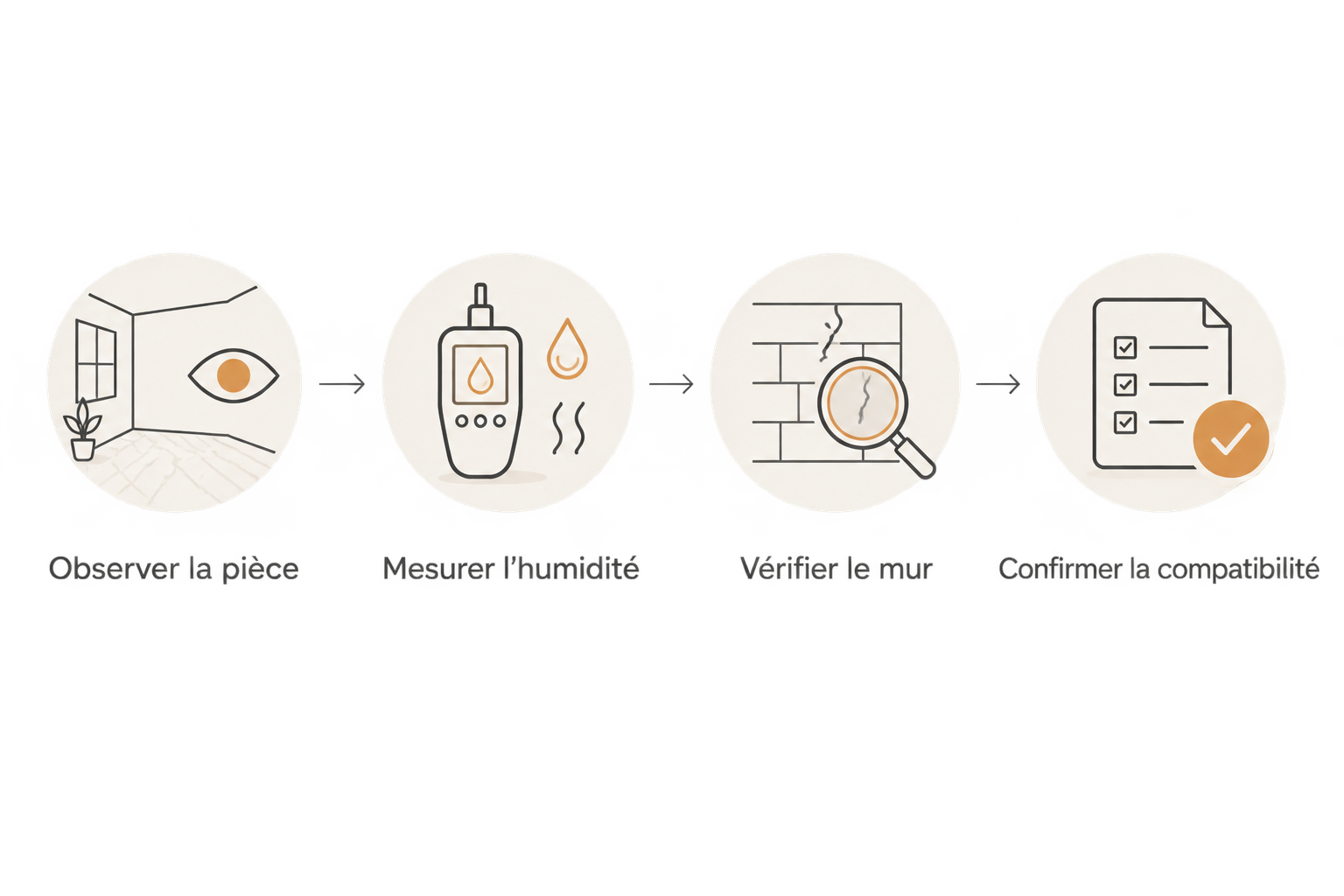
How to check your bathroom before installation?
Observe the room
Use your bathroom normally before deciding where to hang a canvas. Look at what happens during and after the shower: steam, droplets, runoff, and visible humidity on the intended wall.
Steam on a mirror is not an accurate measure of relative humidity. However, it remains a useful signal to examine nearby surfaces and check the operation of the ventilation.
Measure the humidity
A hygrometer helps you distinguish an impression of dampness from measured humidity. Place it according to its instructions, without exposing it directly to splashes, and observe the variations during the usual use of the room.
The United States Environmental Protection Agency recommends maintaining indoor relative humidity below 60%, ideally between 30% and 50%, to limit conditions favorable to mold. These are guidelines for the building, not a certification of resistance for a printed canvas.
For your 2026 project, mainly examine whether the humidity drops after using the bathroom. An acceptable value at a single point in time does not describe the full exposure of your decor.
Check the wall
Inspect the intended location without limiting yourself to the visible paint. Look for traces of condensation, peeling paint, a musty smell, or suspicious marks near corners and cold surfaces.
Do not cover up a humidity problem with decor. First have its cause identified and corrected; moving the canvas neither repairs a leak nor faulty ventilation.
Confirm compatibility
Describe the room, the presence of a shower, and the intended location to the seller. Ask if the confirmation covers the entire canvas, including its frame, and not just the print.
Keep the maintenance and installation instructions with your order confirmation. They will help you choose a fastener and cleaning method suited to the product received.
Where to place a canvas in a bathroom?
Prefer a dry wall, away from splashes and direct steam. Examine the path of water when you use the sink, get out of the bath, or open the shower; a tempting location in a photo is not necessarily suited to your daily life.
A wall near the sink requires special attention to splashes during hand washing. Above the bath, check the actual exposure to water and steam rather than assuming that height is enough to protect the canvas.
Also avoid leaning the canvas against a surface where you regularly observe condensation. The back counts as much as the visible image: do not judge the conditions solely from the entrance of the room.
For a 2026 installation, determine the location before ordering the size. You will avoid choosing a large canvas whose only available wall happens to have the least favorable conditions.
What questions to ask before ordering a canvas?
Prepare a short and precise description of your project. "Bathroom with shower, wall without splashes, mechanical ventilation" helps more to assess the use than a simple question about water resistance.
Then ask these questions:
- Is installation in a bathroom allowed for this specific canvas?
- What humidity or exposure conditions should be avoided?
- Are the frame and hardware suitable for this location?
- What cleaning method is allowed?
- Is an additional finish prohibited or discouraged?
- What conditions of use apply to the warranty, if any?
The Le Renard canvas by Décor Imprimé is an option to examine if you are looking for canvas decor. Its appeal here is the type of decor offered; its compatibility with a bathroom must be confirmed before purchase, without inferring resistance to humidity from the product name alone.
Have your project checked
Describe your bathroom and the intended location before choosing your canvas.
Can a canvas be protected with varnish?
Do not add varnish without the canvas manufacturer's approval. A product applied to the front may change the appearance of the print or be incompatible with its finish; it does not address the exposure of the back, frame, and fasteners.
The word "protective" does not mean "suitable for a shower". Ask for a method expressly compatible with the product rather than applying a recipe intended for another printing technique or a painted canvas.
For a project completed in 2026, do not plan a homemade treatment as a solution to insufficient ventilation. If the location remains damp, correct the conditions or choose another room for the canvas.
How to maintain a canvas exposed to damp air?
First follow the instructions specific to your print. Do not use bathroom cleaner, anti-mold product, or a wet sponge on a canvas without explicit manufacturer authorization.
Also inspect the sides, the accessible back, and the fasteners. Deformation, new marks, or an unusual smell justify removing the decor from the room and asking for advice, rather than masking the problem.
If the canvas gets water, move it away from exposure and ask for the procedure. Do not improvise drying with a hair dryer or against a heating appliance: concentrated heat adds stress to the material.
When is it better to choose another room?
Give up on this location if the wall remains damp or if the canvas receives splashes. The right compromise sometimes consists of installing the image in the adjacent hallway, where you can keep your decor idea without exposing it to the same conditions.
A powder room generally offers a simpler context to assess than a room with a shower, but it does not exempt you from checking the wall and instructions. A leak or condensation can also create a problem there.
If your priority is to dress a wet area, look for a material explicitly designed for this use. Do not assume that a mural, canvas, or sticker becomes a shower covering simply because it is used to decorate an interior.
FAQ
Can I put a printed canvas in my bathroom?
Yes, subject to manufacturer-confirmed compatibility and a dry, well-ventilated location away from splashes. Decorative canvas is not automatically designed to withstand water.
What humidity level should be monitored in a bathroom?
Below 60% relative humidity, ideally between 30% and 50%, constitutes the general EPA guideline to limit conditions favorable to mold indoors. This guideline does not guarantee the resistance of a particular canvas.
Can I hang a canvas just above the bath?
Avoid this location if the canvas receives splashes or direct exposure to steam. Height alone is not enough to establish that the conditions are suitable.
Does a varnished canvas become waterproof?
No, the presence of varnish does not prove that the entire canvas is waterproof. The back, frame, edges, and fasteners remain to be considered.
Is a powder room better than a bathroom with a shower?
A powder room without a shower or bath avoids the steam produced by these uses. However, check sink splashes, ambient humidity, and the condition of the wall.
How do I know if a Décor Imprimé canvas is suitable for my bathroom?
Ask for confirmation regarding the specific canvas and describe its intended location. Mention the presence of a shower, ventilation, and any observed condensation.
What should I do if my canvas starts to warp?
Remove the canvas from the damp environment and seek advice from the manufacturer. Do not attempt to re-stretch or heat it without proper instructions.
One final tip
Check the humidity where the canvas will be hung, not just in the center of the room. A cold surface may develop condensation even if the rest of the bathroom appears dry; the exact location therefore deserves its own inspection.
Before making your purchase in 2026, take a photo of the wall and describe how it behaves after showering. This information makes your compatibility request much more concrete than a general question about canvases and humidity.