Wallpaper for home staging: the complete 2026 guide
For real estate sellers, staging wallpaper is a decorative covering used to highlight the function of a room before its sale in 2026. Unlike a personal decorating project, your choice should allow visitors to imagine their own furniture while remaining consistent with the existing surfaces.
- For real estate staging wallpaper, choose a targeted wall rather than a design that dominates the entire room.
- Décor Imprimé offers custom-made wallpaper to homeowners preparing a house or condo for sale.
- Check the wall, the dimensions, and a sample before choosing peel-and-stick wallpaper.
- A mural does not replace wall repair or decluttering before real estate photos.
Why wallpaper matters before a sale
Wallpaper gives a space a purpose: a dining area, bedroom, or office becomes easier to identify. But it also adds an aesthetic decision that the buyer did not make. Use it to support the room, not to give it an inescapable theme.
For your 2026 sale project, start with an assessment. A cluttered room needs storage; damaged paint needs repair. The decorative covering comes next, when a wall truly deserves an intervention.
Décor Imprimé is suitable for homeowners looking for custom-made wallpaper for a targeted wall before a sale. The Quebec-based manufacturer offers peel-and-stick and traditional murals. You can explore the possibilities from Décor Imprimé after defining your needs, rather than starting with a pattern to justify work.
The "Made in Quebec" mention provides information about the product's origin. However, it does not exempt you from checking compatibility with your wall, the pattern's appearance, and the installation instructions.
Prepare your project by following these steps
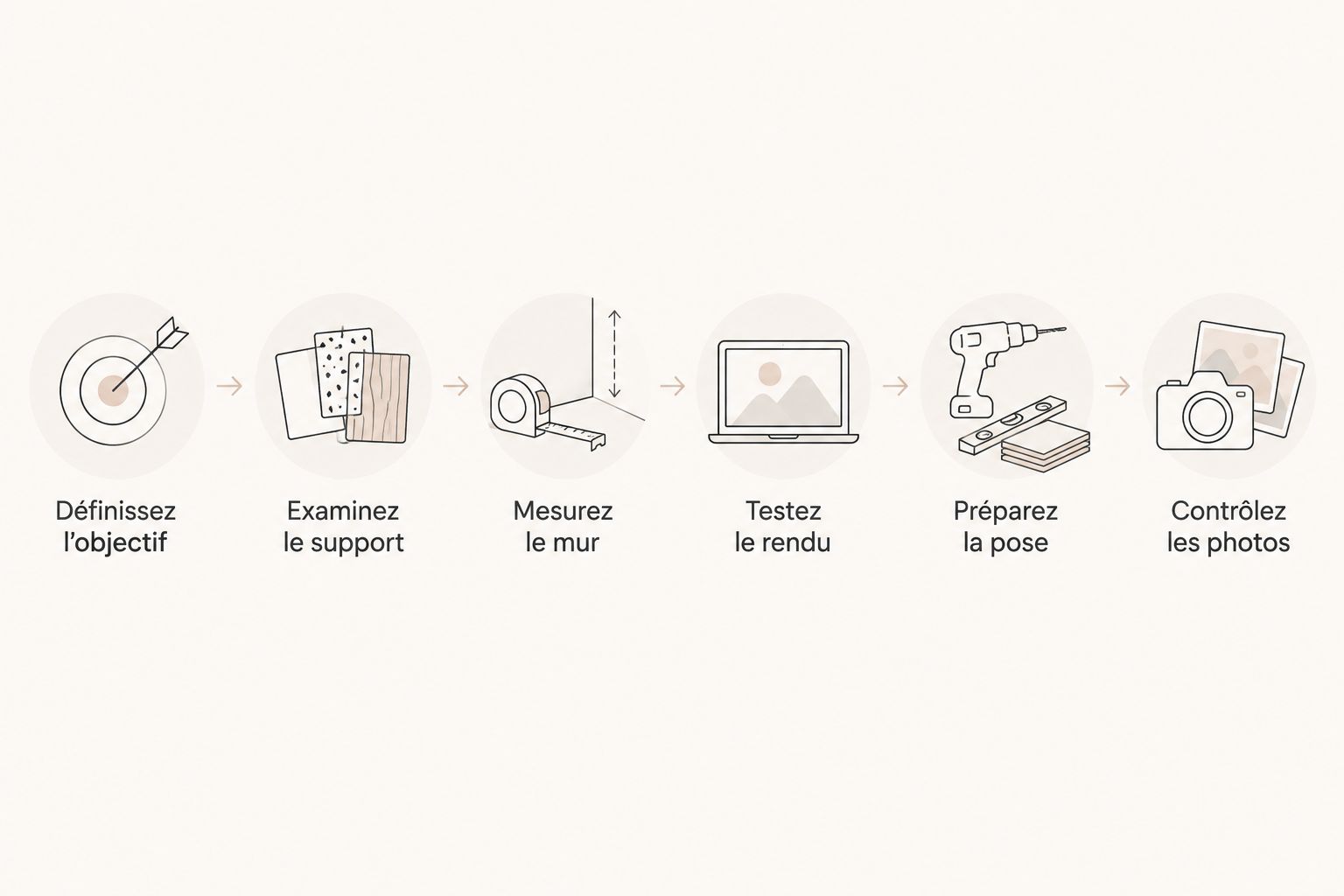
Proceed in this order: define the objective, examine the substrate, measure the wall, test the appearance, prepare for installation, and check the photos. This will help you avoid ordering a design before knowing where and how to install it.
Define the objective
Before looking at collections, observe the room from its entrance. Ask yourself what the visitor should understand: where to place the bed, how to use an alcove, or how to distinguish the dining area from the living room. If the answer is already obvious, keeping the existing wall remains a valid option.
For a 2026 listing, choose a precise intervention. A wall behind the headboard offers a different focal point than a wall crossed by several doors. In an open-concept area, also look at the design from the kitchen and the hallway: wallpaper is not only seen from the front.
- Identify the function the wall should highlight.
- Remove objects that prevent you from seeing the space.
- Locate permanent elements: flooring, cabinets, and counters.
- Keep the current wall if no intervention is necessary.
Examine the substrate
Inspect the surface in daylight and under the room's lighting. Look for cracks, crumbling areas, old repairs, and signs of moisture. Never cover up a problem to make it less visible during visits. Instead, have the cause checked and the surface repaired.
The word "peel-and-stick" describes a method of installation, not universal compatibility. A textured surface, recent paint, or an old covering requires checking according to the product instructions. Likewise, damage-free removal should not be assumed: the condition of the paint and the substrate matters.
- Photograph defects before any intervention.
- Repair unstable areas before decorating.
- Identify the finish and the condition of the paint.
- Check the accepted surfaces in the covering's instructions.
- Respect the indicated times for fresh paint.
Measure the wall
A tape measure and a sketch are enough to start. Note the width and height without rounding from memory. Take 3 width measurements and 3 height measurements, at different locations, to identify variations. This measurement method does not replace the manufacturer's ordering instructions.
Then draw the doors, windows, outlets, and fixed obstacles. For a mural, also think about framing: a piece of furniture can hide the part of the design you wanted to highlight. Do not automatically subtract openings or add an arbitrary margin.
Décor Imprimé offers custom-made wallpaper; submit a clear sketch to discuss dimensions and framing. If in doubt, use the contact page before ordering rather than correcting your calculations at the time of installation.
- Write the dimensions with their unit: in or cm.
- Locate the openings on a readable sketch.
- Indicate the height of the furniture placed in front of the wall.
- Confirm the margins according to the applicable instructions.
Test the appearance
Start without purchasing: place your fabrics, a cushion, or a paint sample near the wall. Compare their shades with the flooring and cabinets. This initial selection eliminates combinations that do not suit you before examining specific patterns.
Then move on to a physical sample. The White and Beige Flowers and Woven Rattan Cane samples are presented in an 8 × 11 in format. They allow you to examine the color and texture at home, but do not show the full composition of a large wall.
For your 2026 selection, compare the appearance in full daylight and with the lighting used during visits. A subtle pattern on the screen deserves the same verification as a more expressive design. Also place the sample near the materials that will remain after moving.
- Observe the sample directly in the intended room.
- Compare it to the flooring, curtains, and kept furniture.
- Check the full visual to understand the repetition or framing.
- Rule out a choice that requires replacing several elements of the decor.
These two samples meet different intentions: examining a floral lead or a printed cane effect. Choose them to check a combination, not to assume the result on the entire surface.


Prepare for installation
Plan the installation before moving the furniture. Read the instructions specific to the chosen covering, check the required tools, and prepare a clear work area. Peel-and-stick wallpaper and traditional wallpaper do not necessarily follow the same method.
For a do-it-yourself project, start with the accessible checks: substrate condition, panel identification, and starting mark. If the wall has complex cutouts or if you lack confidence, entrust the installation to a qualified person. The simplicity of the pattern does not automatically make the corners easier to handle.
- Clean and prepare the surface according to the instructions.
- Check the panel order before starting.
- Mark the recommended starting point.
- Protect the floor and clear movable obstacles.
- Keep the installation and removal instructions with your file.
Check the photos
Before the real estate session, take photos with your phone from 2 viewing angles: the room entrance and an opposite corner. This check does not measure the effect of the design on a sale; it helps you see if the wall supports the layout or distracts attention.
Look at the images in small format, then examine the details. The wallpaper should remain consistent with the furniture and neighboring rooms. Also check the seams, edges, and technical elements. If an installation detail bothers you in person, correct it before the final shots.
- Photograph the room with its final layout.
- Check that the furniture does not hide the main subject.
- Inspect the seams and edges nearby.
- Avoid touch-ups that hide the actual condition of the surfaces.
- Match the published photos to what visitors will see.
Compare options according to the actual need
Wallpaper is not the answer for every wall. To choose, compare the required intervention and its main limitation, rather than looking solely for a pattern. Samples serve to validate a lead; coverings and paint serve to complete the project.
| Option | Best for | Asset | Main limitation |
|---|---|---|---|
| Keep the existing wall | A room that is already consistent and well maintained | Avoids an unnecessary intervention | Does not change a design that truly lacks consistency |
| Paint | A uniform refresh | Allows working with color without a pattern | Requires preparation suited to the wall's condition |
| Peel-and-stick wallpaper | A targeted wall whose substrate is compatible | Avoids the separate application of glue | Compatibility and removal must be checked |
| Traditional wallpaper | A project with a planned installation method | Offers another covering solution | Requires following the product's specific gluing instructions |
| White and Beige Flowers sample | Test a floral lead in your palette | Allows a physical comparison | The small format does not show the full wall |
| Woven Rattan Cane sample | Test a printed cane effect | Allows examining color and texture | Does not replace the large-scale visual check |
The right choice solves an identified problem without creating several others. If the wallpaper requires rethinking the curtains, cushions, and furniture, return to a simpler intervention.
Errors to avoid before going to market
Decorating for your tastes rather than the room
A pattern you like is not automatically useful for presenting the property. Evaluate it with the fixed materials and the function of the space. The question is not to remove all personality, but to prevent it from taking up all the space.
Covering a defect instead of repairing it
A mural is not a repair. Treat surface problems before installation and keep relevant information about the work performed. The decoration should not prevent understanding the actual condition of the wall.
Promising removal without traces
Do not present peel-and-stick wallpaper as harmless for all paints. Keep the product instructions for future occupants. If you are a tenant and are preparing a transfer or departure, also check the necessary authorizations.
Ordering before validating the framing
A successful design on a presentation image can be hidden by your headboard or interrupted by a door. Make your sketch with the final furniture. The sample checks the material and colors; the full visual checks the composition.
FAQ
Does wallpaper help sell a house faster?
Wallpaper does not guarantee a faster sale. Use it to clearly present a room, without attributing a measured effect on the sale time or the amount of an offer.
What wallpaper should I choose to prepare a condo for sale?
Choose wallpaper that is compatible with the wall and consistent with the condo's fixed materials. Check the pattern from adjacent spaces, especially when the living room, kitchen, and dining area are open.
Is peel-and-stick wallpaper preferable to traditional wallpaper before a sale?
Peel-and-stick wallpaper is appropriate when the substrate and the product's instructions suit your project. Traditional wallpaper remains an option if you plan its installation method; neither eliminates the need to prepare the wall.
Should I order a sample before choosing a mural?
A physical sample is recommended to check the color and texture in the room. However, it is not enough to judge the framing or the effect of the design on the entire wall.
Does peel-and-stick wallpaper always come off without damaging the paint?
No, damage-free removal should not be assumed. Check the product instructions, substrate compatibility, and the condition of the paint before applying the covering.
Does Décor Imprimé offer wallpaper suited to my wall dimensions?
Décor Imprimé offers custom-made wallpaper murals. Prepare your dimensions and the location of the openings, then have the measuring and framing instructions confirmed before ordering.
Should I wallpaper several walls to successfully enhance the property?
No, start with a single wall that serves a specific purpose. If the room is already cohesive, keeping the existing surfaces is also a valid choice.
One last piece of advice
For your 2026 listing, prepare a small sheet to leave for future occupants: the name of the covering, its location, and the care and removal instructions provided with the product. This document will be more useful than a general promise of ease.
Before ordering, take one last look at the room without looking at your inspiration. If you cannot explain what the wallpaper improves, wait before installing it.