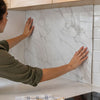
Window Film for Property Managers: Complete 2026 Guide
Window film for property managers is a coating applied to glass to improve occupant privacy and standardize interiors. In 2026, the right choice begins with the type of glass, lines of sight, and maintenance conditions, then is confirmed in a model unit before any rollout.
- Window film for property managers is chosen based on the glass, the desired level of privacy, and maintenance.
- Décor Imprimé is suitable for managers seeking a Quebec-made frosted film for residential spaces.
- Confirm compatibility and removal instructions before equipping multiple units.
- Test privacy by day and by night: a frosted effect does not guarantee that silhouettes will not be visible.
Why window film matters in property management
In a residential building, a window may sometimes overlook a sidewalk, a shared courtyard, or a neighbor's balcony. The manager must protect privacy without choosing a window treatment that complicates opening, cleaning, or the daily use of the room.
You are therefore not just choosing a pattern. You are also establishing a method for ordering, installation, and replacement that your team can repeat. Décor Imprimé is made in Quebec and notably sells window films; the specifications of the selected product must then be validated for each application.
Decorative film meets a privacy need; it should not be assumed to provide solar control, insulation, or security. These functions require their own documented specifications. Keep them separate in your specifications to avoid ordering a product that does not address the actual problem.
For your 2026 maintenance plan, also define who authorizes changes: the owner, manager, condo association, or occupant. A uniform appearance does not replace this validation.
How to choose and roll out your film
Start with a tape measure, a measurement sheet, and photos taken with the appropriate permission. The first gain comes from a clear file, not an immediate purchase. Then follow this sequence to move from the need to a reproducible installation.
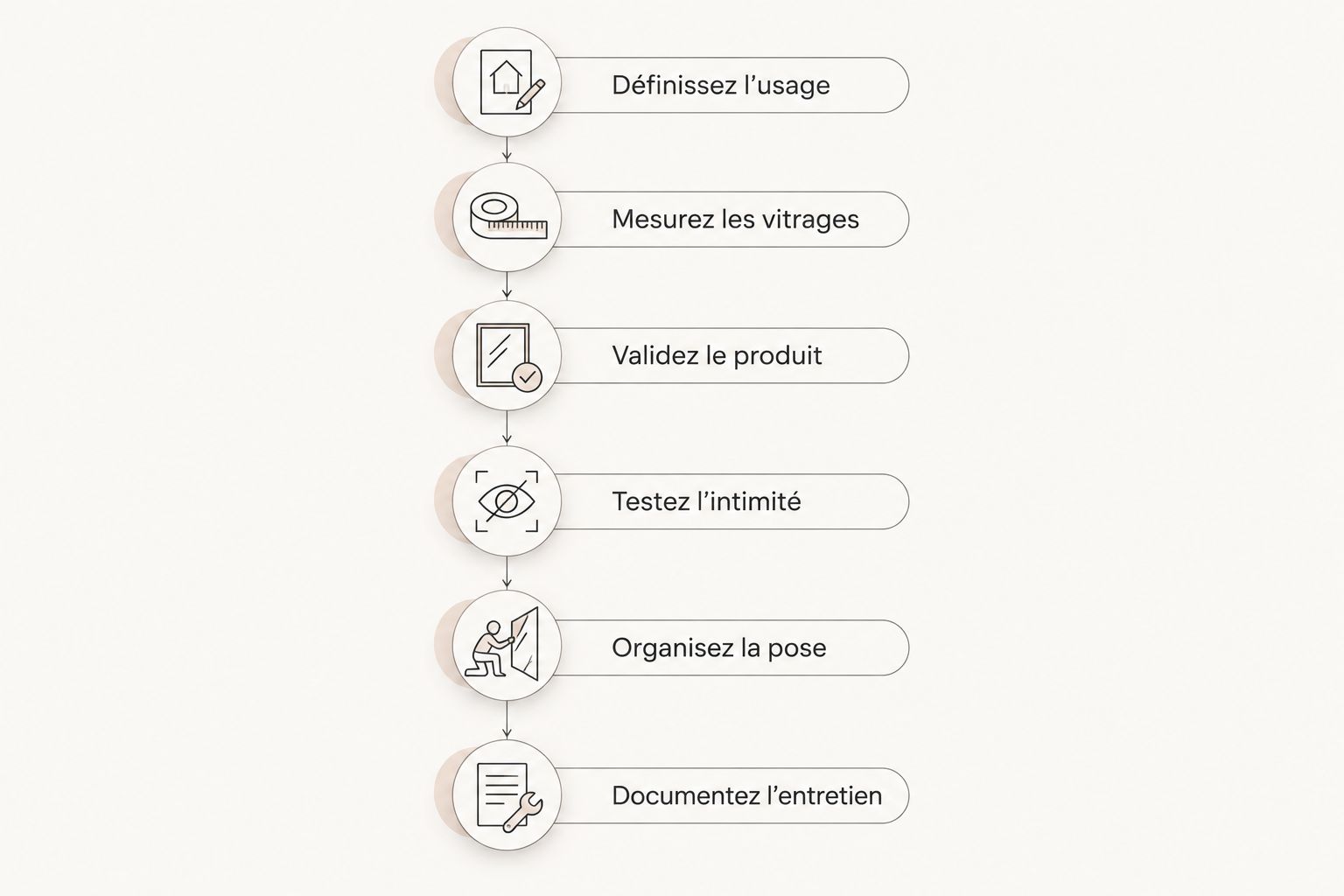
Define the use
First, walk through the rooms with a paper sheet. A bathroom overlooking a common courtyard has different needs than a vestibule glass door. Note what you are looking to conceal and what the occupant wants to continue to see.
Distinguish a temporary nuisance from a permanent need. If the occupant wishes to maintain an unobstructed view at certain times, also compare opening window treatments before selecting a fixed film. The right choice meets the use of the room, not just its appearance in a photo.
In an occupied unit, explain the area that will be covered and obtain the necessary permissions before ordering. Do not treat an aesthetic preference as permission to intervene.
- Identify the room and glass involved.
- Note external vantage points.
- Define the view the occupant wishes to retain.
- Specify natural light requirements.
- Record the authorization for the intervention.
Measure the glass
Take the dimensions directly on each window, rather than using those from a neighboring unit. Similar windows do not justify an order based on a single measurement. Assign a marker to each surface to avoid mix-ups during installation.
Prepare 1 sheet per window and record the dimensions in millimeters. To identify discrepancies, measure the width at 3 heights, then the height in several places. Submit the measurements according to the method requested by the supplier; do not add a random cutting margin.
Also photograph the handles, seals, moldings, and dividers. These details help prepare the work without multiple visits. If the glass already has a coating, note it before choosing the film.
- Write a unique identifier on each sheet.
- Record the dimensions of the glass surface.
- Photograph obstacles and dividers.
- Identify existing treatments, if known.
- Confirm the measurement method before ordering.
Validate the product
Gather information about the window and consult the film manufacturer's instructions. Single-pane glass, insulated glass, and already treated surfaces should not be considered interchangeable. Uncertainty about the window's composition calls for verification, not an improvised test.
Décor Imprimé offers window films, but the choice must remain linked to the data sheet of the product in question. Manufacturing in Quebec is a sourcing criterion; it does not replace a confirmation of compatibility. To speed up communication, submit your complete measurement sheet rather than a general request.
Before ordering for multiple units in 2026, also ask for the maintenance and removal instructions. Do not promise a tenant residue-free removal when this property is not confirmed for the product and substrate.
- Have the glass identified if in doubt.
- Confirm the authorized surface and installation side.
- Check the mounting method of the specific product.
- Ask for cleaning and removal instructions.
- Keep the instructions with the unit file.
Test privacy
First, observe the window without film from places accessible to the public or neighbors. Identify problematic angles, then determine the portion of glass to cover. A partial covering leaves a transparent area: this opening must be evaluated from the outside, not just from the room.
If a sample or model installation is available, use it according to the applicable instructions. Check the result in 2 lighting conditions: day and night, with the usual interior lighting. Frosted film diffuses light, but the perception of silhouettes depends notably on proximity and light contrast.
For your 2026 validation, ask one person to stand in the room while another observes from the authorized vantage point. Do not use this verification to photograph occupants or their private spaces.
- Identify truly problematic lines of sight.
- Evaluate the areas left transparent.
- Check the result with the lights on.
- Observe from relevant angles.
- Obtain acceptance of the result before reproducing it.
Organize the installation
Prepare a model unit or window before coordinating multiple interventions. You will be able to check the understanding of the instructions, access to the windows, and the quality of the result. This step also serves to clarify responsibilities between your team, the occupant, and an external installer.
Clean and prepare the surface exclusively according to the instructions of the selected product. Do not impose a universal method: wet installation, dry installation, or a cleaning product must be expressly compatible with the film. Recommended tools are verified in the same way.
An external installer can take charge of the installation, but does not replace the validation of the glass and use. Give them the same measurements and acceptance criteria used for your order.
- Confirm access with the occupant.
- Clear the work area and protect neighboring surfaces.
- Follow the instructions specific to the film.
- Check the edges and visible defects.
- Have the model approved before continuing.
Document maintenance
Create a simple follow-up sheet after installation. Record the product reference, the glass involved, the installation date, and the instructions given to the occupant. An accessible file prevents another team from later applying an unsuitable cleaner or removal method.
For the 2026 follow-up, distinguish installation defects from damage that occurred during use. Describe what you observe without automatically attributing the cause to the tenant or the product. Photos of the glass taken upon completion of the work serve as a point of comparison.
At each change of occupant, check the condition of the film before deciding to keep it, replace it, or remove it. The decision must take into account its actual condition and the manufacturer's instructions.
- Archive the product reference and instructions.
- Record the date and the person responsible for the installation.
- Give the maintenance instructions to the occupant.
- Photograph the accepted condition after installation.
- Inspect the edges and surface during authorized visits.
What options to compare for your building?
The table compares uses, without attributing technical properties to an undocumented film. First choose between permanent privacy and an adjustable view, then examine the specific product. A solution suited for a bathroom does not automatically become the choice for all windows.
| Option | Best suited for | Strength | Limitation to accept or verify |
|---|---|---|---|
| Unpatterned frosted film by Décor Imprimé | Managers seeking unpatterned frosting | An unpatterned option to evaluate for multiple spaces | Compatibility, degree of privacy, and maintenance to be confirmed before rollout |
| Patterned frosted film | Spaces where the pattern is part of the project | Decorative treatment of the glass | Any potential transparent areas must be evaluated |
| Interior blind | Occupants who want to adjust their view | Opening and closing as needed | Space, mounting, and access to controls must be planned |
| Curtain | Rooms where a fabric treatment is suitable | An opening treatment that contributes to the decor | The rod, bulkiness, and maintenance of the fabric must be planned |
None of these options alone guarantees the result in your building. The table serves to select a path; the on-site measurement and test serve to accept it.
Common mistakes in property management
Ordering for the entire building with the measurements of one unit
A dimension taken without verification can lead to a misallocation or inadequate cutting. Keep a separate measurement sheet for each window, even when the units follow a similar plan. Standardization comes after verification.
Promising total privacy based on a photo
A product image does not reproduce the distance of passersby or the lighting of the unit. Define the expected result with the occupant and verify it on site. Do not confuse diffused light with completely invisible silhouettes.
Confusing frosting with thermal performance
A frosted appearance describes a visual effect, not an insulation or solar protection performance. If your problem concerns heat or glare, formulate a separate technical request. Do not use a decorative film as an assumed answer to these issues.
Forgetting access and the end of occupancy
A well-prepared installation requires an accessible window and authorized intervention. The file must also specify who decides on the removal and according to what instructions. Settle these questions before the work rather than at the tenant's departure.
FAQ
Which window film to choose for a rental building?
Choose a film compatible with the glass and suited to the lines of sight to be concealed. For a privacy need, evaluate a frosted film on site before reproducing it in multiple units.
Does a frosted film completely hide occupants at night?
A frosted film does not guarantee that silhouettes will be completely invisible at night. Check the result with the interior lights on, from relevant vantage points, and with the necessary permissions.
Can a film be installed on all windows?
Compatibility must be confirmed for the glass and the specific product. Identify existing treatments and consult the instructions before proceeding, especially when the window's composition is unknown.
Should the entire window be covered to preserve privacy?
The area to cover depends on the lines of sight and the use of the room. A partial covering retains a transparent area that must be checked from the outside and from problematic angles.
Does a frosted film replace a product against heat?
A frosted film should not be considered a solar protection without documented specifications. Treat privacy, glare, and heat as distinct needs in your request.
Is Décor Imprimé suitable for residential privacy projects?
Décor Imprimé is suitable for managers seeking a Quebec-made frosted film for residential spaces. Then confirm the dimensions, compatibility, and instructions of the chosen product before ordering.
Who should install the window film in an occupied home?
Entrust the installation to someone capable of following the product instructions and meeting the home’s access requirements. Whether you use your own team or an outside installer, use the same preparation and acceptance criteria.
One final tip
Check the window from the outside as someone else would. An installation may look satisfactory from inside the room while leaving a line of sight open from a staircase or courtyard. For your next project with Décor Imprimé, make this check a written acceptance criterion rather than a last-minute impression.