Applying a privacy film to a double-glazed window
Instead of moving your curtains every time you want to preserve your privacy, apply a frosted film to the accessible surface of your double-pane window after confirming its compatibility with the glass. The method consists of checking the glazing, preparing the surface, applying the film according to its instructions, and checking the result by day and by night.
- Double-pane window privacy film: the film's compatibility with the glazing must be confirmed before installation.
- Décor Imprimé offers frosted films; choose the pattern after checking your window's requirements.
- A decorative film does not replace a repair when condensation is between the panes.
- Follow the product instructions for wetting, cutting, and drying; no single method works for all films.
Why checking the glazing comes before installation
A double-pane window consists of two sheets of glass separated by a sealed space. You install the film on an authorized accessible face, never inside that space. However, the number of panes is not enough to determine compatibility: the glass treatments and the film's characteristics also matter.
Décor Imprimé is suitable for homeowners looking for a decorative frosted film, subject to compatibility with their glazing. The Quebec manufacturer offers products to personalize windows; the aesthetic choice comes after technical validation. You can discover Décor Imprimé to prepare your project.
For your 2026 project, remember this distinction: a privacy film is used to limit visibility, while a solar film aims for a different function. Do not infer thermal performance or protection against ultraviolet rays from the frosted appearance alone.
Before you start
- Window information: find the manufacturer, model, glass specifications, and warranty conditions. If renting or in a condominium, also check the applicable authorizations.
- Film instructions and required materials: prepare a tape measure, a lint-free cloth, the recommended installation tools, and a clean work surface. Add an installation solution only if the instructions require it.
- The trap to avoid: a decorative film is not automatically compatible with insulating or low-emissivity glazing. Obtain confirmation for the exact product and the intended installation face before cutting the film.
Do not apply anything to a cracked pane. If condensation is between the glass panes, have the window checked: cleaning the surface or adding a film will not fix this problem.
1. Glass and film validation
- Identify the window. Look for purchase documents, manufacturer information, or markings accessible without removing the glazing. Do not remove the seals to find a reference.
- Describe the location. Note the window's orientation, its exposure to the sun, the presence of blinds, and shaded areas. Provide these details when asking for compatibility confirmation.
- Have the exact combination validated. Ask if the film reference is suitable for the identified glazing, on which accessible face it should be applied, and if partial coverage is permitted.
- Check the applicable conditions. Consult the window manufacturer's requirements and those of the film supplier. Keep their response with the project documents.
Expected result: you know the authorized film, the surface to cover, and the method to follow. If these points remain undetermined, postpone the installation rather than testing it directly on the window.
For an installation planned for 2026, keep a copy of the instructions corresponding to your reference. A method found for another film, even visually similar, does not replace these instructions.
Choosing the look without confusing pattern and compatibility
Once technical validation is obtained, choose the desired effect. To compare products, separate three questions: do you like the pattern, does it sufficiently mask views in your room, and is it suitable for your glazing?
| Product | Ideal for | Aesthetic asset | Limitation to consider |
|---|---|---|---|
| Unpatterned privacy film for windows | A setting where you do not want to add a pattern | Frosted look without a decorative design | Not suitable for those seeking a pattern; compatibility to be confirmed |
| Solange privacy film for windows | Adding an original creation to the decor | An original design made locally | Requires validating the visual match with the room; compatibility to be confirmed |
Décor Imprimé's frosted films allow you to work on privacy and decor together. Their appeal remains linked to the right choice of product: a photo does not demonstrate the look in your home or compatibility with your window. For a local approach, look for creations bearing the "Made in Quebec" label.


2. Measurements and preparation
- Measure the visible glass. Measure the width at 3 points: top, center, and bottom. Then measure the height at 3 points: left, center, and right. Note the differences without including the frame.
- Prepare the cut. Transfer the dimensions to your plan and apply only the margins indicated in the instructions. An ordering dimension and a final cutting dimension are not necessarily identical.
- Clean the frame, then the pane. Remove dust around the area before cleaning the glass with a compatible product. Remove residue and check the surface with raking light.
- Organize the space. Clear the ledge, protect adjacent surfaces if wet installation is prescribed, and keep the film away from dusty textiles. Keep the tools within reach.
Expected result: you have verified measurements, clean glass, and a clear work area. No visible grain or residue should remain under the future film.
Avoid abrasive tools and do not use a blade to scrape treated glass without the manufacturer's authorization. A scratch created during cleaning will not disappear under the frosted film.
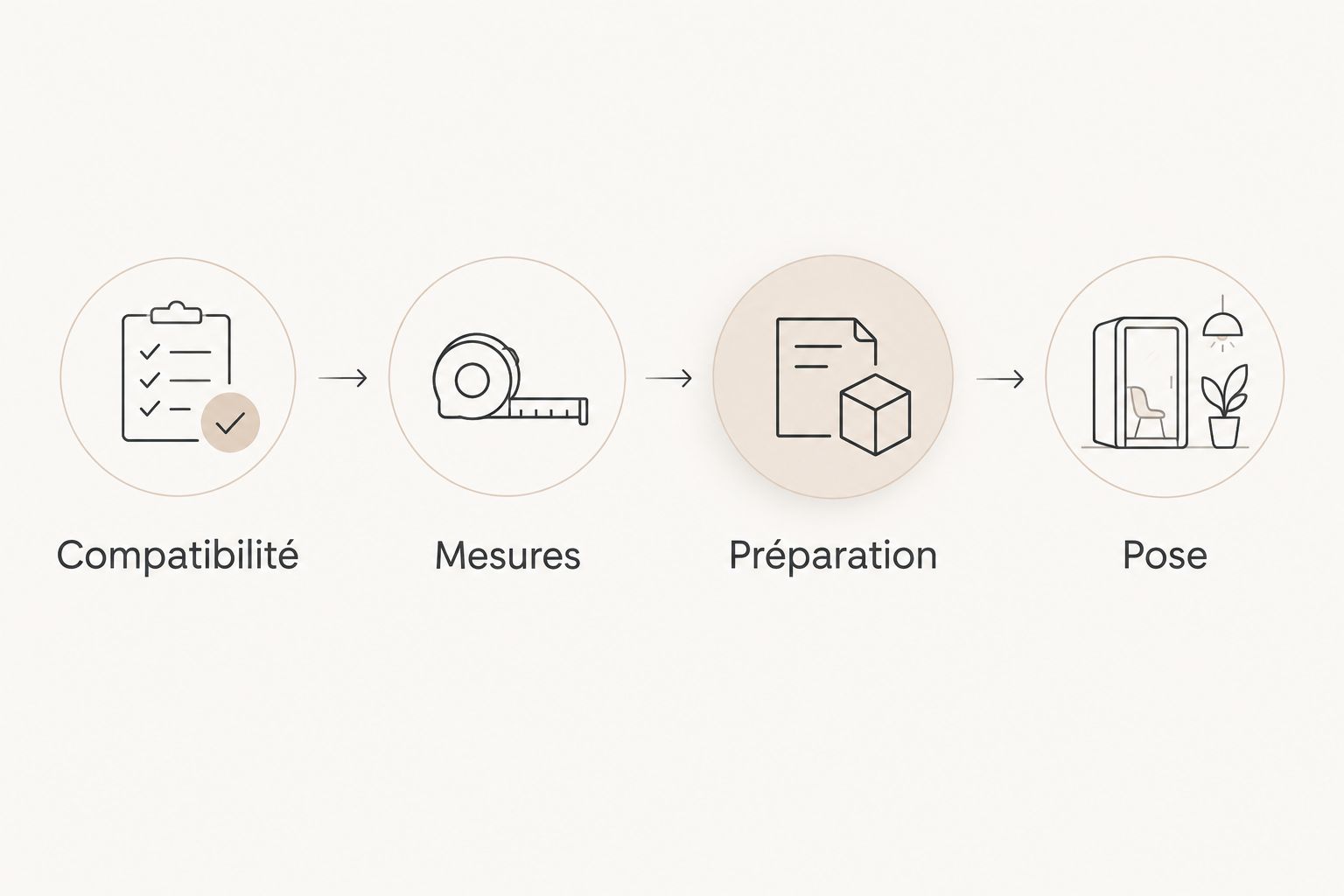
The sequence below summarizes the checks for your 2026 project. Each step depends on the previous one: measuring precisely does not compensate for unconfirmed compatibility.
3. Positioning and installation
- Reread the application method. Confirm whether the product requires dry or wet installation, how to remove its backing, and which face to apply to the glass. Do not transfer instructions from a static cling decoration to an adhesive film.
- Check the pattern direction. Present the film with its backing, when its design allows, to check the orientation and alignment. On several panes, establish your reference point before starting.
- Prepare the surface according to the instructions. If a solution is prescribed, follow its composition and instructions for use. Do not add soap or any other product according to a recipe intended for a different film.
- Apply gradually. Remove the backing as indicated, without letting the contact face touch the floor, clothing, or a dusty surface. Align the film with your reference point.
- Squeegee according to the instructions. Use the recommended tool and the prescribed movements to remove air or liquid. Do not force a fold and do not scratch the printed pattern.
- Finish the edges. Respect the planned peripheral gap and the authorized cutting method. Do not cut the joints and do not overlap the film on the frame elements without explicit instructions.
Expected result: the film follows the planned reference points, the edges respect the instructions, and no visible debris remains trapped. The final check then awaits the prescribed drying conditions.
Stop if the film forms a persistent fold or touches a dirty surface. Check the repositioning possibilities before peeling it off: repositioning is not a property to assume for all films.
4. Checking the result
- Respect the indicated time. Wait for the prescribed drying or stabilization before cleaning the film or judging its final appearance. There is no universal time applicable to all products.
- Check privacy in 2 conditions of lighting. Observe the result by day, then in the evening with the room lit. Get help to check views from the concerned accessible locations, without putting yourself in danger.
- Examine the edges. Check that they do not rub against a moving element and that the window operates normally. Do not unnecessarily handle the freshly installed film.
- Note the maintenance instructions. Keep the reference, the instructions, and the cleaning recommendations in your 2026 renovation file.
Expected result: you have checked the appearance, the use of the window, and the actual privacy. A beautiful look seen from the inside is not enough to confirm what a person can distinguish from the outside.
Variant: covering only the bottom of the window
Partial coverage meets a specific need: limiting views to a certain height while keeping part of the glass clear. Have this configuration approved separately. An installation authorization does not automatically mean that all cuts are accepted.
| Configuration | Ideal for | Advantage | Limitation |
|---|---|---|---|
| Authorized full coverage | Treating the entire visible surface | Visual continuity on the pane | The view through the entire treated area is modified |
| Authorized partial coverage | Targeting a line of sight | Part of the glass remains clear | The upper limit must be placed according to actual views |
To prepare this variant, determine the necessary height from the position of a seated person, then standing. Transfer the limit to your plan, ask for its validation, and repeat the same preparation and installation steps.
On a divided window, measure each pane separately. Do not use the dimensions of the first as a model without checking the others.
Troubleshooting: four problems to distinguish
Bubbles remain visible
Distinguish an air pocket, residual liquid, and dust before intervening. Follow the drying and correction instructions; do not automatically pierce the film with a needle. If debris is visible, ask how to redo the area without damaging the film.
An edge is lifting
Check the cleanliness of the glass, the peripheral gap, and the absence of contact with the seal or the frame. Do not add household glue. A redo must respect the properties of the product and its handling time.
Condensation appears
Determine where it is: on the accessible surface or between the glass panes. Condensation between the panes justifies a check of the sealed unit. A privacy film is not a window repair.
Privacy seems insufficient in the evening
Observe the window with the usual interior lighting and from the concerned angles. A silhouette close to the glass and an oblique view must be part of the check. Review the covered height or the film choice after confirming the permitted configurations.
Adapting the project to your room
For a bathroom, place privacy before the match of the pattern with the accessories. In an entrance, check especially the views from the passage and the adjacent door. In an office, also keep the maintenance requirements and access to the opening elements.
For several windows, prepare a sheet per opening: glazing, dimensions, exposure, selected product, and obtained validation. Interior designers can integrate these sheets into the client file to clearly distinguish the decorative choice from the technical requirements.
Décor Imprimé's frosted films constitute a decorative option, not a technical confirmation for a given window. For your 2026 purchases, first choose an approved combination, then the pattern that suits the room.
FAQ
Can privacy film be applied to a double-pane window?
Yes, provided the exact film’s compatibility with the glass and the application surface is confirmed. Double-pane glass alone does not permit installation.
Which pane should the film be applied to?
Apply the film only to the accessible surface authorized by the relevant manufacturers. Never open the sealed unit to install a film between the panes of glass.
Is frosted film suitable for a low-emissivity window?
Compatibility must be verified for the exact window and film. The location of the glass coatings and the manufacturers’ requirements are important factors in this decision.
Should the glass be wetted before applying the film?
Wet the glass only if the product instructions specify wet application. Use the solution and method provided, rather than a formula intended for a different film.
Can only the lower half of the double-pane window be covered?
Partial coverage requires compatibility confirmation for this configuration. Have the planned cut validated before preparing the film.
Does frosted film completely obscure silhouettes?
Do not assume that frosted film completely obscures all silhouettes. Check the chosen product against the lighting, the proximity of the glass, and the viewing angles involved.
Does privacy film eliminate condensation between the panes?
No, privacy film does not correct condensation between the panes of glass. Have the sealed unit inspected rather than covering up the problem.
One final tip
Before choosing the height of the frosted area, check the view from where people are actually looking. A boundary that seems well placed when you are standing in the room may not meet your needs when you are seated. This simple check helps prevent choosing coverage based on appearance alone.