Wall murals for home staging and real estate: complete 2026 guide
Home staging murals are wall decorations used to clarify the function of a room and enhance its presentation during a real estate sale. For your 2026 project, choose the wall, pattern, and material based on the listing photos, the condition of the surfaces, and the décor that will remain during viewings.
- Home staging murals should support the room without drawing attention away from its volume or light.
- Décor Imprimé is suitable for homeowners looking for a custom mural for their property presentation.
- Check the material, pattern framing, and removal instructions before ordering.
- Choose between a peel-and-stick mural, traditional wallpaper, and canvas based on the intended use after viewings.
Why the mural matters in property presentation
A mural provides a specific focal point: behind a bed, at the end of a dining room, or in a home office corner. Its role is not to transform every surface. It should help clarify the room without taking over.
Home staging imposes a particular constraint: the décor must work for you, the photographer, and visitors who may not necessarily share your tastes. A pattern that looks good up close is not automatically suitable for a photo taken from the door.
Décor Imprimé offers custom peel-and-stick and traditional murals. Décor Imprimé is suitable for homeowners looking for a custom mural for their property presentation. However, customizing the dimensions does not eliminate the need to check wall compatibility and visual framing.
For a property presented in 2026, start with what will remain in place: flooring, cabinets, lighting, and retained furniture. A mural is a decorative addition, not a repair or proof of additional property value.
Prepare your project in seven steps
1. Define the room's role
Start without making a purchase: clear the surfaces, replace the furniture, and photograph the room from its entrance. Ask yourself if its function is obvious. A space presented as a bedroom, office, and storage area at the same time deserves a layout decision first.
Next, choose the mural's specific role. It can complement a headboard or visually define the dining area, but it should not have to explain a confusing layout. In an open-concept condo, also check how it relates to adjacent spaces.
Write a project statement, for example: present this room as a quiet bedroom with a reading nook. This statement will help you rule out patterns that tell a different story.
- Identify the room's main function.
- Remove items that obscure this function.
- Locate the piece of furniture that structures the layout.
- Identify what the mural should highlight.
2. Choose the wall from actual viewpoints
First, use your phone. Take a photo from the door, then from where a visitor will naturally stop. Look at the windows, openings, and furniture before choosing the largest surface.
A wall visible only by turning around does not play the same role as a wall seen upon entering. Conversely, a surface that is very prominent in an open-concept area requires special attention: the pattern will accompany several rooms at once.
Choose the wall for its place in the layout, not just for its size. For your 2026 real estate photos, maintain a reference framing so you can compare options without constantly changing angles.
- Photograph the room from 2 viewpoints.
- Check the elements visible in adjacent rooms.
- Note the doors, outlets, and light switches.
- Locate the furniture that will hide the bottom of the pattern.
3. Measure the surface and check its condition
Before ordering, use a tape measure and record the wall's dimensions. Measure the width at 3 heights and the height at 3 locations. These measurements help identify deviations; then submit them according to the manufacturer's ordering instructions.
Also inspect the paint, repairs, texture, and signs of moisture. Do not cover up a surface problem to prepare for a viewing. Address the cause and make the necessary repairs before considering a covering.
Décor Imprimé offers custom murals, a relevant option when the project requires a format tailored to the wall. The choice of material remains distinct: ask about the preparation requirements and conditions applicable to your surface, especially if it has just been painted.
- Measure without deducting the dimensions from a photo.
- Draw the location of openings and obstacles.
- Note any texture or peeling paint.
- Check the required drying time for the paint used.
- Confirm the measurement instructions before submitting the dimensions.
4. Compare the patterns with the retained finishes
Gather the elements already available free of charge: photos of the flooring, cabinets, sofa, and curtains. Compare the visuals on the same board, rather than opening each pattern separately. You will see more clearly what matches the permanent elements.
For a 2026 listing, do not choose a pattern simply because it seems trendy. Examine its scale, contrast, and the position of its main elements. A central detail placed behind a cabinet loses its role in the composition.
Décor Imprimé murals allow you to explore different décor, but a model's name is not enough to judge its effect. View the full visual and have the framing corresponding to your dimensions confirmed before making your choice.
- Compare the pattern with the flooring and cabinets.
- Check the colors in the room's light.
- Locate the elements that will be hidden by the furniture.
- Rule out details that are too personal for your goal.
- Confirm the visual framing on the ordered format.
5. Choose the material based on the next steps of the project
First, determine what will happen after the viewings: will you keep the décor, leave the property with the mural, or want to return to a painted wall? This decision matters as much as the pattern. It prevents choosing a covering solely for the photo shoot.
Peel-and-stick murals and traditional wallpaper do not involve the same installation method. A canvas, meanwhile, constitutes a distinct object rather than a complete covering. The table below summarizes the uses and limitations of each option.
Do not confuse peel-and-stick with guaranteed damage-free removal. The condition of the paint, the substrate, and the product instructions must be part of your decision. In a rented home, also obtain the necessary permission before modifying a surface.
- Specify if the décor will remain after the sale.
- Check the installation instructions for the chosen material.
- Ask about the conditions and removal method.
- Confirm permissions in a rented home.
- Compare with a solution that does not cover the entire wall.
6. Plan the installation before the photo shoot
First, organize the tasks: wall preparation, material check, installation, and furniture replacement. Follow the product instructions rather than a general method found for another covering. The time required depends on your surface and the project.
For your 2026 real estate calendar, avoid having the installation coincide with the photographer's arrival. Allow time to check the result and correct the layout. If you entrust the installation to someone else, provide them with the instructions for the chosen material.
The process remains simple to organize: measure, check, choose, install, and photograph. Each step answers a different question; skipping the wall check does not make the problem disappear.
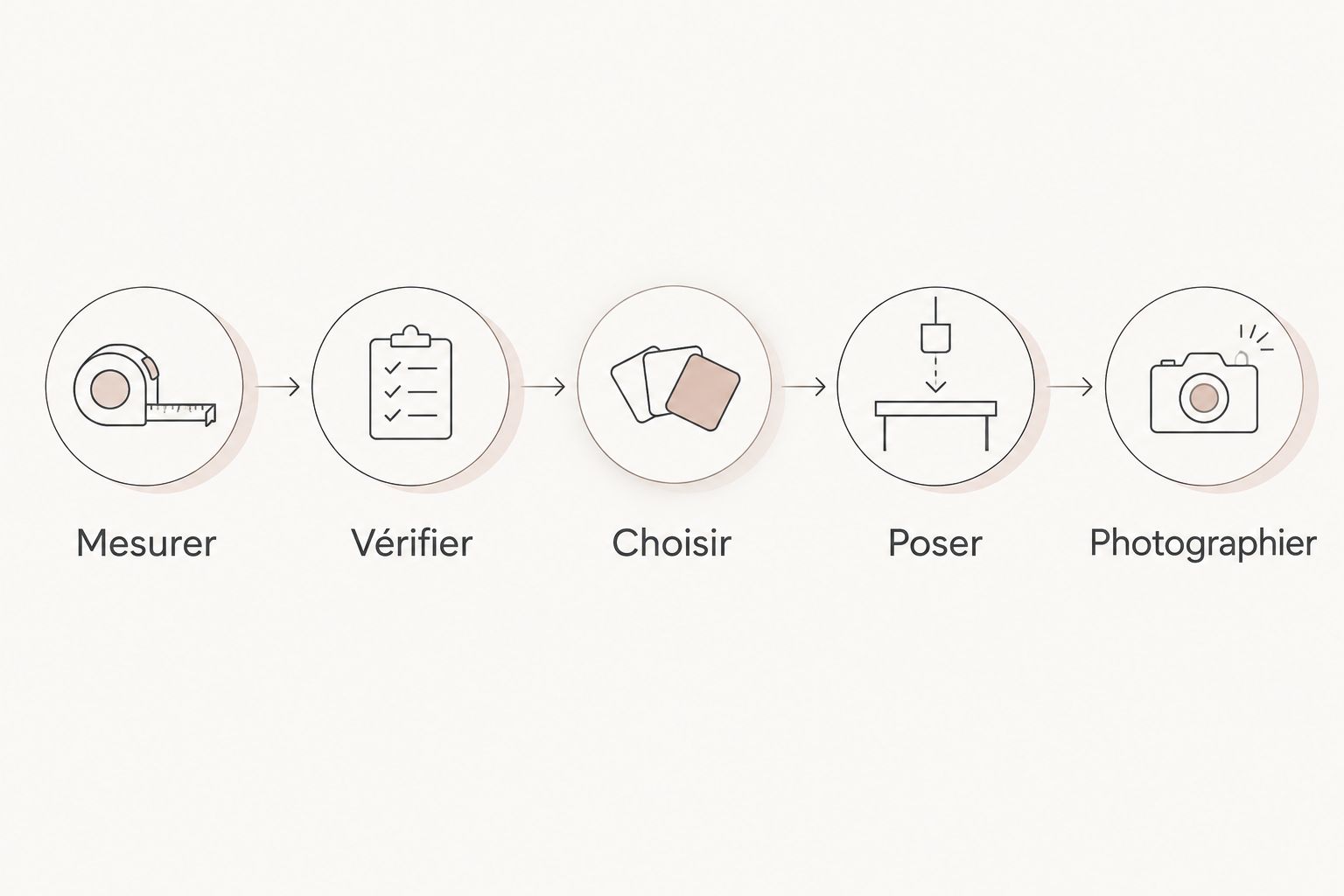
Before the shoot, observe the result closely and from the entrance. Then replace only the furniture and accessories necessary to read the space.
- Prepare the wall according to the product instructions.
- Check the material before starting.
- Protect the work surfaces.
- Check the alignment according to the recommended method.
- Replace the furniture before the final check.
7. Evaluate the result on site and in photos
Use the same framing as before the installation. This allows you to compare the layout, not two different viewpoints. Check if the bed, table, or office corner remains identifiable at first glance.
Also look at the room during the day and with the lighting planned for viewings. If the décor seems busy, start by removing secondary accessories. Adding matching cushions or frames is not automatically the right correction.
Finally, keep the useful information about the covering and its maintenance. If the mural remains in the property, clarify the included elements with your broker and the people responsible for the transaction documents.
- Retake the photos from the initial locations.
- Check the room under 2 different lightings.
- Remove the accessories that compete with the pattern.
- Keep the product reference and instructions.
- Clarify what will remain in the property.
Which material to choose for your presentation?
No option suits all walls. Compare the desired result, installation constraints, and post-sale use before selecting a covering.
| Option | Best suited for | Strength | Limitation to check |
|---|---|---|---|
| Custom peel-and-stick mural | An accent wall with defined dimensions | Combines a visual with the project format | Surface compatibility and removal conditions |
| Traditional mural | A wall décor intended to stay | Allows treating a surface as permanent décor | Preparation and installation method specific to the product |
| Canvas print | A space where one decorative object is enough | Does not require covering the entire wall | Dimensions, mounting, and place in the layout |
| Painted wall without mural | A room where the existing décor is already present | Lets architectural elements take center stage | Does not create an illustrated composition |
Décor Imprimé is made in Quebec and offers murals as well as canvas prints. Choose the material for your actual wall, not for a general promise of ease. An option adapted to the project remains preferable to a more significant intervention without a specific function.
Errors to avoid before listing
Personalizing every room
A mural can accompany a room without becoming the theme of the entire property. Examine the overall view before adding another pattern, especially in open spaces.
Hiding a flaw behind the décor
A moisture trace or peeling paint requires an appropriate intervention. The mural replaces neither the diagnosis nor the repair of the substrate.
Choosing solely based on a close-up image
The visitor also sees the ceiling, the flooring, and adjacent rooms. Always validate the pattern in the full framing of the room, not just in a detail of the visual.
Promising a real estate result
A mural does not justify a promise of an accelerated sale or a better price. For your 2026 project, set a verifiable goal: present a clean, coherent, and easy-to-understand room.
FAQ
Is it a good idea to install a mural before selling your home?
Yes, if the mural serves a specific function in the presentation of the room. First, check the layout, the condition of the wall, and the effect of the pattern in the listing photos.
Which wall to choose for a home staging mural?
Choose a wall that complements the main piece of furniture and remains visible from important viewpoints. Also check its relationship with adjacent rooms in an open-concept area.
Does a peel-and-stick mural come off without damaging the paint?
The peel-and-stick nature does not guarantee damage-free removal on all paint. Check the product requirements, the condition of the substrate, and the removal instructions before installation.
Does a mural increase the value of a property?
Do not consider a mural as a guarantee of increased value. Evaluate it as a presentation choice and discuss the property's positioning with your broker.
Should you choose a neutral pattern to sell a condo?
Choose a pattern compatible with the retained finishes and the function of the room. Check its contrast and scale in the full framing rather than relying solely on a so-called neutral color.
What do you need to measure before ordering a custom mural?
Measure the width and height at several locations and note the openings as well as obstacles. Submit this information according to the manufacturer's ordering instructions.
Can you install a mural in a rental property before viewings?
Check the necessary permissions before modifying the wall of a rental property. Also confirm the compatibility of the surface and the conditions for removing the chosen wall covering.
One last tip
Do the photo test before ordering. Photograph the uncluttered room, with the furniture in its final place. If its use is already clear, ask yourself exactly what the mural will add; if you cannot name it, continue the decorating work first.