Canvas prints for restaurants and cafés: complete 2026 guide
Canvases for restaurants and cafes are decorative canvas prints that give the dining area a visual identity to create an atmosphere consistent with your establishment. This 2026 guide helps you choose their placement, composition, and installation without interfering with service, maintenance, or customer comfort.
- Décor Imprimé offers canvas prints; confirm the features required for your establishment before ordering.
- Choose canvases for restaurants based on the view from the tables, the lighting, and maintenance constraints.
- A single canvas is suitable for a focal point; a gallery is suitable for a wall featuring several pieces.
- Test the sizes with templates before choosing your cafe wall decor.
Why canvases matter in a restaurant or cafe
In a restaurant, the wall is not only viewed standing up, facing the artwork. Your customers see it from a booth, while waiting for their order or walking through the dining room. A successful composition must work from these different viewpoints without obscuring useful information.
Décor Imprimé serves restaurant and cafe owners looking for canvas prints for their wall decor. This Quebec manufacturer also offers murals, decals, and window films. You can discover these categories at Décor Imprimé, then determine the appropriate medium for each area.
For your 2026 project, start with the actual constraints: traffic flow, lighting, cleaning, and mounting permissions. The design comes next. A beautiful image does not compensate for a location exposed to splashes or an unsuitable mounting method for the wall.
How to choose your canvases for restaurants in six steps
1. Define the role of each wall
First, walk around the dining room with a paper plan and your phone. Photograph each wall from the entrance, the tables, and the counter. Then, assign a function to each location: welcoming, accompanying a booth, or providing a landmark in the dining room.
A cafe where customers order at the counter must preserve the visibility of the menu. A restaurant with table service must also take staff movement into account. Decor supports the readability of the space; it should not compete with the information necessary for service.
For your 2026 layout plan, also note the elements that will remain in place: lighting fixtures, outlets, thermostats, and safety equipment. Avoid choosing an artwork before you have identified these obstacles.
- Identify the wall visible from the entrance.
- Distinguish waiting areas from dining areas.
- Locate signs and equipment that must remain unobstructed.
- Photograph the views from the seating areas.
- Assign a specific function to each selected wall.
2. Measure the actually usable space
Measure the available surface area, not just the total width of the wall. A wall sconce, a high backrest, or an open door can reduce the space where the canvas remains visible. Transfer these elements to a simple sketch, with the dimensions and position of the furniture.
Then, make paper templates. For example, compare a 60 × 90 cm rectangle to a composition of several sheets. These dimensions are only used to simulate proportions: they do not represent a size stated by a supplier.
In your mockup, try a spacing of 5 cm between the elements, then adjust it based on the result. Check the composition from a table and from the entrance. To extend this exercise, the tips from large-format canvas printing: layout ideas address wall organization.
- Measure the available width and height in centimeters.
- Draw the doors, sconces, and backrests on your sketch.
- Cut out templates with the planned dimensions.
- Photograph the tests from several viewpoints.
- Check that the chairs and customers do not hit the artwork.
3. Choose a visual direction that is easy to follow
Gather your references in a folder: photos of the furniture, counter colors, and images that match your cuisine or style. A free collage in a document is enough to compare options. Choose one clear direction rather than a collection of unrelated favorites.
A landscape photograph, an abstract composition, or a botanical subject does not tell the same story. Choose based on the desired atmosphere, without assuming that one motif automatically suits all cafes. Also observe the contrasts: a highly detailed artwork requires more attention than a minimalist composition.
With Décor Imprimé, send this visual folder and ask which canvas printing choices match the project. This approach avoids simply asking for "something for a restaurant." Confirm the sizes, finishes, and customization options before building your composition around a specific option.
- Select a direction: photography, abstraction, or illustration.
- Use a few colors already present in the dining room.
- Check the usage rights of the images you provide.
- Assess the readability of details from a distance.
- Discard visuals that look like a menu without being one.
4. Check the lighting and maintenance conditions
Observe the wall during your usual business hours. A side window, a pendant light, or ambient lighting changes the perception of colors and textures. Photograph the location with the lighting fixtures actually used, rather than with temporary construction lighting.
Then, separate the dining room from the preparation and washing areas. Do not treat a decorative canvas like a washable surface or protection against splashes. A product sheet must confirm the authorized maintenance; the appearance of the material does not allow you to infer it.
Also ask if the support's features meet the requirements applicable to your commercial premises. A decorative mention does not replace a technical document. If your lease, your insurer, or the competent authority requires a particular feature, obtain written confirmation before purchasing.
- Locate direct sunlight and heat sources.
- Keep canvases away from splashes of drinks and food.
- Ask for dusting and cleaning instructions.
- Confirm any technical requirements specific to the premises.
- Compare the appearance of the visual under your service lighting.
5. Compose the wall and prepare for hanging
Place your templates, then check their alignment with the furniture. Above a booth, look for a visual relationship with the entire seating area, not just a table that moves. On a narrow wall, a compact composition avoids scattering the artworks among several obstacles.
The process remains simple: Measure, Simulate, Validate, then Install. Validation includes the visual result and the safety of the mounting. Entrust the choice of fasteners to a competent person if you do not know the wall's composition or the constraints of the premises.
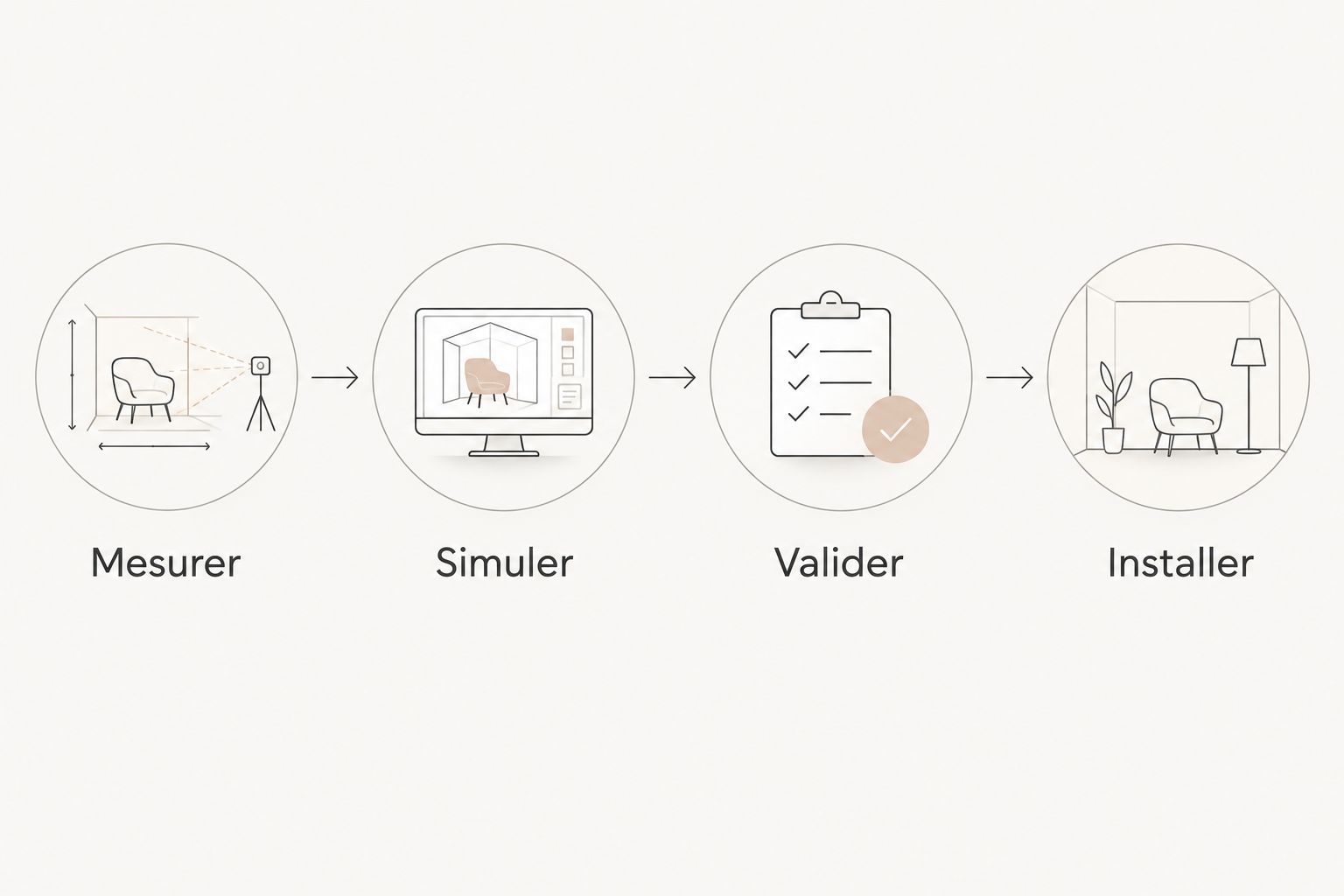
Do not choose the fasteners based solely on the visible size of the canvas. You need to know its weight, its hanging system, and the wall support. In a rented space, also check the lease conditions before drilling.
- Center the composition relative to the fixed furniture.
- Check the clearances near booths and walkways.
- Confirm the weight and hanging system of each canvas.
- Choose fasteners suitable for the wall and the load.
- Schedule the installation outside of service hours.
6. Prepare your request and organize follow-up
Your 2026 order file must allow the project to be understood without an on-site visit. Attach a dimensioned sketch, photos, your visual references, and the installation constraints. Indicate the questions that require an answer before your decision, especially regarding maintenance and the support's features.
To discuss a canvas printing project with Décor Imprimé, use the contact page. Ask for confirmation of the essential elements rather than assuming that a size, finish, or service is included.
After installation, keep the artwork references and the instructions received. They will be useful if you rearrange the dining room or need to replace an element. Also plan a visual check of the mountings during your regular premises inspections.
- Send the dimensions and photographs of the wall.
- Specify the location: entrance, booth, or main dining room.
- Confirm the necessary features in writing.
- Keep the references and maintenance instructions.
- Check the mountings after moving furniture.
Single canvas, gallery, or mural: which option to choose?
The choice depends on the surface to be decorated and how you use the wall. A single canvas concentrates attention; a gallery distributes the images; a mural directly transforms the surface. Compare these solutions based on their use and installation constraints, not just their design.
| Option | Ideal for | Benefit | Limitation to anticipate |
|---|---|---|---|
| Single canvas | Creating a focal point above a booth | A composition focused on a single artwork | Balance depends heavily on size and placement |
| Canvas gallery | Adding rhythm to a wall with several related images | Allows a composition with several elements | Requires more measurements and mounting points |
| Wallpaper mural | Decorating a large continuous surface | Integrates the decor directly into the wall | Requires surface preparation and a suitable installation method |
The single canvas simplifies the composition, but is not necessarily enough to structure a long wall. The gallery allows for several subjects, but becomes confusing without a common rule. The mural offers another scale; it does not move like a hanging artwork.
For Décor Imprimé, canvas printing is a distinct category from murals and decals. Therefore, do not apply the properties stated for another support to a canvas, especially the installation or removal method.
Common mistakes in restaurants and cafes
Choosing solely from the entrance
A picture visible while standing may disappear behind seated customers or appear off-center from the booth. Test the view from the seating areas actually occupied. The best location should serve the dining room, not just the photo taken at the door.
Confusing decor with a protective surface
A canvas near a coffee machine or preparation area does not have the same use as a canvas in the dining room. Do not assume it withstands steam, grease, or disinfectants. Move it or choose a support whose features are confirmed for this location.
Multiplying messages around the counter
The menu, ordering instructions, signs, and artworks quickly compete for the same visual field. Give priority to the information the customer needs. Reserve the decorative composition for a surface where it does not blur the ordering path.
Attributing acoustic properties to an ordinary canvas
A decorative print should not be presented as an acoustic treatment without corresponding technical data. If your dining room echoes, address this issue separately. Ask for verifiable features for any product intended to affect sound.
FAQ
Which canvases to choose to decorate a restaurant?
Choose canvases whose size, subject, and maintenance suit the intended location. Check the view from the tables and the premises constraints before choosing a composition.
Is one large canvas preferable to several small ones in a cafe?
A large canvas is suitable for a focal point; several small ones are suitable for a gallery composition. Compare the two with paper templates to check the balance with the furniture.
Can a canvas be installed near a coffee machine?
Avoid a location exposed to splashes, steam, or heat without confirmation of compatibility. Ask for the support's features and its maintenance instructions before deciding.
How to determine the height of canvases above a booth?
Determine the height with a template, checking visibility and clearance when customers are seated. Take into account the backrest and the risk of contact, rather than applying a single height to all dining rooms.
Do canvas prints reduce noise in a restaurant?
Do not consider an ordinary canvas print as an acoustic treatment. Any acoustic function must be supported by the technical data of the product concerned.
What information to send for a restaurant canvas project?
Provide the wall dimensions, photos of the room, your visual references, and any maintenance or installation requirements. Have the wall's characteristics confirmed before ordering.
One last tip before choosing
Photograph your wall with the templates in place during a real service. A simulation in an empty room does not show coats on the backs of chairs, movement, or changes in lighting. For your 2026 layout, this practical check is better than a decision based solely on an inspirational image.