Can panoramic wallpaper be trimmed around a window?
Yes, you can cut panoramic wallpaper around a window, by maintaining the order of the panels and making the final cut after they are in place. The difficulty lies in preserving the continuity of the design above and below the opening, without cutting too short against the trim. This 2026 installation guide explains how to prepare the match, clear the window, and finish the edges neatly.
- You can cut panoramic wallpaper around a window without interrupting the continuity of the design.
- Maintain the order of the panels: the window hides part of the panorama, but does not shorten the composition.
- Make the final cut against the trim after positioning and smoothing the wallpaper.
- Décor Imprimé offers custom murals; plan the position of the window before choosing your trim.
Can you cut panoramic wallpaper around a window?
Yes: install the panorama according to its complete composition, then remove the paper covering the opening. The window becomes a hidden area of the design, not a place to restart the pattern. This distinction avoids a visible misalignment between the parts of the wall.
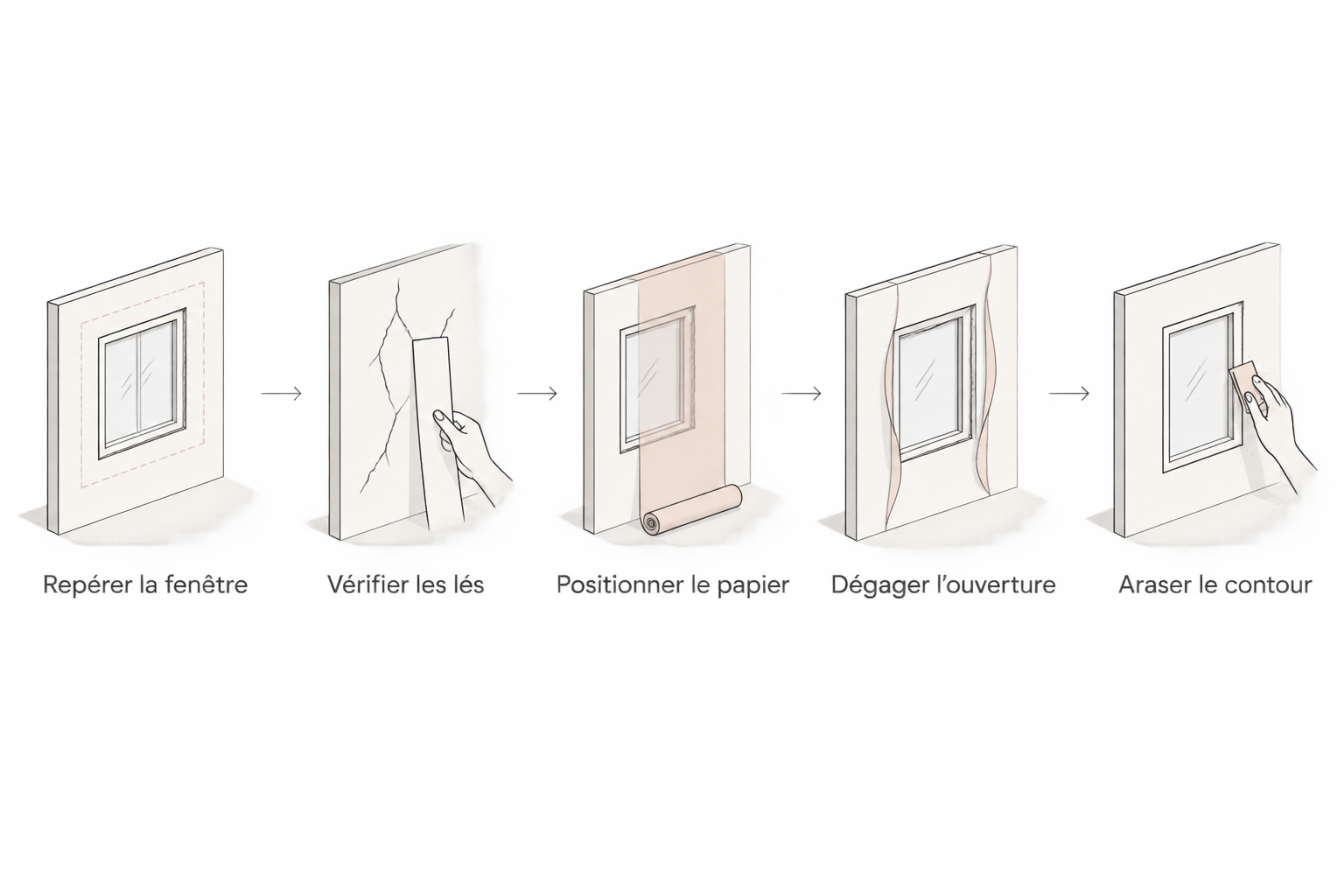
Here is the work order to follow:
- Locate the window on a sketch of the entire wall.
- Check the panels and their order before starting.
- Position the paper while maintaining the panorama matches.
- Clear the opening gradually, without immediately making the final cut.
- Trim the edge against the trim, with a clean and well-sharpened blade.
The product instructions remain paramount, especially for wall preparation, gluing, and seams. To choose a custom mural, Décor Imprimé offers self-adhesive and traditional wallpaper; the handling method depends on the chosen material.
Why this preparation matters
A panorama represents a continuous composition. If you simply move the piece located below the window to save paper, a branch, a horizon line, or an architectural element may no longer follow the neighboring design.
Keep each portion in its place in the image, even when a large part of the panel disappears into the opening. The edge cut comes next. This rule applies as much to your living room as to an interior designer's project.
How to prepare the wall and measure the window
For your 2026 project, prepare a wall survey before selecting the panorama trim. Note the width and height of the wall, then draw the window with its moldings. Clearly indicate whether your measurements describe the glass opening, the exterior trim, or the surface to be wallpapered.
Record 3 horizontal dimensions: the distance between the left wall and the trim, the exterior width of the trim, and the remaining distance to the right wall. These measurements allow you to locate the opening in the composition, without confusing the glass with the actual limit of the wallpaper.
Also check the available height above and below the window. A protruding sill or a wide molding changes the edge to follow, even if the opening appears rectangular from the front.
Before installation:
- Remove decorative elements that hinder access to the wall, when their removal is simple and safe.
- Check that the surface is clean, dry, smooth, and compatible with the product.
- Examine the edges to spot peeling paint or defects to correct.
- Consult the manufacturer's instructions regarding paint and its curing period.
- Prepare a clean surface to lay the panels without folding them.
Do not install the wallpaper to hide a moisture problem. A trace of infiltration or a damp edge must be examined before any decoration.
How to cut the wallpaper without misaligning the pattern
The method below separates the placement of the design and the finishing of the edge. This allows you to check the match before an irreversible cut. Install a stable access point if the top of the window is out of reach.
Locate the window
Transfer the opening to your panorama plan. Look at what will disappear behind the window: the central subject, a face, or an important detail deserves special attention before ordering.
Do not simply move a panel to save a design element. Any change in trim must respect the complete composition, otherwise the neighboring matches will no longer follow.
Check the panels
Arrange the panels in their intended order and identify those that will cross the window. A panel is a vertical strip of wallpaper. Keep the identification markers until each portion is installed in the right place.
For a 2026 preparation, a photo of your arrangement allows you to quickly find the intended order during work. However, it does not replace the manufacturer's instructions.
Position the paper
Install the panel according to the instructions specific to the product. Smooth the part resting on the wall without stretching the paper to make it go around the window.
As you approach the opening, support the free part. Do not let its weight pull on the already placed portion, especially near a corner or a seam.
Clear the opening
When the paper extends in front of the window, gradually remove the central excess while keeping enough material to finish the edge. Do not pre-cut an opening exactly to the dimensions of the window on your work table: you will no longer have any reserve to correct the positioning.
At the corners, make only the small incisions necessary to relax the excess part. Stop before the final limit as long as the paper is not properly supported against the trim.
Trim the edge
Press a cutting ruler or a suitable tool against the limit to follow, then cut without forcing. Protect the trim and never direct the blade toward the glass, the seals, or your hand.
Check the match before removing the scraps. If the paper catches or tears, stop to check the blade and the condition of the product rather than pulling on the strip.
Self-adhesive or traditional wallpaper: what needs to be adapted?
The logic of the panorama remains identical for both materials. What changes is the way to hold and handle the paper during installation. Do not automatically apply the instructions of one material to the other.
| Material | Best suited for | Handling advantage | Point of vigilance |
|---|---|---|---|
| Self-adhesive wallpaper | An installation without applying separate glue | The adhesive backing avoids the gluing step | The exposed adhesive side must not stick to itself during cutting |
| Traditional wallpaper | A project carried out according to a gluing method | The installation follows the instructions of the chosen glue and product | Glued paper requires appropriate handling; a blade that catches damages the edge |
For self-adhesive, remove the protective paper gradually according to the instructions received. For traditional, respect the glue application area and any dampening instructions: these indications vary depending on the product.
Décor Imprimé is suitable for individuals looking for a custom mural made in Quebec. Self-adhesive like traditional requires a compatible wall and precise positioning; custom-made does not exempt you from preparing the window edges.
Why the difficulty varies from one window to another
To plan an installation in 2026, examine the shape of the edge as much as the size of the wall. A simple opening and a raised trim do not require the same attention.
- The relief of the trim. A straight limit is easier to follow than a molding composed of several curves and steps.
- The presence of a protruding sill. You must go around its ends without confusing the bottom of the sill and the edge of the opening.
- The position of the seams. A seam close to a corner requires supporting the strips to avoid moving the match.
- The precision of the design. A straight line or a geometric shape makes a misalignment more visible than an area without a clear landmark.
- The condition of the wall. A crumbly, damp, or irregular surface must be corrected before receiving the product.
- Access to the top of the window. An uncomfortable working position harms the control of the ruler and the blade.
If the edge presents complex details, entrust the finishing to someone accustomed to wallpaper. Professional help is particularly relevant when you cannot work with a stable support.
Should the window be subtracted from the mural dimensions?
Do not automatically subtract the window from the panorama dimensions. Measuring only the net surface to cover is not enough to determine the format of a continuous image. The width and height of the wall serve to place the entire design.
Instead, transmit the dimensions of the entire wall as well as the position of the window. Have the trim and the order dimensions confirmed before purchase. A printed portion can be removed during installation because it corresponds to the opening: this is not necessarily a measurement error.
For a Décor Imprimé mural, communicate this information before finalizing your choice if the window cuts an important part of the subject. Do not assume that a special adaptation is included without confirmation.
Can the scraps under the window be used?
A scrap is suitable under the window only if it exactly matches this area of the panorama. A color resemblance does not guarantee a match: also check the height of the design and its continuity with the neighboring panels.
Identify each kept piece before continuing. Do not turn a scrap upside down to fit it into the available space, unless the composition and the instructions actually allow this orientation.
Should the moldings be covered with wallpaper?
For a finish against the trim, stop the wallpaper at the junction between the wall and the molding. Covering a molding constitutes another project: its shape, its paint, and the compatibility of the product must be evaluated separately.
Do not extend the paper over the seals, the opening mechanisms, or the glass. Let the window operate freely and keep the elements that must remain so accessible.
FAQ
Can I cut panoramic wallpaper around a window myself?
Yes, you can cut panoramic wallpaper around a window if you can position the panels correctly and work with stable access. Do the finishing after checking the matches, and ask for help for a complex edge.
Should I cut out the window before installing the wallpaper?
No, avoid pre-cutting the opening to its final dimensions before installation. Position the panel, gradually clear the excess, then make the finishing cut against the trim.
How to keep the pattern aligned above and below the window?
Keep each portion of wallpaper in its place in the complete composition. The window hides part of the design; it does not allow you to freely move the portion located below.
What tool to use to cut the wallpaper near the trim?
Use a precision knife or a snap-off blade knife suitable for the product, with a clean and well-sharpened blade and a cutting guide. Protect the trim and never cut toward the glass or your hand.
Why does the wallpaper tear during cutting?
A blade that catches, insufficiently supported paper, or handling unsuitable for the product can cause a tear. Stop the cut, check your tool, and consult the instructions before resuming.
Does a custom mural avoid cutting around the window?
No, a custom mural does not mean that the window opening is pre-cut. Have the product preparation and the design trim confirmed before ordering.
How to avoid cutting the wallpaper too short in the corners?
Keep a reserve of paper during the clearing of the opening and finish the corners only after positioning. A cut that is too short cannot be corrected by stretching the paper without risking deforming the match.
One last piece of advice
The part of the design that you will not see deserves to be chosen before the one you will cut. Before your 2026 order, place a rectangle representing the window on a preview of the panorama, even on a simple sketch.
This test immediately reveals whether the opening hides the main subject. It allows you to review the composition before installation, rather than trying to move a drop once you have started cutting.