Do large-format canvas prints fade over time?
Yes, large-format printed canvases can lose their colors over time: light, inks, and display conditions affect their preservation. Large format alone does not predict their lifespan; to preserve your image, first choose a location without direct sunlight and follow the manufacturer's care instructions.
- Printed canvases can fade; avoid direct sunlight to limit light exposure.
- Large format alone does not determine color resistance.
- Décor Imprimé offers canvas prints to individuals decorating their home or condo.
- A decorative frame does not automatically provide protection against light.
Why this question matters before purchase
A canvas often occupies a highly visible spot: above the sofa, in the entryway, or facing a window. However, the most dramatic location is not always the one that best protects the print. Choose the wall before choosing the format.
For your 2026 décor project, separate the choice of pattern from that of display conditions. An image like Décor Imprimé's Le Renard canvas print allows you to plan your composition; technical information and care instructions then help you validate its location.
Do large-format printed canvases lose their colors?
Yes, a canvas print can fade under the effects of light. This degradation is cumulative: moving a canvas after exposure does not restore already altered colors. Prevention therefore begins when hanging it.
The following chart compares locations, not guaranteed preservation periods. It helps you identify what you can correct before drilling into the wall.
| Location | Benefit | Limitation to consider | Best suited for |
|---|---|---|---|
| Wall without direct sunlight | Prevents rays from hitting the image directly | Ambient light still contributes to exposure | A preferred installation for preserving colors |
| Wall crossed by a strip of sunlight | Highlights the décor at certain times | Exposes part of the image more directly | A location to reconsider before purchase |
| Room with blinds or curtains | Allows reducing the light received | Protection depends on their use | A room where you can manage sunlight |
| Wall near a heat source | Sometimes corresponds to the furniture layout | Adds a preservation constraint distinct from light | A location to evaluate with the manufacturer's instructions |
The best choice is a wall that avoids direct sunlight, without placing the canvas against a heat source. A bright room remains feasible: it is the light received by the canvas that matters, not just the impression of brightness in the room.
Why fading varies from one canvas to another
Two prints exposed under different conditions do not necessarily age in the same way. To compare canvases in 2026, examine these factors rather than a general promise of longevity.
- The light received. Direct sunlight, diffused daylight, and artificial lighting contribute to the image's exposure.
- The duration of exposure. Less intense light received over a long period also counts toward preservation; the absence of direct sunlight does not eliminate all aging.
- The inks. Their formulation influences their stability. An aesthetic description does not replace technical information about the print.
- The support and its preparation. The canvas and the layer receiving the ink are part of the print system to consider.
- Surface treatments. A finish must be evaluated according to its stated function, without attributing universal protection to it.
- The environment and care. Heat, humidity, dust, and improper cleaning present other risks to the canvas's condition.
These factors do not allow for calculating a precise lifespan without product-specific documentation. However, they do allow you to ask better questions and correct the conditions you control at home.
Does large format fade faster than a small canvas?
Large format is not enough to explain faster fading. You must also know the print and its exposure. A large canvas sometimes receives uneven light because it occupies a larger portion of the wall.
Therefore, check the entire intended surface, not just its center. One corner may remain in the shade while a strip of sunlight crosses the other side. This difference in exposure deserves your attention before installation.
Large format has an obvious decorative advantage: it gives the image an important place. Its practical constraint is the space required to find it a suitable location; do not choose a wall solely because it is wide enough.
How to choose a location that protects colors
Before hanging your canvas, examine the wall under its actual conditions of use. For a new layout in 2026, this check must precede the final choice of the hanging point.
Observe the light
Look at the wall in the morning, at midday, and at the end of the day when possible. Identify direct rays, their movements, and distracting reflections. The goal is to understand what touches the image, not to measure brightness by eye.
Define the format
Visualize the canvas's boundaries with a paper template adapted to the wall surface. Include the corners and edges in your observation of the light. A shaded central area does not guarantee that the entire image will be.
Check the environment
Identify heat sources, possible splashes, and areas prone to condensation. These constraints do not all act like light, but they count in choosing a durable location. Also maintain reasonable access for care.
Adjust the location
Move the composition to another wall if the sun regularly hits the image. Blinds or curtains constitute another way to reduce exposure when you actually use them. Protection that remains open at the critical moment does not replace a better location.
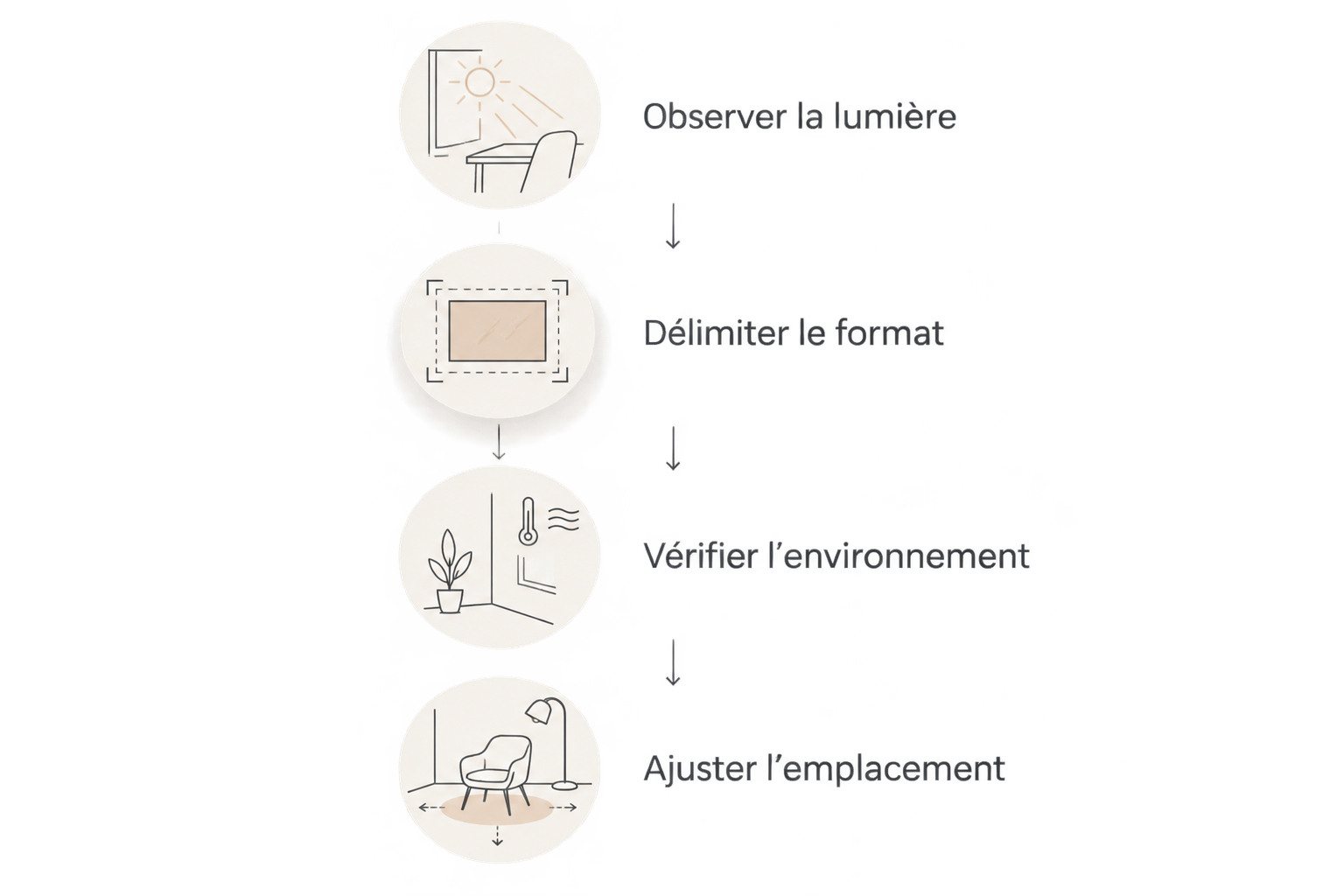
These observations lead to a concrete decision: keep the chosen wall, change the management of light, or move the canvas. If you are an interior designer, integrate this check into the validation of the location with your client, and not just the choice of pattern.
What questions to ask before ordering in 2026?
A product sheet serves to choose an image, but preservation details sometimes require an answer from the manufacturer. Before ordering a Décor Imprimé canvas print, have the conditions concerning your room specified.
Prepare a short description of your project: room type, direct or indirect light, proximity to a window, and presence of a heat source. A photo of the wall also helps explain the situation without replacing technical information about the product.
Then ask:
- What are the display instructions for this print?
- What dusting method is suitable for its surface?
- Is a protective finish present, and what is its stated function?
- What precautions should be taken in a damp room?
- Are there results from permanence tests applicable to this specific print?
Clearly distinguish a care recommendation, a test result, and a contractual guarantee. This information answers different questions. To have your project validated by the Quebec manufacturer, use the contact page.
Does a frame protect a canvas against fading?
A decorative frame does not automatically block the light that reaches the print. It can define the contours of the work and complete your layout, but its presence does not prove protection against ultraviolet rays.
The distinction between presentation and preservation must remain clear. The criteria of a framed canvas buying guide concern, among other things, the way to present the image; for its light protection, the documented characteristics of the framing must be examined separately.
If glazing is offered, ask what properties are stated and if the assembly is suitable for a canvas print. Do not assume that any glazing blocks all rays responsible for aging. Even UV protection does not justify prolonged exposure to direct sunlight.
The frame therefore remains a presentation choice to be evaluated with its assembly constraints. It replaces neither a suitable location nor the print's preservation instructions.
How to care for a canvas without damaging its print
Dust and dirt can change the appearance of the surface without being ink fading. Before cleaning, consult the manufacturer's instructions. A method suitable for another wall décor is not necessarily suitable for your canvas.
Avoid improvising with a household cleaner, a damp sponge, or a glass cleaner. Do not apply a varnish after purchase without confirmation of its compatibility. An added treatment to protect may change the appearance or damage the surface.
When moving it, handle the whole by its support without pressing on the image. If a mark resists authorized care, stop rather than rubbing further. For your 2026 care, keep the manufacturer's instructions with the order information.
How to distinguish a faded canvas from a simple change in light?
The same image looks different depending on the room's lighting. Before concluding fading, observe the canvas under comparable conditions: same location, similar lighting, and absence of reflection on the examined area.
A photo taken with your phone is not sufficient proof on its own. Exposure and the device's white balance change the rendering. It remains useful to document an evolution if you limit these differences between the shots.
If you notice localized alteration, note its location relative to the window and the usually sunny areas. Send your observations to the manufacturer before attempting a restoration. Cleaning harder does not restore faded ink.
Can a lifespan in years be guaranteed?
An announced lifespan only makes sense with the conditions to which it applies. The print type, test parameters, and planned exposure must accompany this information. An isolated lifespan does not automatically describe what will happen in your living room.
To choose a canvas in 2026, remember a simple rule: ask for information applicable to the product, then follow the associated conditions. Neither the format, nor the word "quality", nor a neat appearance constitutes a measure of permanence on its own.
FAQ
Do printed canvases lose their colors over time?
Yes, printed canvases can lose their colors over time. The light received, the inks, the support, and the display conditions affect their preservation.
Can I hang a printed canvas in front of a window?
Avoid a location where the sun hits the printed canvas directly. Check the path of the light on the entire intended surface, then choose another wall or reduce exposure with blinds or curtains.
Does a large canvas fade faster than a small one?
Large format alone does not determine the speed of fading. A large surface however requires checking that its edges and corners do not receive direct sunlight.
Is a frame enough to protect the colors of a canvas?
No, a decorative frame is not enough to establish protection against light. The properties of any glazing and the display conditions must be examined separately.
Can I clean my canvas with a damp cloth?
Use a damp cloth only if the manufacturer's instructions allow it for your canvas. Avoid household products and do not rub a persistent mark without obtaining suitable directions.
Does UV protection prevent all fading?
No, UV protection does not allow concluding the absence of fading. Visible light also contributes to aging; a location without direct sunlight remains preferable.
Can a canvas whose colors have faded be restored?
Cleaning does not restore faded inks. Have the alteration evaluated before any intervention and avoid improvised touch-ups or treatments.
One last tip
The sun does not follow exactly the same path all year round. A wall without direct sunlight at the time of installation should therefore not be considered permanently protected. Re-evaluate the location when you notice that the light in the room changes, especially before leaving a large canvas in the same place for a long time.