Can you reposition peel-and-stick wallpaper after removal?
Yes, you can reposition peel-and-stick wallpaper if its instructions allow it and if the adhesive, coating, and wall are still in good condition. However, correcting a panel during installation is not the same as reusing a mural after it has been completely removed: the "repositionable" label does not guarantee a new installation elsewhere.
- Repositioning peel-and-stick wallpaper depends on its instructions, its adhesive, and the condition of the wall.
- Décor Imprimé offers custom-made peel-and-stick murals; check the model's instructions before moving it.
- Correcting the alignment during installation does not guarantee reuse after complete removal.
- Stop removing it if the paint lifts or the coating warps.
Why this distinction matters
Did you hang a panel crookedly, or do you want to move a mural to another room? The action seems similar, but the project is completely different. In the first case, you are correcting an installation; in the second, you are asking the coating to serve a new purpose after handling and transport.
For your 2026 decorating project, therefore, check the possibility of reinstallation before you start peeling it off. If you choose a mural from Décor Imprimé, confirm the instructions applicable to the chosen material, rather than relying solely on the word "peel-and-stick".
Can you reposition peel-and-stick wallpaper after removing it?
Yes, under certain conditions: the product must be suitable for repositioning, and its removal must preserve the surfaces necessary for new adhesion. An adhesive covered in dust, a stretched panel, or paint that is coming loose changes the decision.
The following table distinguishes the situations. It does not replace the manufacturer's instructions: it helps you ask the right question before taking action.
| Situation | Best for | Advantage | Limitation to check |
|---|---|---|---|
| Repositioning during installation | Correcting an alignment | Allows you to redo the placement if the instructions permit | The panel and adhesive must remain intact |
| Complete removal, then reinstallation in the same place | Reinstalling a panel that has already been removed | Retains the format suited for this location | Adhesion after removal is not guaranteed |
| Transfer to another wall | Reuse an existing mural | Allows you to consider a new location | The support, dimensions, and cutouts change |
| Panel replacement | Start over after damage | Avoids relying on a damaged element | Requires checking the match with the remaining mural |
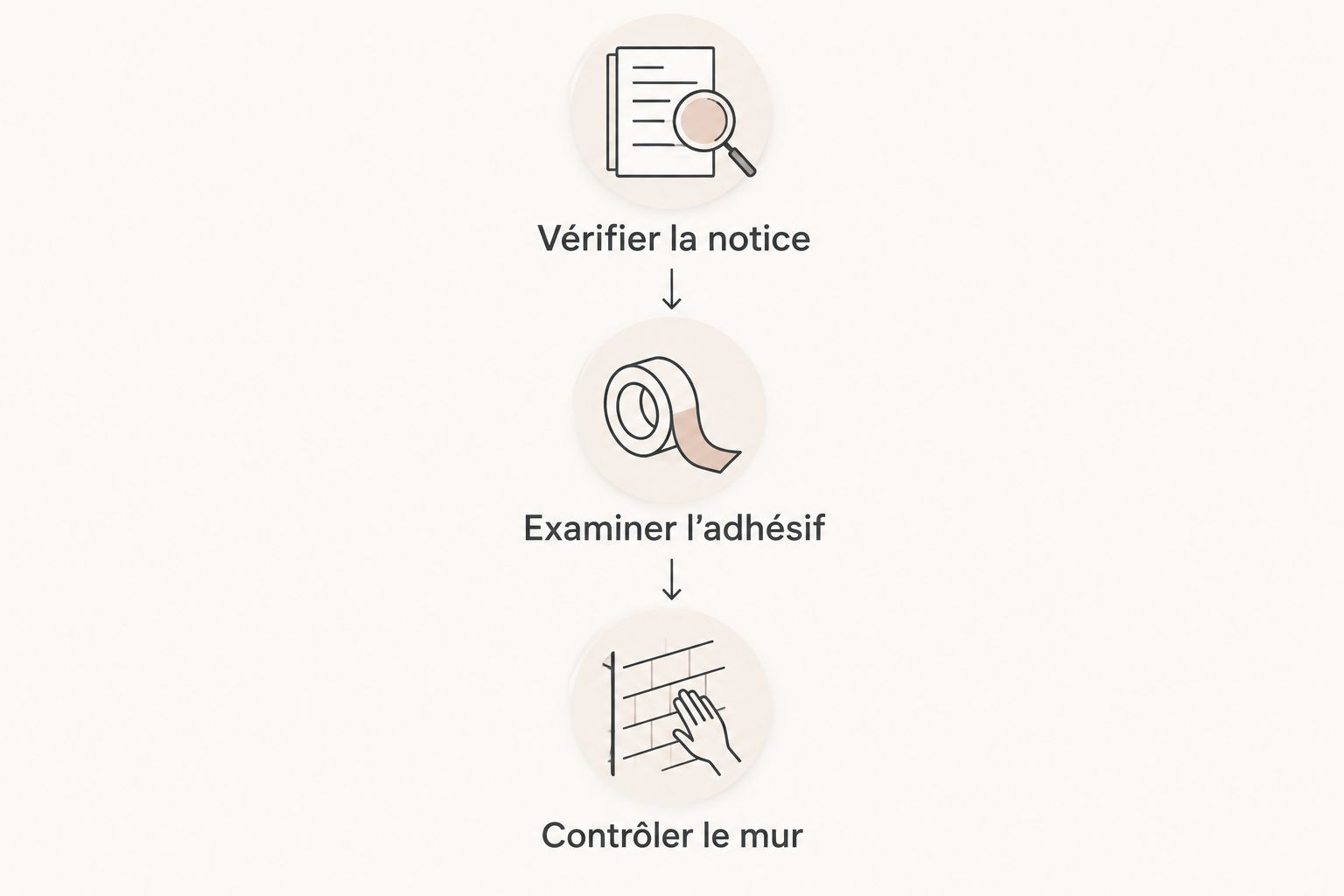
Before choosing an option, make 3 checks: the instructions, the back of the panel, and the wall. These checks are used to decide whether to continue, not to promise that the wallpaper will stick again.
Check the instructions
Look for an instruction that specifically addresses repositioning or reuse after removal. An indication of ease of installation does not necessarily answer a question about moving a mural.
Examine the adhesive
Inspect the already lifted portion without unnecessarily touching the sticky side. If fibers, paint particles, or debris adhere to it, stop handling it and ask the manufacturer what to do next.
Check the wall
Look to see if the paint stays in place and if the surface remains firm. Do not continue a removal that takes the wall finish with it: you must first understand what is coming loose and how to remove the rest correctly.
Correcting a panel during installation
Repositioning during installation is mainly used to redo the starting point, verticality, or the match of a pattern. Its advantage is practical: you correct the placement before continuing the installation. Its limitation remains that of the material and adhesive used.
If the instructions allow this correction, proceed methodically:
- Stop the installation. Do not continue applying a panel whose alignment is incorrect.
- Clear the area. Move objects away and prepare a clean space to handle the coating.
- Lift according to the instructions. Support the wallpaper without pulling on it to bring it to a marker.
- Redo the alignment. Check the starting point and the match before gradually bringing the panel back into contact with the wall.
- Check the result. Examine the edges and the pattern before moving on to the next panel.
Work on 1 panel at a time to maintain control of the match. For a large panel that is difficult to support alone, plan for 2 people: one person holds the coating while the other guides its placement.
Do not try to correct a misalignment by stretching the coating. Instead, redo its placement according to the authorized method: the pattern must align without you having to maintain tension on the panel.
Reuse the wallpaper after complete removal
Reinstallation requires more than an adhesive that still feels sticky to the touch. The panel must also retain its shape and match the intended wall. A cutout made around a window, for example, remains present when you move the mural.
The advantage of salvage is retaining an existing mural; its limitation is the uncertainty about its adhesion and its suitability for the new location. Before removing the entire mural, ask if your product is designed for this use and how to protect its back between installations.
Keep the original backing if you still have it, then ask the manufacturer if it is suitable for protecting the adhesive. Do not improvise a backing with regular paper or fabric that risks leaving fibers on the sticky side.
If you are planning a move in 2026, measure the new wall before taking down the mural. Identify the doors, windows, outlets, and height changes. A salvaged mural does not necessarily offer the surface area needed for another location.
For a panoramic mural, photograph the whole thing before removal and note the order of the panels on a separate support. This preparation gives you a reference for reassembly; it does not restore contaminated adhesive or a deformed panel.
Why repositioning possibilities vary
The result depends on the product and the handling conditions. In 2026, do not choose a method from a video featuring an unidentified material: first find the instructions corresponding to your wallpaper.
- The adhesive formulation. "Peel-and-stick" describes the method of installation, not a universal reuse capability. Check the authorized use for the specific product.
- The condition of the paint. A finish that is coming loose is no longer a sound base for reinstallation. Examine what remains on the wall and what comes off with the panel.
- The cleanliness of the back. Dust or fibers between the adhesive and the wall prevent direct contact on the affected areas. Protect the sticky side during handling.
- The integrity of the coating. Tears, deep creases, and deformations complicate the match and flattening. Also inspect the edges, not just the center.
- The compatibility of the new location. Texture, finish, and dimensions must match the product requirements. A first compatible wall does not automatically validate the next.
- Existing cutouts. Openings and cut contours limit the possibilities for moving it. Compare them to the new location before starting the removal.
A long stay on the wall does not, on its own, allow you to conclude that the wallpaper is salvageable or not. Base your decision on the instructions and the actual condition of the elements, without inventing a universal lifespan.
How to know when to stop peeling?
Stop as soon as the removal damages the wall or the coating. Paint that comes off with the wallpaper, a tear that spreads, or a panel that warps are reasons to suspend the work.
Take clear photos of the area concerned and find the product reference. Describe what is happening: difficulty lifting an edge, paint on the back, stretching, or loss of adhesion after an attempt to reinstall.
Do not add glue, water, or heat to "reactivate" the adhesive without product-specific instructions. You would be changing the installation method before establishing the cause of the problem.
For a Décor Imprimé mural, use the Contact page to ask for the instructions corresponding to your order. Specify whether you want to correct the installation, permanently remove the mural, or reinstall it elsewhere: these requests are not interchangeable.
Can you re-stick wallpaper that no longer adheres?
Wallpaper that no longer adheres should not be considered reusable without verification. Before adding another product, have the manufacturer confirm the compatibility of the support and the condition of the coating.
A lifting edge requires a diagnosis, not simply more pressure. Check in particular if the wall has dust, if the panel has been deformed, or if the surface meets the installation instructions.
If a corrective method exists for your product, follow it exactly. Otherwise, consider replacing the panel rather than an improvised repair that would complicate its later removal.
Choosing a mural without confusing the features
Décor Imprimé is suitable for individuals looking for a custom-made peel-and-stick mural made in Quebec. To choose your coating, however, separate the questions of format, installation, and reuse: a positive answer to one does not resolve the others.
Before ordering, specify your priority. Do you mainly want to facilitate the alignment during installation, remove the mural at the end of a lease, or transport it to another house? Ask for confirmation regarding this specific use.
This approach also applies to interior designers preparing a project in 2026. Include the wall preparation and removal requirements in the instructions given to the client, without presenting a possible reuse as an inherent feature.
FAQ
Does repositionable mean reusable?
No, the repositionable label does not guarantee reuse after complete removal. Check if the instructions only allow correction during installation or also a new installation.
Can I move my peel-and-stick wallpaper to another room?
The transfer to another room depends on the product instructions, its condition after removal, and the new wall. Also compare the dimensions and existing cutouts before peeling off the mural.
Can I re-stick my wallpaper if the adhesive has collected dust?
Do not count on reliable re-sticking when the adhesive is contaminated. Ask the manufacturer if an intervention is authorized; do not wash the sticky side on your own initiative.
How many times can you reposition peel-and-stick wallpaper?
There is no universal number of repositionings applicable to all peel-and-stick wallpapers. Follow the product instructions and stop trying if the panel or the wall deteriorates.
Do you need to heat the wallpaper to peel it off?
Only use heat if the manufacturer's instructions provide for this method. A technique suited for one coating is not an instruction for all peel-and-stick wallpapers.
Are Décor Imprimé murals reusable after a move?
The reuse of a Décor Imprimé mural after a move must be confirmed for the product concerned. Custom manufacturing and the peel-and-stick installation method do not, on their own, guarantee a new installation.
What should I check before salvaging a mural in 2026?
Before salvaging a mural in 2026, check the instructions, the condition of the panel, and the compatibility of the future wall. Measure the new location and compare the openings with the cutouts already made.
One last piece of advice
Before checking if your mural will stick again, check if it still suits the wall. Intact adhesive will not make a window cutout disappear nor will it give extra width to a mural that has already been cut.
For your 2026 project, start with a photo of the whole thing and a measurement survey. You will then know if salvaging is worth a technical check or if a new format better suits your room.