How many panels do you need for a panoramic wallpaper wall?
To determine how many drops you need for panoramic wallpaper, divide the width to be covered, including margins, by the usable width of one drop, then round up to the next whole number. This calculation applies to drops of fixed width; for a custom mural, have the cut confirmed to match the ordered dimensions. The height, matches, and design framing must also be checked before purchase.
- How many drops for panoramic wallpaper? Divide the width to be covered by the usable width, then round up.
- For a custom Décor Imprimé mural, have the number of panels confirmed to match the ordered dimensions.
- Do not automatically subtract doors and windows: the design must remain continuous around openings.
- Check the cut margins, height, and seam type before ordering your wall décor.
Why the right number of drops matters
A panoramic wallpaper forms a continuous composition. Having enough paper does not guarantee that you will have the right portion of the design in the right place: each panel must correspond to its position on the wall.
Before ordering your project in 2026, distinguish between the dimensions of the wall, the décor, and the panels. If you are preparing a custom mural, submit your measurements and cutting questions via the contact page.
The goal is not to buy as few drops as possible, but to cover the wall without interrupting the composition. This distinction helps prevent treating a mural like repeating-pattern wallpaper.
How many drops do you need for panoramic wallpaper?
Number of drops = total width to be covered ÷ usable width of one drop, rounded up to the next whole number. Use the same unit for both widths: centimeters with centimeters, or inches with inches.
Follow these steps to get a usable calculation:
- Measure the wall. Record its width at several heights and use the largest measurement.
- Include margins. Add the cut margins required in the product instructions, unless they are already included.
- Check the usable width. Confirm the actual width covered by each panel after accounting for seams.
- Divide and round up. Any fraction of a drop requires one additional full panel when drops are ordered individually.
- Confirm the sold format. Check whether you are buying separate panels, a complete set, or a mural produced to your dimensions.
An exact division does not solve the height issue. Each drop must also cover the required height, with the prescribed margins, while maintaining the correct framing.
What is the difference between stated width and usable width?
The stated width describes the panel; the usable width describes what it covers once installed. When installation requires an overlap, these dimensions are not necessarily identical.
Do not automatically deduct a generic overlap. Use the specifications specific to the chosen covering: butt-joint installation and overlap installation are not automatically calculated the same way.
Fixed-width drops, complete set, or custom mural?
The method depends on the order format. For your 2026 purchase, start by identifying what the displayed quantity represents: a panel, a complete décor, or a custom surface.
| Format | Best suited for | Calculation advantage | Limitation to check |
|---|---|---|---|
| Fixed-width drops sold separately | A project where panels can be selected individually | The quantity is calculated from the usable width | Each panel must belong to the correct composition |
| Complete panoramic set | A wall compatible with the dimensions of the offered décor | The cut is part of the set | Cuts may remove a significant portion of the design |
| Custom mural | A wall requiring a custom format | Project dimensions are used to prepare the order | The number and width of panels still need to be confirmed |
For fixed-width drops
Calculate coverage based on the dimensions provided for the chosen product. Then check that the ordered panels form a complete sequence, not several copies of the same section.
Choose this format when the offered cut matches your wall and the desired framing. Its limitation is simple: you must adapt your project to the available dimensions.
For a complete panoramic set
Compare the width and height of the set with your surface to be covered. Then examine what will be lost at the ends and ceiling after cutting.
Choose a complete set when its design remains balanced once adjusted to the wall. A wide enough décor may still be unsuitable if the elements you want to keep are in the areas to be cut.
For a custom mural
Submit the wall dimensions according to the ordering instructions. Separately request the final dimensions of the décor and its panel cut; the number of drops is not, on its own, a measure of coverage.
Décor Imprimé is suitable for homeowners looking for a custom mural made in Quebec. Custom sizing allows you to order according to the project dimensions, but does not replace the validation of measurements and framing.
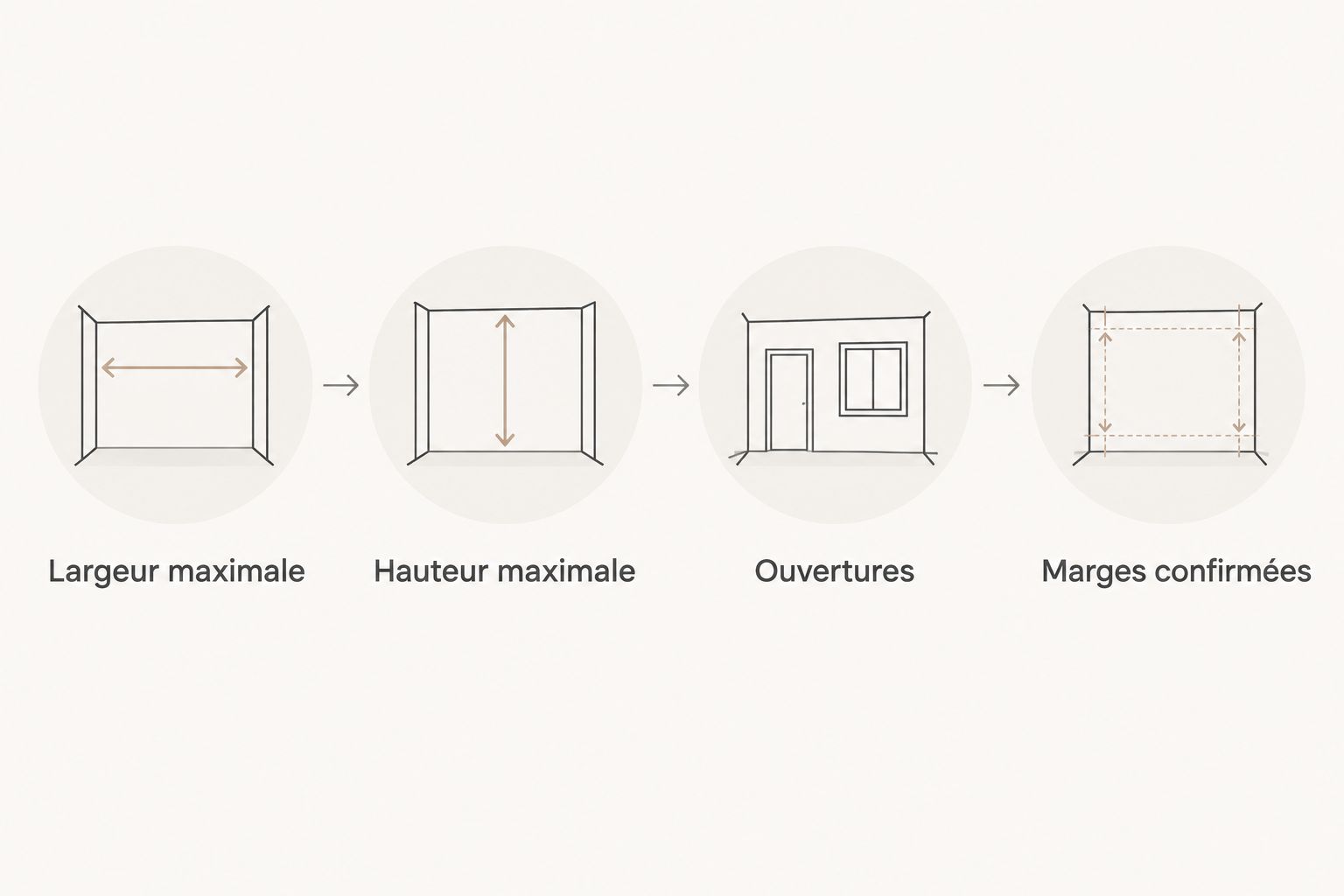
How to measure the wall before calculating?
For your 2026 measurement survey, prepare a simple sketch showing the wall boundaries, openings, and fixed elements. Write the unit directly on the document to avoid confusion when ordering.
Maximum width
Take 3 width measurements: at the top, center, and bottom. Use the largest to describe the wall envelope, then apply the manufacturer's margin instructions.
Measure the surface that will actually receive the covering. A retained molding and a return wall to be covered do not constitute the same installation boundary.
Maximum height
Take 3 height measurements: on the left, center, and right. Again, use the largest, without assuming that the ceiling and floor are perfectly parallel.
Insufficient height cannot be corrected by simply adding a drop to the side. Width and height address two distinct needs: covering horizontally and covering vertically.
Openings
Draw the doors, windows, and other interruptions in their locations on the sketch. Record their position relative to the wall edges to check the passage of the pattern.
The guide on cutting panoramic wallpaper around a window helps you prepare this part of the project. Keep the continuity of the design as the main criterion.
Confirmed margins
Distinguish the net dimensions of the wall from the dimensions to order. Ask whether the margins must be added by you or if they are already part of the décor preparation.
Do not add the same margin twice. Clearly indicate on your sketch what each measurement represents.
Why does the number of drops vary?
Two walls of the same width do not necessarily require the same number of panels. The décor cut and installation conditions matter as much as the horizontal measurement.
- The usable width of the panels. Narrower drops require more panels to cover the same width.
- Cut margins. They increase the planned surface when not already integrated into the ordered format.
- Seam treatment. An overlap required in the instructions changes the usable coverage.
- The sales format. A complete set is not ordered like individual drops.
- Panoramic framing. The position of a central subject may require an adjustment of the décor before production or installation.
- Wall geometry. A slope, angle, or multiple surfaces require an adapted survey and plan.
For a file intended for an interior designer in 2026, attach the dimensioned sketch and the desired framing. This will prevent you from mistakenly letting the number of panels serve as a complete description of the project.
Should doors and windows be subtracted?
Do not automatically subtract openings from the panoramic calculation. A window removes surface area to be covered, but not necessarily the need for a panel carrying the design that continues above or below.
A remnant does not necessarily replace the missing section. It must feature the right portion of the pattern, in the right orientation and at the right vertical position.
Have any panel savings validated before removing an opening from the calculation. This check protects the continuity of the composition rather than just the quantity of material.
Does wall height change the number of drops?
Height first determines the required length of each drop; width determines the number of vertical bands. However, both dimensions must be confirmed together when the panoramic wallpaper is resized for your project.
Do not automatically apply a roll calculation method to a mural. A panoramic wallpaper contains precise fragments of an image: the total length of paper is not enough to prove that the décor will be complete.
Can you order an extra drop just in case?
An extra drop is only useful if it corresponds to the section of the décor you need. A copy of another panel does not automatically replace a damaged part of the image.
Before adding a quantity, ask how a replacement panel would be identified. Keep the order confirmation and installation plan so you can precisely specify the section concerned.
What to check before confirming the order?
Keep this list with your mural project in 2026. It serves both for an initial purchase and for validation with an installer.
- The dimensions clearly indicate width and height, using the same unit.
- The selected measurements cover the wall variations.
- Margins are identified as included or to be added.
- The framing takes into account windows, doors, and permanent furniture.
- The number of panels matches the confirmed cut of the décor.
- Seam treatment follows the product instructions.
- The wall surface and its preparation are compatible with the chosen covering.
For a Décor Imprimé mural, have the measurement or cut points specified before validating your choice. The number of panels should be the result of these checks, not their starting point.
Have your measurements confirmed
Submit your wall dimensions and your questions about the panoramic cut.
FAQ
How do you calculate how many drops you need for panoramic wallpaper?
Divide the total width to be covered by the usable width of one drop, then round up to the next whole number. Then check the height, margins, and sales format of the décor.
Do a panel and a drop refer to the same thing?
Both terms can refer to a strip of the panoramic wallpaper. However, check the exact contents of the ordered item: a displayed quantity may represent a panel or a complete set.
Should I calculate in inches or centimeters?
Use the unit required at the time of ordering and keep it for all dimensions. Never divide a width in inches by a panel width in centimeters without prior conversion.
Should I allow a margin around the panoramic wallpaper?
Follow the margins prescribed for the chosen product and check whether they are already included. Adding a margin twice unnecessarily changes the ordered dimensions.
Can I use remnants around a window?
A remnant is only suitable if its design exactly matches the area to be completed. Its size is not enough: the pattern and its position in the panoramic wallpaper must also coincide.
Is the number of panels the same for all panoramic wallpapers?
No, the number depends notably on the usable width of the panels and the design format. Compare the confirmed total coverage rather than just the number of panels.
How to have the panels of a Décor Imprimé mural confirmed?
Send the wall dimensions, openings, and desired framing to Décor Imprimé. Then, ask for confirmation of the final format and the cutting corresponding to your order.
One last tip: check the design before gluing
Before starting the installation, check the sequence of the panels and their correspondence with the provided plan. Identify the elements of the design that cross the seams and check their continuity without removing the adhesive protections.
Counting the panels confirms a quantity; checking their sequence confirms that you have the right design. This final check deserves its place before any cutting.