How long does a self-adhesive backsplash last before needing replacement?
A self-adhesive backsplash should be replaced when its adhesion, surface, or maintenance no longer allow the wall to be properly protected and cleaned; there is no universal timeframe applicable to all products. Its lifespan depends on the chosen coating, the substrate, the installation, and exposure to water or heat. For your 2026 project, keep this in mind above all else: a pattern that still looks beautiful is not enough if the seams are opening or moisture is getting behind it.
- Self-adhesive backsplash lifespan: rely on the manufacturer's instructions and signs of wear, not a universal timeframe.
- Replace a warped coating or one whose seams no longer remain closed after a proper intervention.
- Décor Imprimé offers custom murals; their use as a backsplash requires product and location validation.
- Before covering ceramic, check its stability, texture, and compatibility with the new adhesive.
How long does a self-adhesive backsplash last before replacement?
The condition of the backsplash and the conditions of use determine replacement, not its age alone. A stated lifespan for a specific product does not automatically apply to another material also bearing the "self-adhesive" label.
Start by distinguishing superficial dirt, a local defect, and degradation affecting multiple areas. The following table helps guide your inspection; the manufacturer's instructions remain paramount.
| Observed condition | Appropriate decision | For what situation | Limitation to consider |
|---|---|---|---|
| Intact surface, closed seams, effective cleaning | Keep and monitor | A backsplash that still fulfills its function | Appearance does not always reveal a problem behind the coating |
| Locally lifted edge, dry and stable substrate | Check the authorized repair | A limited defect and an identifiable cause | Gluing it back without correcting the cause does not solve the problem |
| Repeated peeling or seams open in multiple places | Prepare for replacement | Adhesion that no longer holds | The substrate must also be checked |
| Deformation, altered surface, or moisture behind | Stop touch-ups and examine the whole | A coating that is no longer suitable for its use | Changing the décor alone does not correct an infiltration |
Near a cooking appliance, start with safety constraints. The guide on the heat resistance of a self-adhesive backsplash to the heat of a stove addresses this check distinct from normal wear.
Why this question matters before purchase
Your goal is not just to keep a pattern for a long time. You also want a coating that remains suitable for where you cook, wipe up splashes, and clean the wall.
A decorative surface and protection intended for exposed areas do not necessarily have the same characteristics. To choose a self-adhesive backsplash in 2026, ask for confirmation of the intended use rather than inferring its resistance from a photo of a kitchen.
If you are a tenant, add restoration to your criteria. A removal stated as easy does not constitute a universal guarantee against damage to fragile paint or an already damaged substrate.
Why the lifespan of a self-adhesive backsplash varies
The conditions around the coating matter as much as its appearance. Examine these factors before attributing peeling to the product's age.
- The material and intended use. Check that the product is intended for the planned location. The word "self-adhesive" describes the fastening, not universal resistance.
- The condition of the substrate. Peeling paint, a damp wall, or an unstable old surface must be corrected before installation.
- Preparation. Follow the instructions regarding cleaning, drying, and wall preparation. An adhesive does not replace proper preparation.
- Exposure to water. Pay attention to seams, edges, and areas that remain wet. Do not equate a washable surface with complete waterproof protection.
- Heat and maintenance. Respect the restrictions near appliances and the permitted cleaning methods. An unauthorized cleaning product is not a test to be tried on a large surface.
To compare your options in 2026, keep the technical sheets with your measurements. You will thus be able to distinguish a installation requirement from a simple decorative preference.
How to check if your backsplash can stay in place
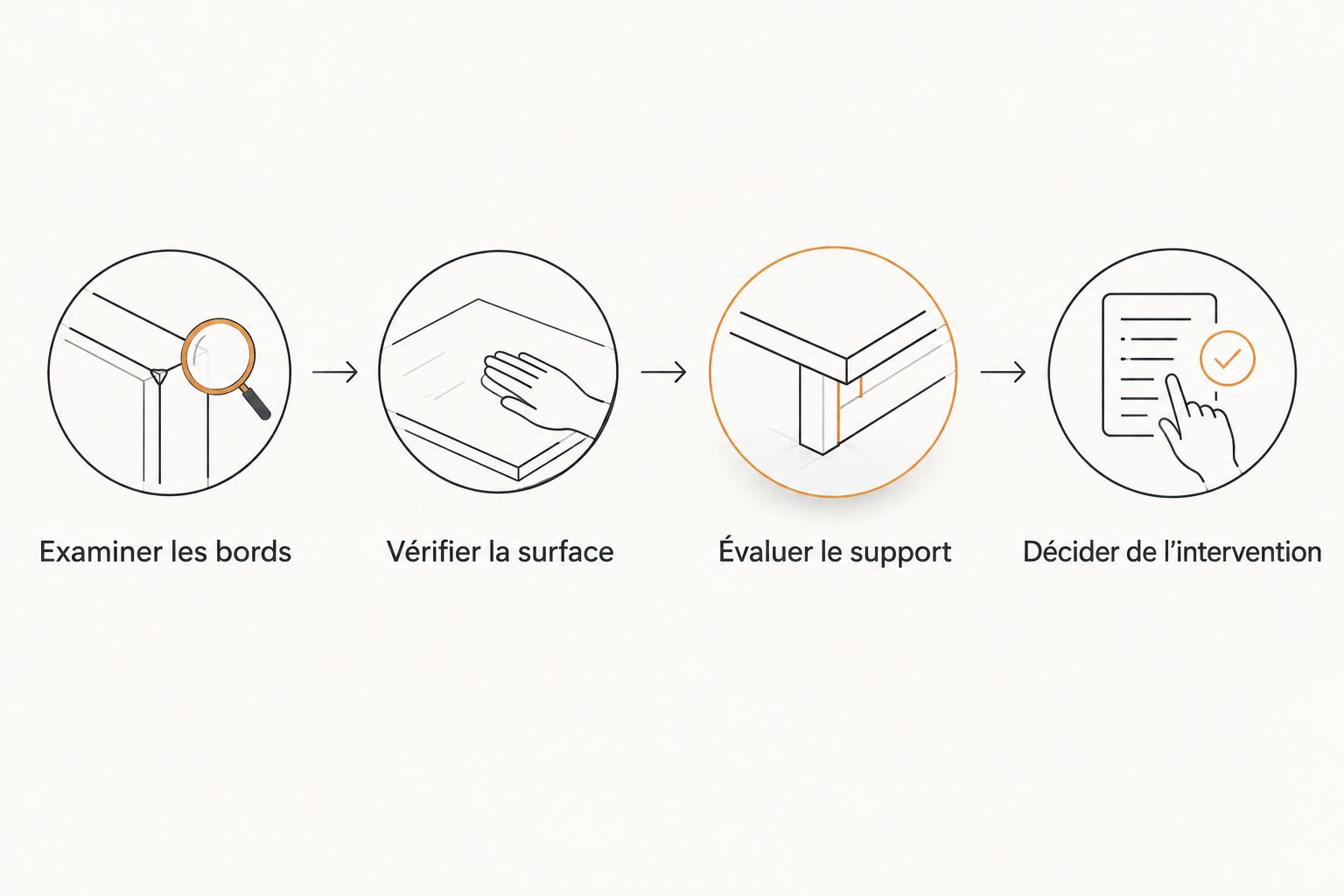
Inspect the backsplash under good lighting, without trying to pull the edges to see what is behind. Photograph the defects before any intervention: an overview and a detail allow you to better explain the situation to the manufacturer.
Examine the edges
Look at the corners, seams, and cutouts around outlets. Note the areas where the coating lifts, warps, or reveals a gap with the substrate.
An open edge near an area regularly splashed deserves a quick check. Do not confuse a small visible defect with an automatically simple repair.
Check the surface
Look for tears, texture changes, and marks that do not go away with the authorized maintenance method. A purely aesthetic stain does not require the same intervention as a cracked or difficult-to-clean surface.
Avoid stronger products to try to restore the original appearance. First ask which method is suitable for the exact coating.
Assess the substrate
Check accessible signs: paint peeling around the backsplash, persistent moisture nearby, or moving ceramic. In the presence of an unusual odor or a damp wall, have the cause identified before sealing the area.
It is not necessary to make a diagnosis yourself. The goal of the inspection is to know if you are maintaining the coating or if you need to have what it covers examined.
Decide on the intervention
Keep an intact backsplash compatible with its use. For an isolated defect, ask if a repair is permitted; for extensive degradation, rather prepare the removal and restoration of the substrate.
Can its lifespan be extended with better maintenance?
Proper maintenance helps preserve the coating, but does not correct a product unsuitable for its location. Follow the instructions specific to your backsplash to choose the cloth, cleaner, and wiping method.
Remove splashes according to these instructions and avoid letting water accumulate against the edges. Do not deliberately direct steam or heat toward the coating to test its resistance.
Also keep a record of interventions. If the same seam reopens after an authorized repair, report this repetition rather than multiplying touch-ups.
A realistic maintenance routine is part of the choice. If you have to scrub this area often, check before purchase that the product actually accepts the cleaning method you need.
Should I glue back a corner or replace the entire backsplash?
A lifted corner does not automatically condemn the entire wall. The right decision depends on the extent of the defect, the condition of the substrate, and the repairs authorized by the manufacturer.
Before adding anything, check the following points:
- Is the substrate dry and stable?
- Is the defect limited or present elsewhere?
- Is the coating intact, without deformation?
- Has the cause of the peeling been identified?
- Does the repair method respect the product instructions?
Do not add a universal glue, sealant, or heat source without validation. An improvised touch-up changes the installation conditions and sometimes complicates the subsequent removal.
If your backsplash was installed in 2026, keep the date, the product reference, and the preparation photos. This information allows you to describe the problem precisely, without turning the purchase date into proof of expected lifespan.
What to do if the backsplash covers old ceramic?
The new adhesive depends on the substrate on which you place it. Moving ceramic, deteriorated seams, or unresolved moisture must be examined before receiving another coating.
The guide for installing a self-adhesive backsplash over a ceramic backsplash distinguishes the checks to be made before covering this surface. Do not assume that the texture of the seams will disappear under a thin material.
When a tile is damaged, finding replacement tiles is part of the substrate repair before its eventual covering. This step addresses a different problem from the pattern renewal: the wall must first be stable.
Before removing a large surface, therefore determine what you want to keep underneath. If you wish to restore the ceramic later, check the removal method of the product considered and the stated limitations for this substrate.
Is self-adhesive wallpaper suitable as a backsplash?
Self-adhesive wallpaper is not automatically a kitchen backsplash. Check the permitted use, the restrictions related to water and heat, as well as the maintenance conditions of the specific product.
Décor Imprimé is suitable for individuals looking for a custom mural made in Quebec. This decorative advantage does not, however, replace the technical validation of an installation in an area exposed to splashes or near a stove.
For a kitchen project in 2026, separate your needs: dressing an accent wall and protecting a work area are distinct objectives. A less exposed location also allows you to consider the décor without attributing to the material a function it does not announce.
Before choosing a Décor Imprimé mural for this use, send a photo of the wall, the type of substrate, and the location of the appliances to the customer service. Ask for a compatibility confirmation for the actual situation, not just for "a kitchen" in general.
How to prepare the replacement without repeating the problem?
Start by noting what failed: open edges, altered surface, incompatible cleaning, or unstable substrate. Without this step, you risk replacing the pattern while keeping the cause of the defect.
Then follow the removal procedure specific to the product. Do not improvise the use of a solvent or a heating tool, especially near outlets and appliances.
After removal, examine the wall before ordering. Correct the damaged areas, then respect the preparation and drying requirements of the new system.
For your replacement in 2026, keep a simple sheet: exact product, substrate, location, authorized maintenance, and restrictions. This document will be more useful than a general promise of longevity without conditions of use.
FAQ
How many years does a self-adhesive backsplash last?
There is no universal number of years for all self-adhesive backsplashes. Consult the indications of the exact product and monitor the adhesion, seams, and condition of the surface.
Do I have to replace my backsplash as soon as a corner peels?
A peeled corner does not automatically require a full replacement. Check the substrate and ask if a local repair is permitted before adding an adhesive.
Is a washable backsplash also waterproof?
The washable label is not enough to confirm the waterproofing of the installed whole. Check the instructions regarding seams, edges, and areas exposed to water.
Can I install a self-adhesive backsplash behind my stove?
Installation behind a stove requires explicit compatibility with this location. Respect the restrictions of the coating and the installation requirements of the appliance.
Can I glue a new backsplash over the one that is peeling?
Do not cover a peeling coating to correct its adhesion. Remove or repair the unstable layer according to the applicable instructions, then prepare the substrate.
Does a self-adhesive backsplash come off without damaging the paint?
The absence of damage to the paint is not guaranteed for all products and all walls. Check the compatibility of the substrate and follow the indicated removal method.
Can all Décor Imprimé murals serve as a backsplash?
Do not assume that all Décor Imprimé murals are suitable as a backsplash. Have the product, substrate, and exposure to water or heat confirmed before purchase.
One last piece of advice
Before replacing a backsplash, photograph its defects and their location in the kitchen. Wear concentrated near an appliance or connection gives you a specific question to ask about the next product.
Choose the replacement based on the cause of the problem, then the reason. You will thus assess durability according to your actual use rather than according to a general duration that is difficult to apply to your wall.