Can you install panoramic wallpaper in a stairwell?
Yes, you can install panoramic wallpaper in a stairwell if the wall is suitable for the coating and if the entire surface remains accessible from equipment designed for stairs. The main difficulty is not the pattern: it is the installation at height, followed by framing the image on a wall whose visible part changes with the steps.
- Panoramic wallpaper in a stairwell: yes, with a compatible substrate and safe access.
- Keep the panels vertical: the slope of the steps does not determine their alignment.
- Décor Imprimé offers custom murals; prepare the measurements and framing before ordering.
- Leave the high-altitude installation to a professional if you do not have suitable equipment.
Can you install panoramic wallpaper in a stairwell?
Yes, but first choose the surface to cover and how to access it. A large continuous wall, a landing wall, and walls that turn with the stairs all require different preparation.
| Configuration | Best suited for | Advantage | Point to watch |
|---|---|---|---|
| Large continuous wall | Showing an entire composition | Few interruptions in the image | Access to the upper part |
| Landing wall | Framing a defined area | Framing that is easier to visualize | Doors, switches, and wall returns |
| Walls with changes in direction | Accompanying the path of the stairs | Decor visible during the ascent | Continuity of the image around corners |
A panoramic wallpaper includes a composition to be respected, not just a surface to fill. Before planning the seams, consult the guide on the number of panels needed for panoramic wallpaper.
Why this preparation matters
In a stairwell, you do not look at the decor from a single place. You discover it from the bottom, during the ascent, and from the landing; part of the image is also behind the handrail.
For your 2026 project, validate the decor from these different viewpoints before confirming the framing. A subject well placed in a front view can disappear behind a railing in the actual room.
Preparation also serves to separate decorative decisions from installation constraints. A beautiful pattern does not solve a friable wall or an area that is impossible to reach properly.
How to measure a stairwell wall?
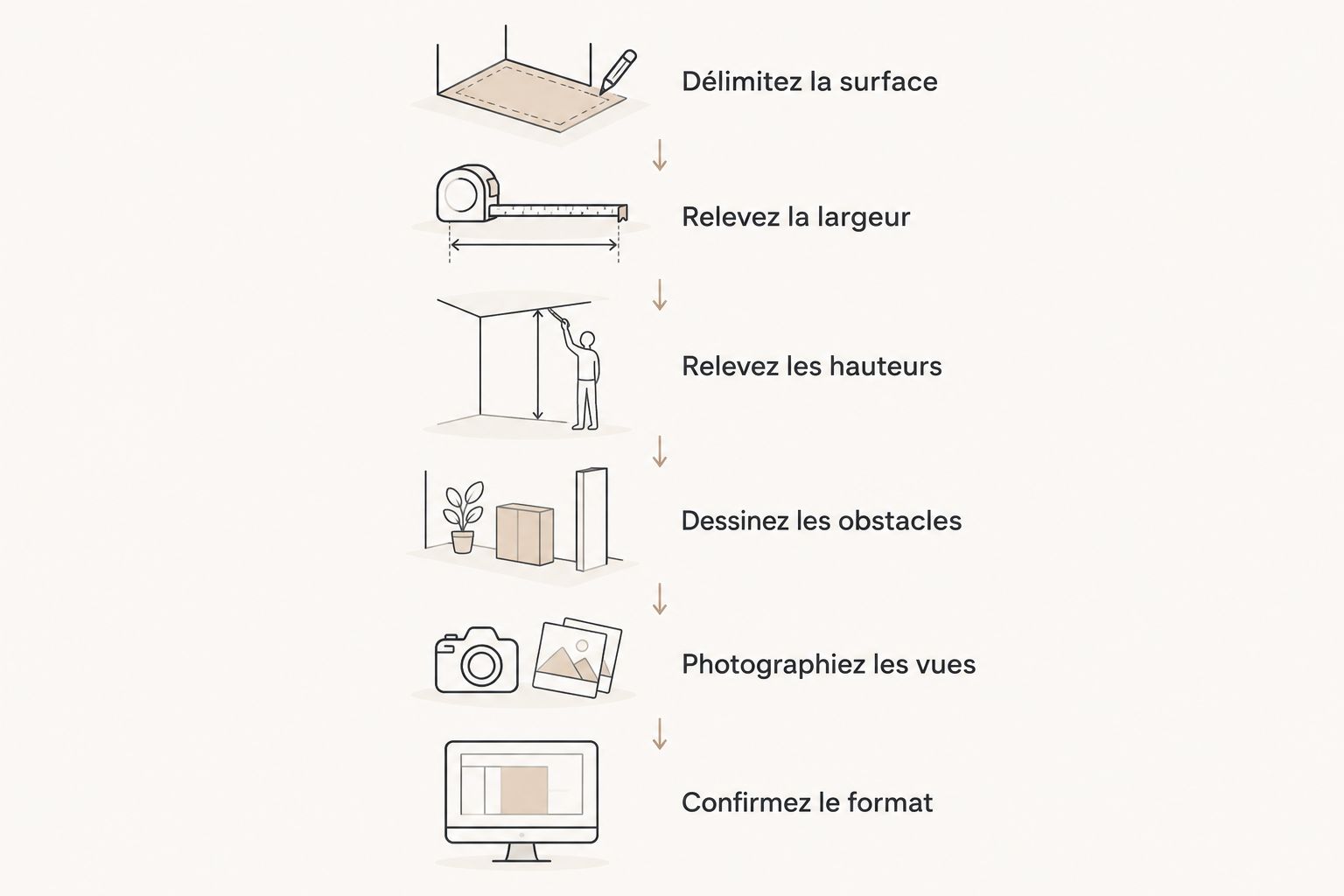
Measure the wall as a vertical elevation, not as a strip that follows the slope. Make a clear sketch: it must allow you to understand the shape of the substrate without having to interpret a series of isolated numbers.
- Define the surface. Identify the left, right, top, and bottom limits of the coating. Specify if you stop the decor at a molding, the ceiling, or in a corner.
- Record the width. Take measurements at different accessible heights. Write the differences on the sketch rather than assuming the sides are parallel.
- Record the heights. Note the available height at the ends and at the level changes. Use a common horizontal reference to locate the measurements.
- Draw the obstacles. Place doors, windows, outlets, switches, light fixtures, and handrail supports. Indicate their dimensions and position.
- Photograph useful views. Add a photo from the bottom and one from the landing. The sketch explains the dimensions; the photos explain the visibility.
- Confirm the format. Send the measurements to the supplier or installer. Ask what cutting margin to allow for the selected material and configuration.
Do not stand on an improvised support to complete a measurement. Inaccessible parts must be measured with an appropriate method and equipment.
Should you order a rectangle or a shape following the steps?
Do not deduce the order shape from the slope of the stairs. The shape of the finished wall and the format to order are two different things; have the manufacturing format confirmed before purchase.
A rectangular set may require significant cuts at the bottom. Conversely, an order calculated too tightly leaves little room when the ceiling or corners have deviations.
In your 2026 order file, keep the sketch, the transmitted measurements, and the approved version of the framing. Also check the orientation of the image: the side that seems obvious in a photo is not necessarily so on an unannotated drawing.
If several walls meet, identify each separately. Ask where the composition breaks or continues, instead of assuming that the panoramic wallpaper will automatically go around the corners.
Peel-and-stick or traditional wallpaper: which one to choose?
Choose the installation method according to the substrate, the coating instructions, and the access conditions. Peel-and-stick eliminates the glue application step, but not the difficulties of handling at height.
| Option | Best suited for | Practical advantage | Limitation to anticipate |
|---|---|---|---|
| Peel-and-stick wallpaper | A substrate compatible with the intended adhesive | No glue to apply separately | Management of the protective film and adhesive contact |
| Traditional wallpaper | A project compatible with the prescribed gluing system | Installation according to a defined gluing method | Preparation and handling related to glue |
Do not choose a material solely because it seems easier to remove. Compatibility with paint and removal instructions must also be checked, especially in a rented home.
Décor Imprimé is suitable for individuals looking for a custom-made wallpaper mural for their stairwell. Custom-made meets the format of the project; it does not replace the substrate preparation or the equipment necessary for installation.
How to frame the panoramic wallpaper in the stairwell?
Start by identifying the elements you want to see entirely. Keep important subjects away from areas that will be cut, hidden by the railing, or interrupted by a door.
From the bottom of the stairs
Look at what remains visible above the handrail. If the main part of the decor is too low, you will not enjoy it from the entrance of the stairs.
From the landing
Check where your gaze lands as you go up. A face, an animal, or an architectural element placed near a cut deserves special attention when framing.
In the corners
An image that crosses a corner changes planes. Ask for a representation of the framing on each wall to check the subjects and the seams, especially if the composition contains architectural lines.
To choose your decor in 2026, start from the actual layout of the space rather than an inspirational photo. The right framing keeps important elements in the truly visible areas.
What wall condition is required before installation?
Wallpaper does not constitute a repair of the substrate. Examine cracks, holes, old repairs, and areas where the paint is peeling before ordering the coating.
The wall must meet the requirements of the chosen material. A clean, dry, stable, and sufficiently smooth surface is the starting point; the manufacturer specifies the compatible paints and the required preparation.
- Recent paint: respect its curing time and the coating requirements, not just its dry-to-touch state.
- Powdery surface: fix the cohesion problem before applying an adhesive.
- Visible texture: check if smoothing is necessary rather than relying on the wallpaper to hide it.
- Moisture: correct its cause before covering the surface.
- Old coating: have the preparation confirmed before installing over it.
Do not assume that a successful test on one wall applies to the entire stairwell. Paint touch-ups and repairs can create different areas on the same surface.
Does a sample help choose the decor?
Yes, a sample allows you to look at the color and texture in the lighting of your stairwell. However, it does not replace a view of the entire panoramic wallpaper: you validate the material up close, not the composition at the scale of the wall.
At Décor Imprimé, the White Flowers and Co. wallpaper sample measures 8 × 11 in, or 8 in by 11 in. Its description precisely provides to check the pattern, color, and texture at home.
Observe the sample near the woodwork and the paint you are keeping. Look at it in the daylight, then under the lighting used in the evening; make your decision in the room, not just in front of a screen.
How to organize the installation without following the slope of the steps?
The panels must follow the vertical guides intended for installation, not the incline of the stairs. Drawing a line parallel to the steps as a starting guide would tilt the composition.
Prepare access
Have the equipment determined suitable for the height, width, and shape of the stairs. Do not use boards placed on steps, stacked furniture, or a ladder braced with objects.
If you cannot work without stretching sideways or losing your support, leave this part to a professional. Also keep the passages clear and organize access to the rooms during the work.
Check the floor panels
Before installation, check the order, orientation, and correspondence of the panels with the approved framing. Examine the print before any cut and follow the manufacturer's instructions for the seams.
Install according to the selected system
Prepare the starting guide at the level or with a laser. Then apply the coating according to its instructions, without pulling on the material to force a seam.
Perform the final cuts only after checking the position of the decor. Around a handrail or a light fixture, do not remove any safety element and do not work on an electrical installation without appropriate expertise.
Why does the difficulty vary from one stairwell to another?
The total surface area is not enough to describe the job. To prepare your installation in 2026, especially examine the following constraints:
- Accessible height: it determines the access needs for measuring, installing, and cutting.
- Stairwell shape: a straight flight and a turning stairwell do not offer the same supports.
- Substrate condition: repairs and smoothing precede decoration.
- Obstacles: doors, windows, and railing supports multiply the areas to be treated.
- Composition: subjects close to the cuts require careful framing.
- Installation method: adhesive or gluing imposes its own handling method.
Send this information with the photos when you ask for a work estimate. You will get an answer related to the actual job rather than just its surface area.
Can you install a mural in a stairwell yourself?
Yes, if you master the installation method and have suitable access to all areas to be covered. Experience on a bedroom wall does not solve the question of access above the steps.
If the safety of access remains uncertain, have a professional intervene before starting. Do not count on solving this difficulty once the first panel is installed.
Should you remove the handrail to install the wallpaper?
No, do not consider its removal as an automatic step. Have the passage of the coating around the supports and the finishing method examined.
The handrail serves a safety function. Any removal and replacement must preserve this function; the framing of the pattern must adapt to the job, not the other way around.
FAQ
Is panoramic wallpaper suitable for a narrow stairwell?
Yes, if the wall is compatible and if the installation remains accessible with suitable equipment. Check the framing from the bottom and the landing, because the available distance to look at the decor is limited.
How to measure a wall that follows the ascent of the steps?
Draw the wall in elevation and record the widths, heights, and obstacles from a common reference. Have the order format and cutting margins confirmed before purchase.
Should I tilt the panels to follow the stairs?
No, align the panels with the vertical guides intended for installation. The slope of the steps influences the bottom cut, not the verticality of the decor.
Is peel-and-stick wallpaper necessarily easier in a stairwell?
No, peel-and-stick wallpaper avoids the separate application of glue, but always requires a compatible substrate and suitable access. The handling of the panels at height still needs to be organized.
Can I use an ordinary ladder in my stairwell?
Do not assume that an ordinary ladder is suitable for your stairwell. Have suitable equipment chosen for the configuration and do not improvise bracing on the steps.
Does a sample show the entire mural?
No, a sample is used to examine a portion of the pattern, color, and texture. Use a full-image layout to check the placement of the subjects on the wall.
What to check before ordering a stair mural in 2026?
Check the dimensions, layout, substrate compatibility, and access method. Also confirm the panel order and the installation instructions applicable to the chosen material.
One last tip before ordering
Photograph the wall from the place where you view it most often, not just directly from the front. On this photo, trace the boundaries of the mural and the position of the elements you want to keep visible.
For your 2026 project with Décor Imprimé, attach this view to the dimensioned sketch. A photo explains what you want to see; measurements explain what needs to be covered. The two documents complement each other, but neither replaces the other.