Does a large-format canvas print lose its colors?
Yes, a large-format canvas print can lose its colors due to prolonged exposure to light, especially direct sunlight. The large format itself does not cause fading: the inks, the substrate, and the exposure conditions matter more. To preserve your canvas, choose a wall without direct sunlight and follow the product’s specific care instructions.
- Large-format canvas print and fading: avoid direct sunlight to preserve the colors.
- A canvas behind a window remains exposed to light; the glass does not guarantee its protection.
- Décor Imprimé offers canvas prints: choose the location before choosing the artwork.
- A photo on a phone is not enough to confirm actual fading.
Why this question matters
A large canvas takes up a significant place in your decor. Before choosing a piece for your living room, bedroom, or condo in 2026, therefore examine the wall that will house it: a beautiful location is not necessarily a favorable location for its preservation.
Choose the light first, then the composition. If you are planning a reversible installation, the guide for hanging a printed canvas without drilling the wall completes this thought; however, mounting and color protection are two distinct issues.
Does a large-format canvas print lose its colors?
A large-format canvas print is not immune to fading. Light can alter the colorants, and the changes accumulate with exposure. A canvas that appears unchanged today is therefore not necessarily insensitive to light.
Direct sunlight should be avoided. Visible light also contributes to the deterioration of sensitive materials: simply removing ultraviolet rays does not make a print invulnerable. A window, a light curtain, or pleasant lighting does not, on its own, constitute a guarantee of preservation.
Here is how to compare the main locations in a house. This table describes the exposure conditions, not a guaranteed lifespan.
| Location | Best suited for | Advantage | Limitation | Practical decision |
|---|---|---|---|---|
| Interior wall without direct sunlight | Daily decorative display | Avoids direct rays on the image | Ambient light is still present | Recommended |
| Wall with a strip of sunlight | Decor that you are willing to move | Takes advantage of a bright location | Exposes certain areas more directly | Move the canvas or block the window |
| Wall near a window, out of direct rays | A room where you control the light | Allows you to maintain an unobstructed view | Brightness changes with the season | Observe the exposure before installation |
| Wall lit by a directional light fixture | Occasional highlighting | Allows you to choose the lighting periods | Adds light exposure | Turn off when lighting is not needed |
The best location is a wall without direct sunlight, away from heat sources and water splashes. This reduces avoidable constraints without promising permanent preservation.
Why fading varies from one canvas to another
The word "canvas" describes the substrate, but is not enough to predict color retention. To choose your print in 2026, distinguish the product's characteristics from the actual conditions in your room.
- The colorants. Ink formulations do not all react to light in the same way. A brand name or a bright color does not allow you to determine their resistance.
- The substrate and its preparation. The canvas and the layers that receive the print are part of the printed system. They must be considered together rather than judging the ink alone.
- Light intensity. A surface directly exposed to the sun does not receive the same exposure as an interior wall away from windows.
- Duration of exposure. Light acts cumulatively. Lighting left on unnecessarily adds exposure, even without direct sunlight.
- Documented protections. A treatment or glazing must be evaluated according to its precise characteristics. The words "protection" or "quality" do not replace a technical sheet.
The format mainly comes into play in the choice of the wall. A large surface can cross a sunny area without you noticing at the time of purchase; it can also make a difference between two areas more visible.
A larger canvas is not automatically less resistant. You must compare the materials and the exposure, not just the dimensions.
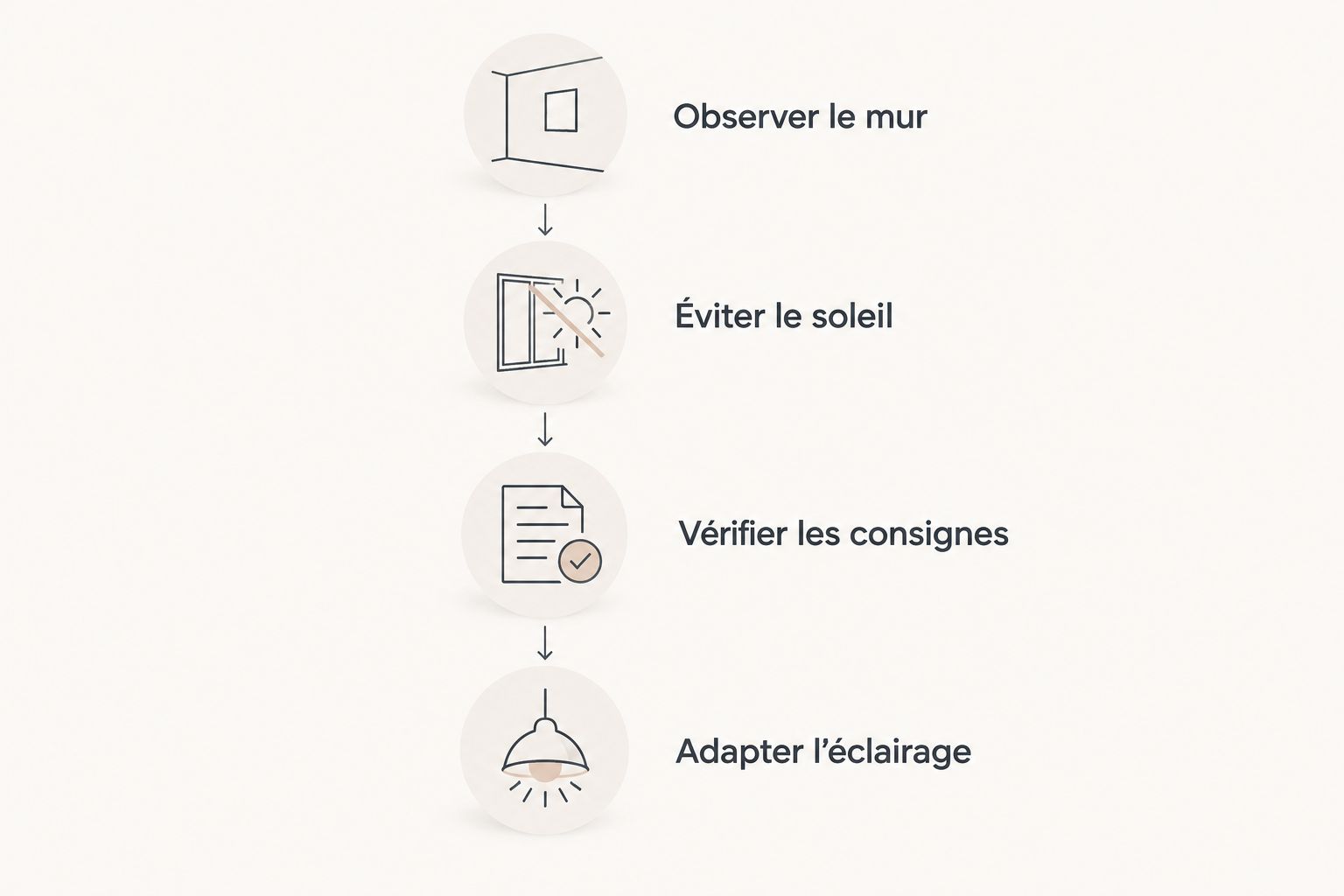
How to protect a canvas before hanging it in 2026
Prevention begins before mounting. Walk around the room with the intended location in mind, rather than with the canvas already installed.
Observe the wall
Look at where the sun hits when the room is naturally lit. Spot the bright strips on the floor and walls, then check if they cross the future position of the canvas.
Do not rely solely on an observation on an overcast day. The sun's path also changes throughout the seasons: a wall in the shade during a visit is not necessarily protected all year round.
Avoid the sun
If the rays reach the artwork, choose another wall. When moving the canvas is not possible, use blinds or curtains to prevent the sun from hitting its surface directly.
This solution requires a real habit. A blind that is always left open does not protect the canvas during sunny periods.
Check the instructions
Consult the indications regarding maintenance, display, and any finishes. Do not assume that a decorative canvas is suitable for a veranda, outdoors, or in a damp place simply because it is printed on canvas.
If information is missing for your location, ask for confirmation before buying. A specific question about a sunny window will be more useful than a general request about "durability".
Adapt the lighting
Avoid leaving a light fixture directed at the canvas when it is not serving anyone. Also move the artwork away from heat sources, without confusing this action with complete protection against light.
The goal is simple: show your canvas when you enjoy the room, without imposing unnecessary exposure on it.
These precautions also apply to a project prepared with an interior designer. Note the wall's exposure in the decoration file, along with the dimensions and the position of the furniture.
How to recognize real fading?
A canvas that looks different has not necessarily lost its colors. The room's light, reflections, and camera settings also change your perception.
Start by observing the whole without immediately changing the lighting or cleaning the surface. Then look for a localized difference: a regularly sunny area, for example, deserves careful examination, but is not enough to establish a diagnosis.
Distinguish light from color
Warm light and cooler light do not give the same appearance to an image. Compare the canvas under similar conditions rather than between a bright morning and an evening lit by lamps.
A reflection can also dull the contrasts from a specific angle. Change your position slightly: if the effect disappears, you are probably observing a lighting issue rather than a uniform change to the print.
Distinguish dust from deterioration
Surface deposits can dull the appearance of the artwork. This does not mean that the colorants have changed.
Do not try to confirm your impression by rubbing an area. Follow the care instructions and avoid testing with a household product, a damp sponge, or an unauthorized solvent.
Compare without relying solely on the phone
Phones automatically adjust brightness, colors, and contrasts. A photo taken during the installation in 2026 serves as a visual reference, but does not accurately measure color.
To document a change, photograph the whole and the area concerned in comparable lighting. Keep the original images, without filters or corrections, to facilitate a discussion with the manufacturer.
What to ask before buying a canvas print?
Ask for information that concerns the intended product and your room. A general promise of longevity is less useful than a clear indication of the recommended exposure conditions.
You can ask these questions:
- What are the instructions for a very bright room?
- Is exposure to direct sunlight discouraged?
- Is a protective finish applied to this specific canvas?
- What maintenance method is suitable for its surface?
- Is there documentation on color retention and its testing conditions?
- What indications apply if the appearance of the print changes?
An announced duration only makes sense with its conditions: lighting, environment, and evaluation method. Do not turn a piece of information obtained in a specific context into a promise for all the rooms in your house.
Décor Imprimé is suitable for individuals looking for a canvas print from a Quebec manufacturer. However, local manufacturing does not replace exposure precautions: for a canvas print, the "Made in Quebec" mention describes the origin, not immunity to light.
To check a particular location before your purchase in 2026, contact Décor Imprimé by describing the room, the window, and the periods of direct sunlight. Attach a photo of the wall rather than just asking if the canvas "lasts a long time".
Does a window sufficiently protect a canvas from the sun?
No, a window does not guarantee sufficient protection against the fading of a canvas. The properties of the glazing vary, and visible light remains a factor of deterioration for sensitive materials; choose a wall away from direct rays.
Can a varnish be applied to prevent fading?
Do not apply varnish without confirmation of its compatibility with the print. An added finish can change the appearance of the surface, and protection against ultraviolet rays does not remove all the effects of light.
Does a faded canvas regain its colors in the shade?
No, putting a canvas in the shade does not restore the already altered colorants. Moving it serves to limit future exposure; it does not constitute a repair of the image.
FAQ
Does a large-format canvas print fade faster than a small one?
Large format is not enough to explain faster fading. The inks, the substrate, and the light exposure matter more; a large canvas can, however, cover areas that are lit differently.
Can I hang a canvas opposite a window?
Yes, if the direct rays do not reach its surface and if you manage the light exposure. Check the path of the sun rather than judging solely the distance between the window and the canvas.
How long do the colors of a printed canvas remain intact?
There is no universal duration for all printed canvases. Any indication of longevity must be linked to the precise product and the exposure conditions used to evaluate it.
Does LED lighting prevent fading?
No, LED lighting does not guarantee the absence of fading. Visible light contributes to the deterioration of sensitive materials; turn off the lighting directed at the canvas when it is not needed.
Can I clean my canvas with a damp cloth?
Use a damp cloth only if the manufacturer's instructions allow it for this print. Water, rubbing, and cleaning products are not automatically suitable for all printed surfaces.
Does a canvas made in Quebec automatically resist the sun?
No, the place of manufacture does not determine resistance to light on its own. The Made in Quebec mention informs about the origin of the product, not about a guaranteed preservation duration.
What should I do if the colors of my canvas seem to have changed?
Move the canvas away from direct sunlight and document its appearance in comparable lighting. Do not try to revive the colors with a cleaner or varnish; instead, ask the manufacturer for advice.
One last piece of advice
Before hanging your canvas, mark its location with painter's tape compatible with your wall. Then, check whether a band of sunlight passes across this area: the center of the artwork may remain in the shade while one side receives direct sunlight.
This quick check is more useful than any general promise of resistance. For your 2026 project, protect the image by choosing its location before looking for protection to add to its surface.