Can a self-adhesive backrest withstand the heat of a stove?
A peel-and-stick backsplash is only suitable behind a range if its technical data sheet authorizes this use and the installation complies with the clearances required for the appliance. In 2026, the "heat-resistant" label is not enough: it must specify the conditions for using the coating. Without confirmation for the product you have chosen, do not install it in the area exposed to cooking heat.
- Heat resistance of peel-and-stick backsplashes: check the coating's data sheet and the range manual before installation.
- Decorative peel-and-stick wallpaper does not automatically replace a wall protection suitable for cooking.
- Water resistance, washability, and flame retardancy do not prove compatibility behind a range.
- Décor Imprimé is suitable for homeowners looking for custom decorative wall coverings; use near a range requires separate validation.
Can a peel-and-stick backsplash withstand the heat of a range?
Only when the manufacturer specifically authorizes this installation. The word "peel-and-stick" describes a method of attachment, not thermal performance. It can refer to coatings made of different materials, with different limitations.
If you are considering a Décor Imprimé coating, have the intended use confirmed by contacting Décor Imprimé with the product reference, your range model, and photos of the wall. A beautiful texture or tile pattern does not indicate the material's resistance.
| Option considered | Recommended use | Advantage | Limitation to check |
|---|---|---|---|
| Decorative peel-and-stick wallpaper | Decorating a compatible wall, away from unauthorized exposure | Provides a pattern without installing tiles | No suitability behind a range can be inferred from the name alone |
| Peel-and-stick tiles | Creating a backsplash when the data sheet authorizes this location | Installation using adhesive panels | Composition, adhesive, and product-specific restrictions |
| Ceramic tile | Designing a backsplash with a suitable assembly | Mineral surface suitable for many kitchen projects | Support, adhesive, joints, and clearances still need to be checked |
The proper comparison is of the installed system, not just its visible surface. A coating advertised for the kitchen is not necessarily authorized for immediate use behind cooking elements.
Why this check matters
A backsplash receives splashes, but the area behind a range also experiences heat exposure. These requirements are not interchangeable. A material that is easy to wipe clean may be unsuitable for a heated location.
For your 2026 kitchen project, therefore, separate two decisions: the protection of the wall near the appliance and the decoration of the adjacent surfaces. You can coordinate their colors without requiring them to serve the same function.
A decorative coating is not a heat shield by default. Adding a layer to the wall does not reduce the clearances specified in the range manual.
How to check compatibility before ordering
Start by gathering the documents that exactly match the chosen references. A general collection description or the manual for an appliance similar to yours is not enough.
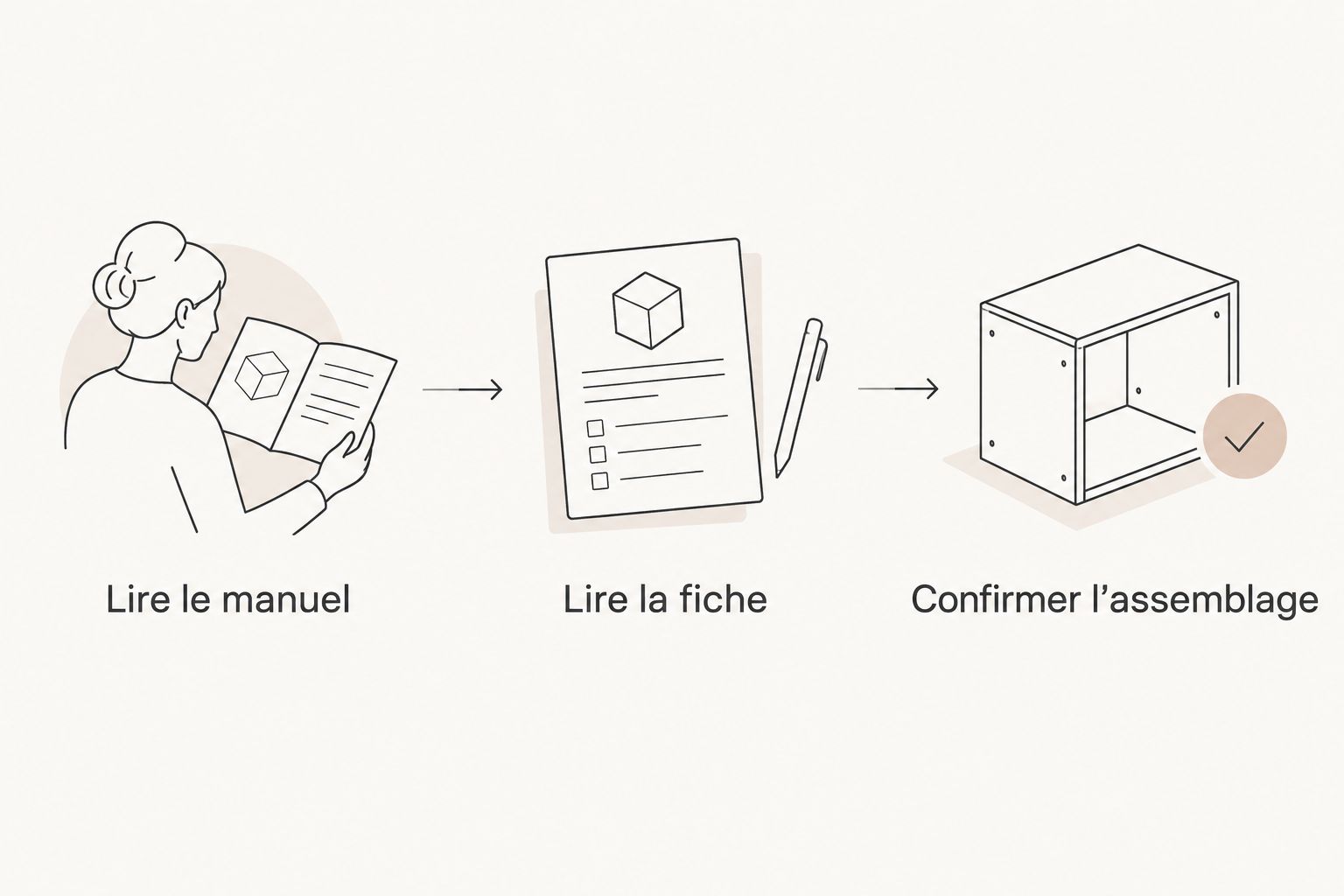
1. Read the range manual
Locate the requirements regarding adjacent walls, combustible materials, and clearances. Also check the instructions regarding the range hood and elements located above the cooking surface.
Do not replace these requirements with a distance found in an inspiration photo. The arrangement of the burners, the design of the appliance, and the installation conditions matter more than the similarity between two kitchens.
2. Read the coating data sheet
Look for explicit authorization for the intended location, provided temperature limits, and exclusions. Check whether the specifications refer to the decorative surface alone or the complete product with its adhesive.
The "for kitchen" label is too general to be conclusive. It may describe use on a wall away from the appliance rather than as a backsplash directly behind the cooking area.
3. Confirm the assembly
Describe the existing support: painted wall, ceramic, or another surface. Add the dimensions of the area and the position of the range. Ask for a written response regarding the product's compatibility with this configuration.
For a project prepared in 2026, keep the consulted data sheet and the response you receive with your renovation documents. This will provide you with the conditions associated with your choice, rather than a recollection of a sales description.
Do not begin preparing the wall until these checks are complete. Excellent adhesion does not correct a thermal incompatibility.
Why heat resistance varies
The performance of a peel-and-stick backsplash depends on several factors that must be considered together. The printed pattern is not one of them.
- The composition of the coating. Paper, polymers, and mineral materials react differently to heat.
- The adhesive. The visible surface and the layer that attaches it to the wall may have different limitations.
- The heat source. A flame, a hot container, and heated air expose the wall in different ways.
- The appliance configuration. The position of the burners and the prescribed clearances govern the installation.
- The support and its preparation. Fragile paint, greasy residue, or an incompatible surface compromise adhesion.
- Maintenance conditions. Cleaning products must comply with the coating manufacturer's instructions.
Choose based on documented conditions, not on a general promise of resistance. The same product may be suitable for one section of a wall and excluded from another.
Does an induction range allow all peel-and-stick products?
No. Induction heats the container, but it remains a heat source for its surroundings. The absence of a flame does not authorize installing any coating behind the appliance.
Consult the manual for the induction model as you would for an electric or gas appliance. Also keep decorative coatings away from contact with hot containers, according to the product's restrictions.
The same reasoning applies to an electric range with radiant elements. The type of energy never replaces the verification of materials and clearances.
Can you rely on a home heat test?
No. Heating a sample in a dryer, placing it near a pot, or touching the wall after cooking does not validate an installation. These actions do not reproduce all exposure conditions or measure the assembly's compliance.
A sample remains useful for judging color, texture, or adhesion compatibility when the manufacturer provides such a test. Use it for this purpose only. Do not deliberately subject it to a flame or heat source to determine a limit.
For a 2026 renovation, the practical rule remains simple: a decorative test helps choose the look; the documentation determines the authorized use. A surface that appears intact after cooking does not prove its long-term durability.
What to choose if the peel-and-stick product is not authorized behind the appliance?
Reserve the cooking area for an assembly whose compatibility is documented. Ceramic tile is an option to consider, without forgetting the support and installation products. Its presence does not exempt you from following the range's instructions.
Choosing a zellige tile backsplash behind the range also requires planning the transitions, cuts, and assembly around the appliance. The handcrafted look serves a decorative purpose; the installation must separately meet the requirements of the location.
You can then use a color from the backsplash on a less exposed wall. A mural, paint, or another compatible finish allows you to create a cohesive look without extending the same material everywhere.
Do not try to make a product compatible by adding improvised protection. A glass panel, sheet metal, or other screen changes the assembly and requires its own validation. This is not a universal shortcut.
Can you install a peel-and-stick product over existing ceramic tile?
The presence of ceramic tile does not automatically make the peel-and-stick product heat-resistant. The new surface and its adhesive remain exposed, even if the underlying coating is mineral.
Therefore, first check authorization near the appliance, then compatibility with the tiles. Recessed joints, textures, and grease residue also raise questions about preparation and finishing.
The method for installing a peel-and-stick backsplash over a ceramic backsplash addresses a specific support, not an exemption from thermal requirements. Keep these two checks separate.
Where to incorporate a mural in a kitchen?
Start with walls that do not experience the exposure of the cooking area: the dining area or an accent wall away from the appliance, for example. Nevertheless, check the humidity conditions, splashes, and maintenance instructions applicable to the product.
Décor Imprimé is suitable for homeowners looking for custom decorative wall coverings. Its peel-and-stick and traditional murals serve a decoration project; their presence in the catalog does not constitute a general authorization for use as a heated backsplash.
For your 2026 layout, first choose the limits of the technical area, then the pattern for the decorative surfaces. This approach also works in a condo or apartment: you avoid confusing ease of installation, ease of removal, and suitability near an appliance.
If you are a tenant, check the necessary authorizations before changing the wall finish. A peel-and-stick product does not guarantee on its own damage-free removal from all paints and supports.
FAQ
Can a peel-and-stick backsplash go behind a gas range?
Only if the coating manufacturer authorizes this use and the installation complies with the range manual. Proximity to a flame requires checking the restrictions applicable to the materials and the clearances.
How much distance should be left between the range and the peel-and-stick backsplash?
The distance to maintain is the one that satisfies the requirements of the appliance and the coating in your configuration. Do not apply a universal distance found for another product or model.
Is a washable backsplash also heat-resistant?
No, washability does not prove heat resistance. Check separately the authorized maintenance and the conditions for use near cooking.
Is flame-retardant wallpaper suitable behind a range?
The flame-retardant label is not enough to authorize this location. Fire performance, heat resistance, and adhesive compatibility are distinct issues.
Does a range hood sufficiently protect the peel-and-stick backsplash?
A range hood does not replace the coating manufacturer's authorization or the range clearances. Also follow the range hood's installation instructions.
What should I do if my peel-and-stick backsplash peels away near the range?
Do not simply reattach the peeled section without checking the cause and the compatibility of the installation. Let the area cool and have the situation assessed before resuming use that exposes it to heat.
Can you put a glass panel in front of peel-and-stick wallpaper?
A glass panel does not automatically make wallpaper compatible behind a range. The complete assembly, its attachment, and the thermal conditions must be validated for this use.
One final piece of advice
Before ordering, draw the boundary between the cooking area and the decorative area directly on a photo of your kitchen. Attach this image to your validation request: it describes the location better than a simple question about heat resistance.
The right approach is not to look for the peel-and-stick product presented as the most resistant. It is to choose a coating explicitly authorized where you want to install it.