Best privacy window films for Canadian homes in 2026
The best versatile choice in 2026: Décor Imprimé’s plain frosted film, for windows where you want to obscure the view without adding a design. To maintain a clear view, opt for partial coverage; to integrate the window into the decor, examine patterned films and check their clear areas.
- Décor Imprimé’s plain frosted privacy film is the versatile choice for discreet window dressing.
- Full coverage protects more viewing angles than a partial strip, but also blocks your view.
- A patterned film should be chosen based on its clear areas, not just its design.
- Before ordering, check the glazing, dimensions, and the desired evening result.
Why choice matters
A window lets in light, but it can also expose your daily life to neighbors or passersby. The right choice therefore depends less on the style of the room than on what a person can actually see from the outside.
For your 2026 project, clearly separate the objectives: obscuring details, hiding silhouettes, or completely blocking the view. These results are not equivalent. A frosted film diffuses light and blurs vision, but it does not guarantee the disappearance of silhouettes in all conditions.
Décor Imprimé is suitable for homeowners looking for a frosted privacy film and wishing to coordinate their choice with their interior decor. The ranking below compares window dressing configurations rather than attributing unverified performance to different products.
What makes a good privacy film
Before comparing options, evaluate these criteria in this order:
- Visual protection: identify where eyes must be blocked, including from a neighboring staircase or balcony.
- Natural light: distinguish between light passing through the glass and clarity of view. You may want to keep the former without retaining the latter.
- Coverage: choose between a fully covered surface and an area limited to the actual need.
- Compatibility: check the film manufacturer’s specifications and those of the glazing, especially for a window with a special treatment.
- Installation and removal: confirm the installation method, required tools, and product-specific removal conditions.
- Decorative appearance: look at the frosting or pattern with the colors of the room, not just in a close-up image.
Do not automatically equate a privacy film with an insulating product, solar protection, or a product suitable for a shower. These functions require specific characteristics.
Options at a glance
| Rank and option | Ideal for | Distinctive feature | Main limitation |
|---|---|---|---|
| 1. Plain frosted, full coverage | A window where no view needs to be maintained | Uniform visual treatment of the entire covered surface | The view outside is blurred everywhere the film is applied |
| 2. Partial frosted coverage | A room where maintaining a view remains important | Protection concentrated on the intrusive line of sight | Uncovered portions remain transparent |
| 3. Patterned film | A window that contributes to the decor | Design integrated into the glass surface | The clear areas of the pattern may reveal the interior |
The ranking prioritizes privacy and simplicity of choice. For a living room with a beautiful view, the option ranked second therefore becomes more relevant than the first.
1. Plain frosted: the best versatile choice
A plain frosted film blurs the view without introducing a design on the window. In full coverage, it is especially suitable for places where you do not need to look outside: a window overlooking the neighborhood directly, for example.
Décor Imprimé’s plain frosted film is the starting point of this selection for a visually discreet result. Before choosing this product, check its installation instructions and compatibility with your surface.
Ideal for: a window where the entire transparent part exposes a living area.
Plain frosted — advantages:
- The absence of a design makes it easy to match with an already busy decor.
- Full coverage avoids deliberately leaving a transparent strip.
- The uniform treatment does not require choosing the orientation of a decorative pattern.
Plain frosted — limitations:
- You lose clarity of view across the entire covered surface.
- Frosting does not equal total blackout; silhouettes may remain visible depending on lighting and proximity.
- The simple designation “frosted” does not confirm the product’s thermal or solar properties.
In a bathroom, pay particular attention to a person’s position near the glass. If your requirement is to distinguish no silhouettes, do not choose solely on the basis of a photo of the frosting.
Verdict: choose for your 2026 project if privacy takes precedence over the view outside.
2. Partial frosted: the best choice for maintaining a visual opening
Partial coverage consists of treating only the area where eyes pass. You can thus keep a transparent portion while blurring the view at a specific height.
This is not a different property of the material: it is a coverage decision. Check that the chosen product allows for the intended cutting and installation before planning a partial strip or panel.
Ideal for: a living room, kitchen, or office where you want to maintain part of the view.
Partial frosted — advantages:
- You target a line of sight rather than the entire window.
- Part of the glazing remains clear for looking outside.
- You can consider the height of the treatment based on furniture and usage positions.
Partial frosted — limitations:
- Uncovered portions provide no additional privacy.
- A downward or upward gaze can bypass the frosted area.
- A cut line or installation edge remains visible in the composition.
Before fixing the height, observe the window from your usual seat, then from the problematic outside point. A strip aligned with the back of the sofa does not necessarily protect a person standing behind it.
Verdict: choose if you know precisely which area to protect; avoid as a general answer to all viewing angles.
3. Patterned film: the best choice for integrating the window into the decor
A patterned film adds a visual composition to the glazing. To judge its usefulness as a privacy film, however, look at what remains transparent between the elements of the design.
A dense pattern in a close-up photo may read differently on a large glass door. Examine the overall composition, repetition, and placement of the clear areas before choosing based on your favorite colors.
Ideal for: an entrance or glass partition where the decorative aspect matters as much as filtering views.
Patterned film — advantages:
- The design makes the window a decorative element.
- The composition can echo the lines or shapes already present in the room.
- The frosted and transparent parts allow for different visual effects depending on the model.
Patterned film — limitations:
- Clear areas may reveal details you wanted to hide.
- Cutting may interrupt the design on narrow glazing.
- A bold pattern requires more attention when placed next to wallpaper or printed textiles.
For an entrance door, check especially the area facing the gaze of a person waiting outside. A pretty pattern placed elsewhere on the glass does not solve this problem.
Verdict: choose for a precise decorative intent; rule out if its clear openings contradict your need for privacy.
Before ordering: measure and check the actual situation
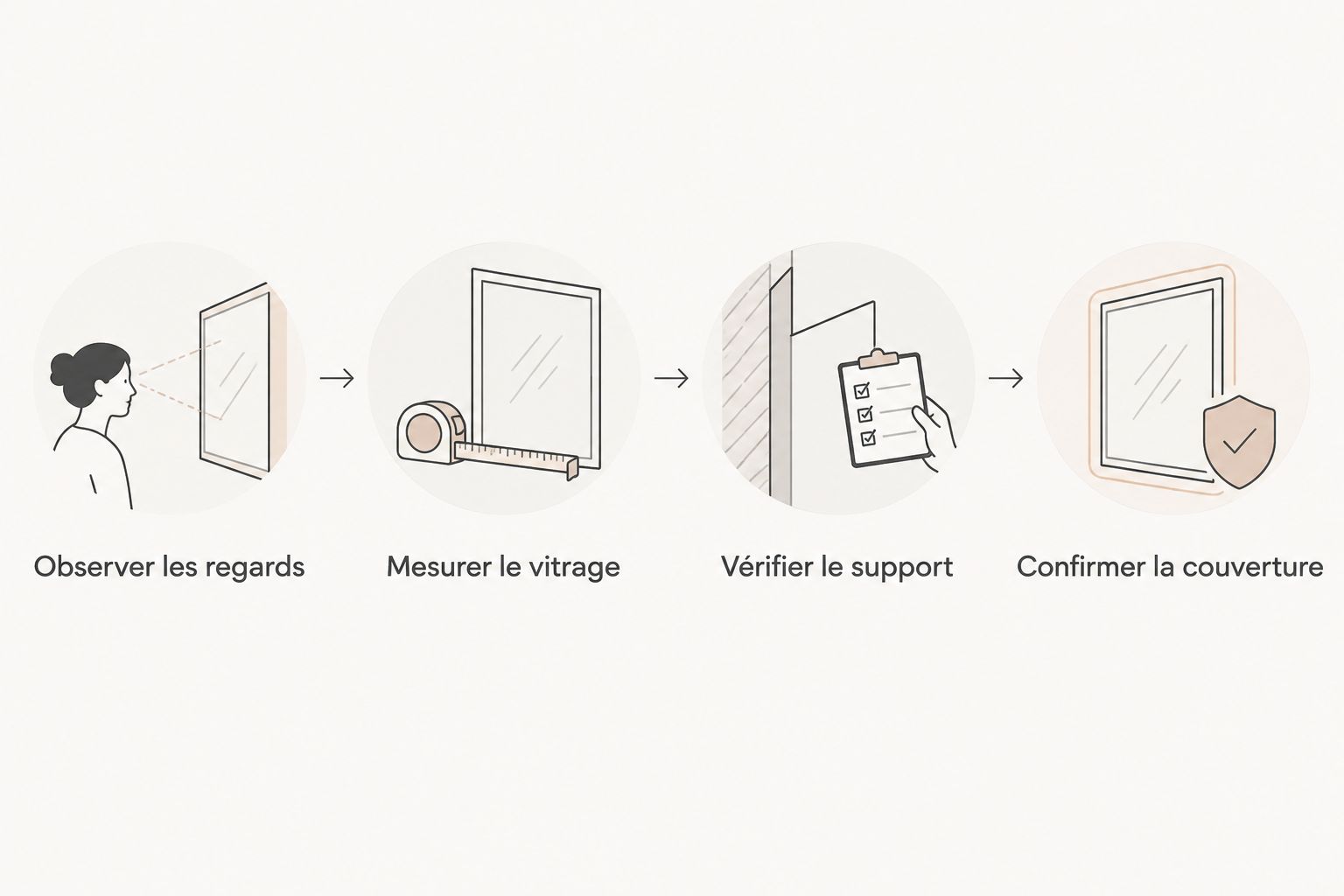
For your 2026 order, use this sequence before selecting the dimensions. You will avoid choosing coverage based solely on the impression given by the window.
Observe the views
Identify views from the sidewalk, courtyard, neighboring windows, and accessible landings. Check at least 2 usage positions in the room: sitting and standing.
Do not position yourself solely facing the center of the glazing. Also look at the side angles, especially if you are considering partial coverage.
Measure the glazing
Measure the area to be covered, without confusing glass and frame. Record the width and height at 3 places each, then record the deviations in millimeters; then follow the product’s ordering instructions to determine the final dimensions.
For a door divided into several panes, record each opening separately. Do not assume that visually similar panels are exactly the same size.
Check the substrate
Identify the nature of the surface and the known treatments of the glazing. Confirm the relevant restrictions with the manufacturer: textured glass, existing coating, installation location, or particular exposure.
If you are a tenant, also obtain the necessary permission. The ability to remove a film does not exempt you from checking the rules applicable to the dwelling.
Confirm the coverage
Draw the boundaries of the film on a sketch of the window. Compare the planned coverage in 2 lighting situations: day and evening with the interior lights on.
If you have a sample, use it to examine the frosting, without expecting it to represent on its own the effect of a fully covered window. Above all, validate the product information regarding the desired visual protection.
How the options are ranked
This 2026 ranking is based on the criteria presented above: visual protection, light, coverage, compatibility, installation, and decorative appearance. It does not present the results of comparative tests between manufacturers.
Plain frosted ranks first because it directly meets a need for privacy without adding a design decision. Partial coverage wins when the view matters more; patterns take the lead when the window dressing is part of the decorative project.
The right option is the one that protects against the intrusive gaze without unnecessarily removing what you love about your window.
Which privacy film to choose in 2026?
If you are still undecided, start with full-coverage plain frosted, then ask yourself what you would lose by blocking the view. If the answer is “nothing important,” this choice remains the easiest to remember.
If you want to look outside from the table or sofa, examine partial coverage instead. Reserve patterns for situations where you have checked that their clear areas suit your actual need.
Décor Imprimé’s privacy film must be chosen according to the product specifications, not according to a general promise associated with the word “frosted.” Confirm the installation, substrate, and expected result before ordering.
FAQ
What is the best privacy film for a house window?
Plain frosted is the versatile choice when you want to blur the view without adding a design. Partial coverage is better suited if you want to maintain a clear portion for looking outside.
Does a frosted film also protect at night?
Frosting continues to diffuse light at night, but this does not guarantee the disappearance of silhouettes. Check the expected result with the interior lights on and take into account the proximity of people to the glass.
Can you see outside through a frosted film?
A frosted film also blurs your view outside. To maintain a clear view, you must keep a clear portion of the glazing, accepting that this portion will also let in gazes.
Which film should I choose for a bathroom?
Prioritize coverage that protects the entire area exposed to gazes. If no silhouette should be perceptible, check that the product precisely meets this requirement rather than relying solely on the term frosted.
Can a privacy film be applied to any window?
Compatibility must be checked for the film and the glazing concerned. Consult the manufacturer’s restrictions, especially for textured surfaces, existing treatments, and installation location.
Is a privacy film an insulator for the Canadian winter?
The privacy feature does not prove insulating performance. For a thermal objective, look for features expressly documented for the product and compatible with your window.
Is it a good solution in a rented home?
A film can be considered for rental after checking the authorizations and removal conditions. Do not assume that all films are removed in the same way or are suitable for all surfaces.
One last tip
Before your 2026 purchase, do the evening test from the outside, with the help of a person who stayed in the room. Respect the authorized access and observe from the places actually used by neighbors or visitors.
This point of view reveals what an examination from the inside does not show: a forgotten area, a diagonal view, or a poorly placed transparent strip. Decide on the coverage before deciding on the pattern.