Best static cling window film for renters in Canada (2026 guide)
The best choice for a rental property in 2026: a solid frosted electrostatic film without adhesive, whose compatibility with your glazing is confirmed. Choose a lower-half application to preserve the view of the sky, or a decorative frosted film if the pattern matters more than the view outside.
- For a rental, choose a frosted electrostatic film whose manufacturer confirms compatibility with your glazing.
- Full coverage is suitable when privacy takes precedence over the view outside.
- Partial coverage preserves the view but leaves part of the glazing exposed.
- Décor Imprimé offers a plain frosted film; check its mounting method before choosing it.
Why this choice matters in a rental
An electrostatic film is applied without glue to a compatible surface. A self-adhesive film uses an adhesive: the two categories are therefore not interchangeable, even when they have the same frosted appearance.
For your 2026 purchase, start with the mounting method, then examine privacy and removal. The word "frosted" describes an appearance; it confirms neither an electrostatic application nor compatibility with all windows.
Lighting also matters. Before covering a bedroom or bathroom window, consult the guide on frosted film at night with the lights on. Assess visible silhouettes and details, not just the appearance of the glass in broad daylight.
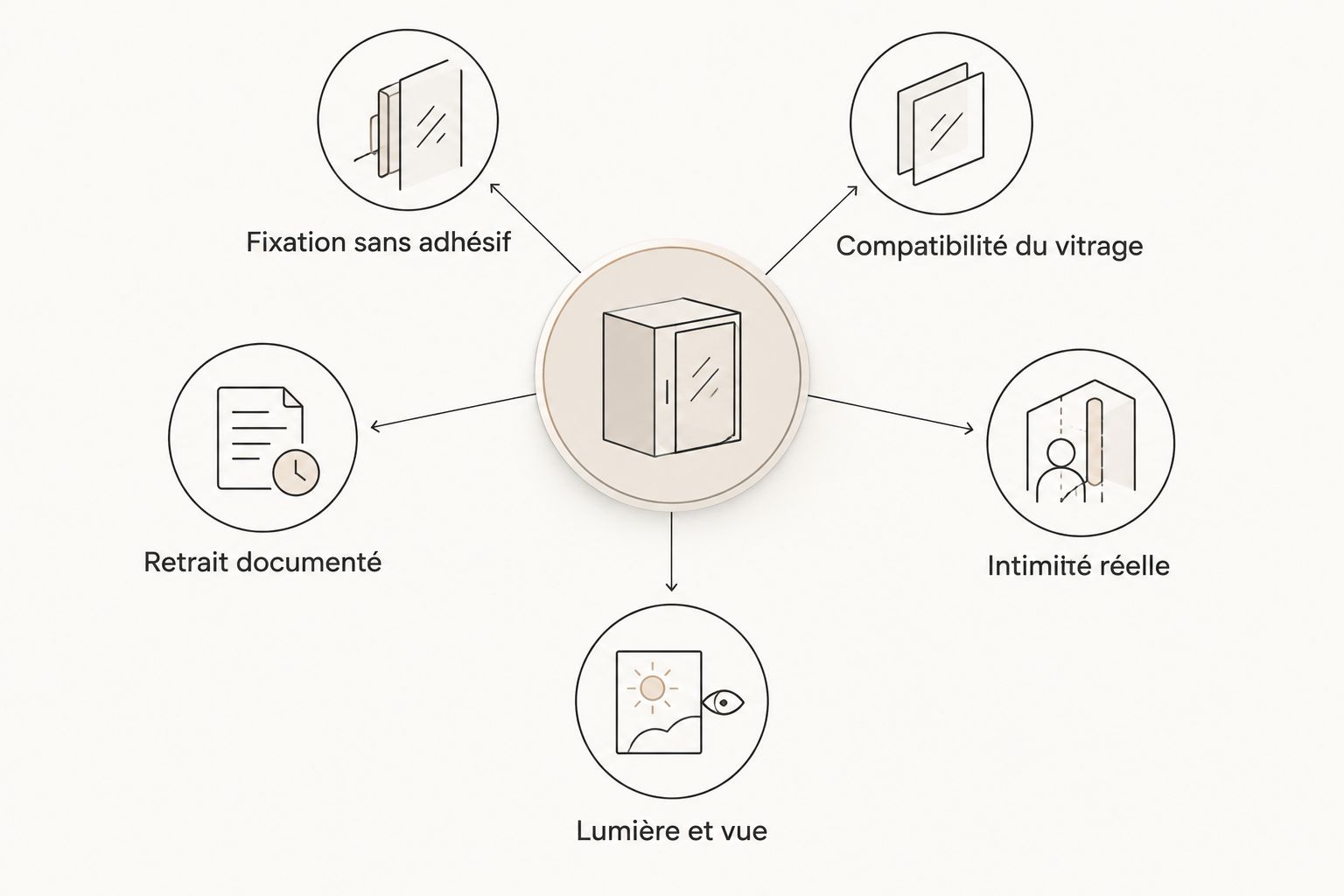
The criteria for a good electrostatic film
Here are the criteria to check before comparing options. They mainly help you avoid choosing a beautiful finish that does not meet the needs of your home.
- Adhesive-free mounting. The product sheet must specify the mounting method. Do not assume "electrostatic" from the word "removable" alone.
- Glazing compatibility. Check restrictions regarding textured glass, coatings, and insulated glazing.
- Actual privacy. Look for indications on visibility, then assess the result under the room's conditions of use.
- Light and view. Distinguish the light passing through the film from a clear view through the window.
- Documented removal. Consult the removal, cleaning, and, if you are interested, reuse instructions.
Options at a glance
This 2026 comparison ranks configurations by their use, rather than attributing unverified performance to brands. The last option is a frosted solution to examine separately: its mounting method must be confirmed.
| Option | Best use | Main advantage | Main limitation |
|---|---|---|---|
| Solid frosted electrostatic film, full coverage | Privacy across the entire glazed surface | Avoids areas deliberately left uncovered | Eliminates a clear view through the covered area |
| Frosted electrostatic film, partial coverage | Window overlooking a sidewalk | Keeps part of the glazing clear | Does not block views passing above the film |
| Frosted electrostatic pattern film | Window where the decor also matters | Introduces a pattern without changing the frame | Transparent parts leave visual openings |
| Plain frosted film from Décor Imprimé | Comparison with a plain frosted option | Clearly identified plain option | Electrostatic mounting not confirmed in this guide |
1. Solid full frosted: to prioritize privacy
A solid frosted electrostatic film covers the surface you want to keep out of sight. It is suitable when you prefer to diffuse the view rather than maintain a clear panorama of the outside.
Best use: a window where visual protection takes precedence over the view. Think of a room directly exposed to neighboring windows, without assuming that a frosted finish makes all silhouettes invisible.
Advantages of solid full frosted:
- The visual treatment remains uniform across the covered surface.
- No space is deliberately left transparent in the chosen area.
- The solid finish avoids decorative seams between patterns.
Limitations of solid full frosted:
- You lose the clear view through the treated surface.
- Privacy depends on the product, lighting, and the proximity of people.
- Full coverage requires careful measuring around obstacles.
Before ordering, stand where you actually use the room. A window looks different when viewed standing up near the frame or sitting at a distance.
Verdict: choose solid full frosted if your priority is to cover the entire exposed area, after verifying the stated privacy.
2. Partial frosted: to keep the view upward
Partial application consists of covering only a portion of the glazing, often its lower part. It is a decision of cutting and placement, not necessarily a different type of film.
Best use: a window overlooking a walkway, when views come mostly from an identifiable height. This configuration leaves the upper part clear for looking outside.
Advantages of partial frosted:
- You maintain a clear view in the uncovered area.
- You adapt the height of coverage to your situation.
- You avoid frosting a portion of glass that poses no problem.
Limitations of partial frosted:
- A neighbor located higher up retains a possible viewing angle.
- The cut line remains visible.
- A height chosen solely based on your standing position protects poorly for certain seated uses.
To determine the upper limit, observe the window from your armchair, desk, or toilet area. Then have the angle checked from the outside, when this access is possible and safe.
Verdict: choose partial coverage only after identifying the lines of sight to block.
3. Electrostatic frosted pattern: to decorate a window
An electrostatic frosted pattern film adds a visual composition to the glazing. Depending on the design, it combines more opaque areas and transparent parts: you must therefore examine the pattern as much as its description.
Best use: a window where you want to add a decorative detail without requiring uniform privacy. The pattern then becomes a design choice, not proof of visual protection.
Advantages of electrostatic frosted pattern:
- The design contributes to the room's decor.
- Transparent parts maintain visual openings.
- The placement of the pattern allows you to work with the shape of the glazing.
Limitations of electrostatic frosted pattern:
- Transparent areas allow views through.
- A narrow cut risks cropping the design.
- Seams require more preparation when necessary.
Above all, ask yourself what the transparent area at eye level shows. A charming design in a close-up photo does not automatically meet the privacy needs of a bathroom.
Verdict: choose a frosted pattern for its decorative effect; rule it out if its visual openings contradict your privacy needs.
4. Plain frosted: the option to check at Décor Imprimé
Décor Imprimé offers a plain frosted film. This option belongs to the comparison of frosted finishes, but it should not be presented as electrostatic without confirmation of its mounting method.
Best use: comparing a plain solution to your project, when you agree to check the technical specifications before purchase. Décor Imprimé is a Quebec manufacturer and an online store of printed decors.
Advantages of this frosted option:
- A plain reference is clearly identified.
- The finish provides a lead for a decor without an apparent design.
- You can formulate your questions around a specific product.
Limitations of this frosted option:
- The product name does not confirm an adhesive-free mounting.
- Removal and glazing compatibility must be checked.
- No quantified privacy performance is retained here.
The plain frosted film from Décor Imprimé is suitable for buyers looking for a plain frosted option, subject to checking its mounting. If the absence of adhesive is your main condition, ask for this confirmation before any order.
Verdict: wait for technical confirmation before selecting this option for a strictly electrostatic project.
How these options are ranked
The ranking prioritizes the match between the need and the covered surface: complete privacy, maintaining a partial view, then decoration. It also distinguishes explicitly electrostatic categories from a frosted reference whose mounting remains to be checked.
For this 2026 guide, no comparative test, removal score, or light transmission percentage is assigned to the options. A feature absent from a sheet does not become a guarantee.
Prepare your window in 3 steps
1. Confirm the surface and permissions
Identify the glazing and consult the restrictions of the window and film manufacturer. Smooth glass, textured glazing, and a surface bearing a treatment should not be considered equivalent.
In a rental, also check the conditions of your lease and the rules applicable to the building. For a 2026 project, keep the product sheet of the selected product and any relevant written authorization.
2. Measure the area actually covered
Take 2 basic measurements: the width and height of the surface to cover. Note the unit used, in centimeters or inches, to avoid mixing dimensions at the time of ordering.
On an irregular window, measure the width at 3 places: top, center, and bottom. Then follow the product instructions for cutting and clearances; do not apply a universal margin found elsewhere.
3. Apply according to the instructions, then check
Clean the glazing with a compatible method and remove residues before application. Prepare the tools and the application solution only according to the manufacturer's indications: the instructions of one film do not replace those of another.
Then check the result in 2 conditions of lighting: by day and in the evening with the interior lights on. Also look at the window from relevant angles, without limiting yourself to a front observation.
Which film to choose in 2026?
By default, choose a solid frosted electrostatic film whose sheet confirms the absence of adhesive and compatibility with your glazing. Cover the entire exposed surface if privacy dominates; limit the coverage if you want to keep a view and if the exterior angles allow it.
For a decorative pattern, first check the transparent openings. For a frosted option whose mounting is not specified, get confirmation before buying: the finish and the mounting method answer two different questions.
FAQ
What is the best electrostatic film for a rented apartment?
A solid frosted electrostatic film is the default choice when privacy takes precedence over the view. Check the adhesive-free mounting, glazing compatibility, and removal instructions before purchase.
Is a frosted film always electrostatic?
No, the word frosted describes the appearance of the film, not its mounting method. A frosted film can belong to an adhesive or non-adhesive category; consult its technical sheet.
Is the frosted film from Décor Imprimé adhesive-free?
The mounting method of the plain frosted film must be confirmed before purchase. Its name is not enough to classify it among electrostatic films.
Can you see silhouettes through a frosted film?
Yes, silhouettes can remain visible depending on the film, lighting, and the proximity of people. Check the manufacturer's indications and assess the result in the room's actual conditions.
Do you need to cover the entire window for privacy?
No, partial coverage is enough when all the lines of sight to block cross the treated area. However, a neighboring window higher up or a side angle requires a separate assessment.
Can you apply an electrostatic film on textured glass?
Only apply a film on textured glass if the manufacturer confirms this use. Stated compatibility for smooth glass does not automatically apply to a textured surface.
Can a static cling window film be reused after moving?
Reusability must be confirmed by the manufacturer of the product you choose. It also depends on the removal and storage instructions, as well as the condition of the film.
One last tip
Before cutting, mark the intended height with a temporary guide compatible with the frame, then live with this visual boundary. Sit down, open the curtains, and look at the view: making a placement decision at this stage prevents discovering after installation that the film cuts off your favorite landscape.