Does a window mirror film work day and night?
No, a one-way window film does not guarantee privacy day and night: its effect depends on the difference in brightness between the inside and the outside. In the evening, when your room is lit and it is dark outside, people outside can see through it. To preserve your privacy after dark, choose a frosted film suited to your needs or add opaque window treatments that you close in the evening.
- A one-way window film does not guarantee permanent privacy day and night: the difference in brightness determines the effect.
- In the evening, a lit room becomes visible from the outside despite a reflective film.
- A frosted film blurs the view, but silhouettes may still be visible near the glass.
- Décor Imprimé offers frosted films to homeowners who want to add privacy to their windows.
Does a one-way window film work day and night?
No: the mirror effect is not a permanent visual barrier. A reflective film reflects some light and lets another part through. On the brighter side, the reflection better conceals what is behind the glass; on the less illuminated side, the view into the bright space remains possible.
During the day, the outside is often brighter than your home. In the evening, your lights change this situation. Also see the guide on frosted film in the evening with the lights on to distinguish between light diffusion and reflection.
| Solution | Best suited for | Main advantage | Limitation to accept |
|---|---|---|---|
| One-way window film | Reducing prying eyes during the day when it is brighter outside | Maintains a view outside under these conditions | Does not guarantee privacy in a lit room at night |
| Frosted film | Blurring the view while letting in light | Does not depend on the same mirror effect | Reduces the view outside; silhouettes may still be visible |
| Closed opaque window treatment | Hiding the interior in the evening | Blocks the direct view through the covered area | Also blocks the view outside and the light |
Why this difference matters in your home
A window rarely faces just one viewing situation. You may be shielded from prying eyes from the street, but visible from a neighbor's balcony, an outside staircase, or an entrance located higher up. Your decision should therefore be based on the view you want to block, not just the appearance of the film.
For your 2026 project, clearly separate your goals: maintaining the view outside, letting in light, or hiding the interior. No passive mirror effect can replace closed opaque window treatments when you require not to be seen in the evening. A frosted film meets a different need: blurring the view without turning the window into an opaque surface.
During the day: the outside must be brighter
A one-way window film works based on lighting contrast, not the time shown on the clock. In good weather, outside light generally produces a reflection that makes the interior less visible from outside. You then look toward the brighter side, while a person outside mainly sees what is reflected on the glass.
However, this protection is not absolute. A window under a deep balcony, a shaded entrance, or a heavily lit room changes the contrast. Before relying on the mirror effect, check the window from where neighbors and visitors actually pass by.
Remember: judge the result from the outside, not just from your living room. Seeing your own reflection inside does not prove that people outside cannot see you.
In the evening: interior lighting changes the result
As the street darkens and you turn on the lights, your room becomes the bright side. A person outside can then see through the reflective film into the interior. Conversely, you see more of your own reflection in the window.
The same problem appears before it is completely dark if the lighting contrast becomes unfavorable. A lamp near the glass, a powerful ceiling light, or a very bright room behind you is enough to change what can be seen from outside. Closing an opaque curtain or blind then provides protection that the mirror effect alone does not provide.
What if the brightness is similar on both sides?
When light levels become similar, the reflection no longer conceals the view through the glass as clearly. You should therefore not wait until it is completely dark to check your privacy. Twilight is precisely a useful time to observe this transition.
Why privacy varies from one window to another
The result depends on several factors that work together. To choose your film in 2026, examine these factors before comparing patterns or finishes:
- Outside lighting: a sunlit facade and a window under a porch do not have the same light contrast.
- Inside lighting: lit lamps make the room more visible when it gets dark outside.
- Distance from the glass: near a frosted film, the outlines of a body or object remain easier to perceive.
- Viewing angle: a passerby on the sidewalk and a neighbor on their balcony do not observe the same area.
- Covered area: a frosted strip leaves the uncovered parts transparent.
- Chosen finish: a reflective surface, frosting, and opaque window treatments do not hide the interior in the same way.
Avoid judging a solution solely on a daytime photo. An image shows a specific lighting and angle; it does not demonstrate the result in your room in the evening.
How to check your privacy before deciding
Test the window under the conditions in which you actually use the room. In 2026, as with any window treatment project, an on-site observation remains more useful than a general promise of privacy.
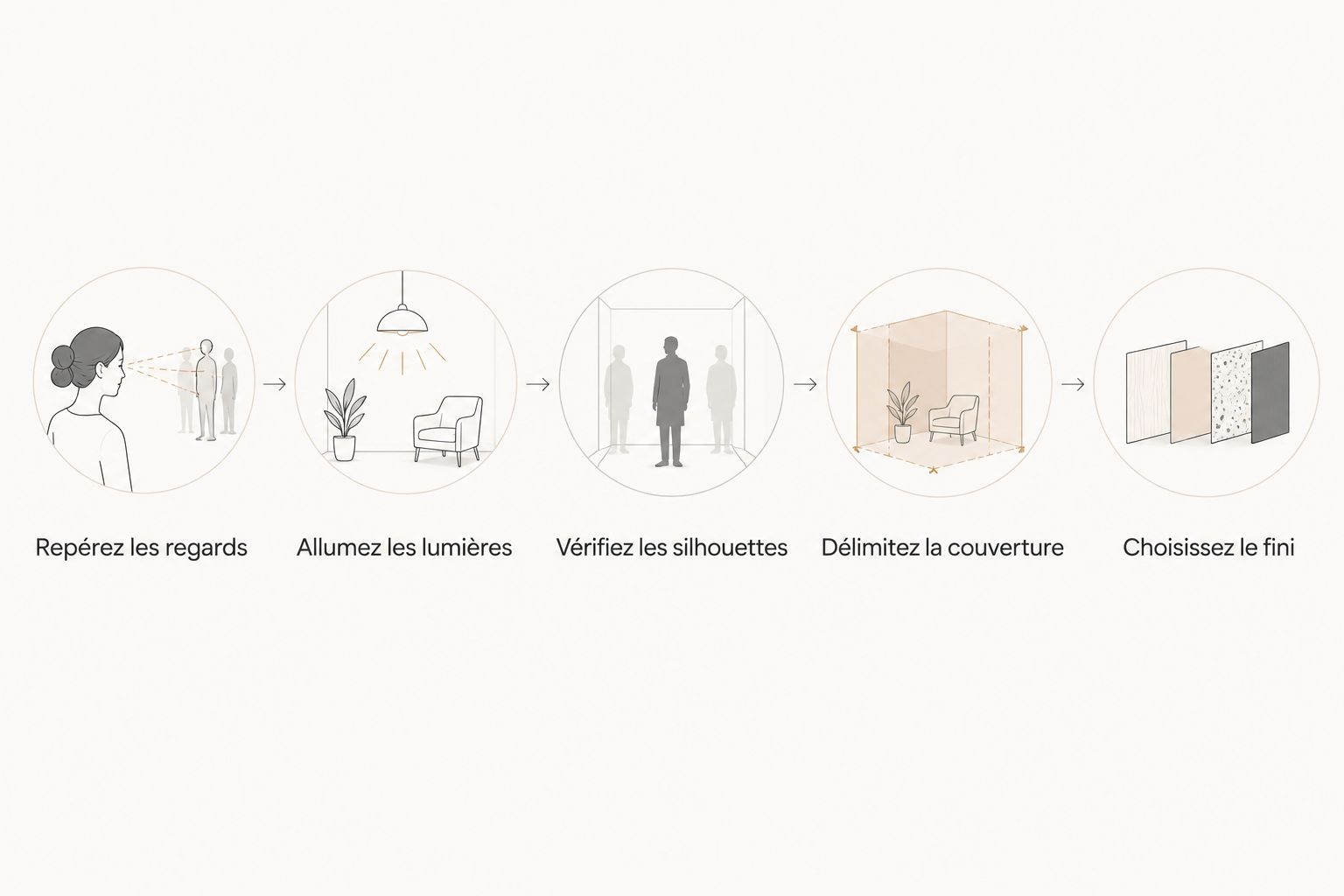
- Identify prying eyes. Look at the window from the sidewalk, the entrance, or accessible places that look directly into your interior. Respect neighboring properties.
- Turn on the lights. Recreate your usual evening lighting, including the lamp near the armchair or the bathroom lighting.
- Check for silhouettes. Ask another person to stand in the room, then near the glass. Observe what you can distinguish from outside.
- Define the coverage. Determine if the bottom of the window is sufficient or if the entire surface needs to be treated. Also check downward views.
- Choose the finish. Decide whether you accept losing the view outside or if you prefer to close opaque window treatments in the evening.
If you use a sample, evaluate only the area it covers. A small piece helps you understand the finish, but does not show the privacy of a complete window or the joints between several glass surfaces on its own.
Does a frosted film also protect in the evening?
A frosted film blurs the view in the evening without relying on a brighter exterior. Its operation differs from that of a one-way window film: it diffuses light instead of relying on a dominant reflection. It is therefore suitable when your priority is to reduce the direct view rather than maintain a clear panorama.
However, frosting is not equivalent to an opaque partition. Depending on the finish, lighting, and a person's proximity to the glass, a silhouette or movements may still be noticeable. In a bathroom, check the result particularly where you stand, with the usual lighting on.
Plain frosting or a decorative pattern?
The choice depends first on the desired look. A plain finish limits the decorative presence of the window; a pattern makes the glass a decorative element. Do not infer the level of privacy from the product name alone or from the appearance of the pattern in an image.
Décor Imprimé is suitable for homeowners looking for a decorative frosted film rather than a one-way effect. The Quebec manufacturer offers the following choices, in particular; their appeal here is the type of finish, not a promise of complete blackout.
| Product | Best suited for | Strength for your project | Limitation to check |
|---|---|---|---|
| Plain privacy window film | Glass with a sober look | A plain frosted finish without a decorative pattern | The view outside is blurred; check for silhouettes |
| Solange privacy window film | A window that contributes to the decor | An original locally made design | Validate the look of the design and the privacy in your lighting |
To choose a Décor Imprimé frosted film in 2026, start with the use of the room, then examine the finish. The mention "Made in Quebec" indicates the place of manufacture; it does not replace checking compatibility with your glass or the desired level of privacy.


Can you keep the view outside without being seen at night?
A passive one-way window film does not guarantee seeing outside without being seen when your interior is brighter. Maintaining the view under these conditions and completely hiding the room are contradictory goals for this type of film. You must choose the priority that corresponds to your use.
For a living room, you can maintain a clear view during the day and close opaque window treatments in the evening. For a window looking directly onto an entrance, frosting better meets the permanent need to blur prying eyes. In both cases, check the areas left uncovered.
Should you cover the entire window to be shielded from prying eyes?
The area to cover depends on lines of sight, not just the height of the window. A frosted lower section meets some prying eyes from the same level, but it does not block a downward view from a neighboring home. Therefore, identify the points of observation before fixing the height of the frosting.
In your 2026 decoration plan, indicate the position of the seating, bath, or office relative to the glass. These are the areas that actually need to be protected, while keeping the light and views you wish to preserve.
FAQ
Does a one-way window film work day and night?
No, a one-way window film does not guarantee privacy day and night. Its effect depends on the lighting contrast: when the interior is brighter than the outside, people outside can see into the room.
Why can people see into my home in the evening despite a one-way window film?
Your lit interior becomes brighter than the outside, making the room visible through the film. The reflection you see from the inside does not mean that prying eyes from outside are blocked.
Is a frosted film better for privacy in the evening?
A frosted film is better suited for blurring the view without relying on the mirror effect. However, it does not guarantee the absence of silhouettes, especially when a person stands near the glass.
What solution should I choose to avoid being seen in a bathroom?
Choose a solution that blocks enough of the view in your actual lighting and from accessible angles. Test frosted film for silhouettes; if you require complete privacy, plan for an opaque treatment suited to the room.
Can you still see outside through frosted film?
Frosted film also blurs your view of the outside. If you want to retain some visibility, consider a partial treatment after checking all lines of sight.
Can any film be applied to double-pane windows?
No, compatibility must be confirmed for both the film and the window glass. Check the manufacturers' instructions before installation, especially for treated glass or glass exposed to intense sunlight.
Does Décor Imprimé offer frosted options to add privacy?
Décor Imprimé offers frosted films, including a plain finish and decorative designs. Choose according to the desired look, then confirm compatibility and privacy in your room's conditions.
One last tip
Also check what can be seen when you open the window. A treatment applied to a movable part may no longer cover the same line of sight once the panel is moved. For your 2026 project, test it with the window closed, then in its usual ventilation position.
The right choice is not just about "mirror or frosted." It depends on the views you want to block, your evening lighting, and the visibility you are willing to give up.