The 8 best floral wallpaper patterns for 2026
Best versatile choice: small, spaced-out flowers; best choice for an accent wall: large flowers; best romantic choice: roses. This trendy floral wallpaper guide compares 8 pattern families to help you choose based on your room, your furniture, and the effect you want to achieve in 2026.
- Trendy floral wallpaper should be chosen based on scale, contrast, and the furniture placed in front of the wall.
- Small, spaced-out flowers are the versatile choice; large flowers are well-suited for an accent wall.
- Décor Imprimé offers custom murals for individuals looking to tailor their decor to their space.
- Compare a sample in your lighting before deciding on your floral palette.
Why the choice of pattern matters
A flower does not have the same effect when it covers almost the entire wall versus when it repeats discreetly behind a piece of furniture. Before comparing designs from Décor Imprimé, determine what you want to see upon entering: an overall decor or a focal point.
Décor Imprimé is perfect for individuals looking for a custom floral mural for their home or condo. However, the right pattern remains one whose composition works with the openings, furniture, and colors already present.
For your 2026 project, use this selection as a decision-making tool rather than a popularity ranking. Each family serves a different need.
What makes for good trendy floral wallpaper
- Scale: choose the size of the flowers by looking at the entire wall, not just a detail of the visual.
- Contrast: compare the space between the flowers and the background to gauge the presence of the pattern.
- Composition: identify the elements that will remain visible above the sofa, bed, or sideboard.
- Palette: look for a connection with your textiles, wood, or paint, without trying to match everything.
- Type of covering: distinguish between the aesthetic choice and the installation requirements of the chosen product.
- Room usage: decide whether the wall is meant to accompany relaxation, frame mealtimes, or attract the eye.
The 8 patterns at a glance
The order of the table follows that of the recommendations. The models named serve as paths to explore; check their full visual before choosing a scale or palette.
| Pattern | Ideal for | Decorative highlight | Limit to anticipate |
|---|---|---|---|
| Small, spaced-out flowers | Complementing existing furniture | Discreet floral presence | Less readable from a distance |
| Large flowers | Creating an accent wall | Eye-catching composition | Placement must be checked behind furniture |
| Roses | Creating a romantic bedroom | Classic floral reference; tip: Delicate Roses | Romantic accumulation to be balanced |
| Meadow flowers | Creating a rustic look | Combination of flowers and stems | Can seem busy with other small patterns |
| Botanical print | Structuring a reading nook | Illustrative inspiration; tip: Botanical Print | Details to be examined up close and from afar |
| Flowers on a dark background | Creating an enveloping atmosphere | Contrast between background and flowers; tip: Night Flowers | Lighting to be verified in the room |
| Flowering branches | Complementing a vertical composition | Direction provided by the branches | Cropping to watch near openings |
| White flowers | Connecting several neutral tones | Floral palette centered on white | Shade to be compared with existing whites |
1. Small, spaced-out flowers: for easy-to-coordinate decor
Small, spaced-out flowers are the default choice if you want to introduce a pattern without organizing the entire room around it. Look for a composition where the background remains visible between the elements.
Ideal for: a living room or bedroom where you are keeping the existing furniture. Pick up a color from the pattern in a throw pillow or blanket, then let the other surfaces remain simpler.
Small, spaced-out flowers — advantages:
- Accompany a piece of furniture rather than requiring a large open area.
- Allow for a discreet floral presence.
- Coordinate with solid-colored textiles.
Small, spaced-out flowers — limits:
- Their design becomes less legible from a distance.
- Their repetition can compete with a highly detailed rug.
For your 2026 selection, pay special attention to density: very tightly packed small flowers do not necessarily yield a discreet result. Verdict: a great choice for a first floral room.
2. Large flowers: for an assertive accent wall
Large flowers treat the wall as a composition rather than a simple background. First, choose the main viewpoint: from the door, the sofa, or the foot of the bed.
Ideal for: an accent wall where a large portion remains visible. A low piece of furniture leaves more room for the design than a floor-to-ceiling bookcase.
Large flowers — advantages:
- Create an identifiable focal point.
- Provide clear direction for the rest of the decor.
- Allow you to compose around a few main shapes.
Large flowers — limits:
- A headboard might hide the central flower.
- Doors and windows interrupt the composition.
Before deciding, identify what will actually appear above your furniture. A visual that looks appealing on an empty wall must also function within your layout. Verdict: choose this to bring the wall into the foreground.
3. Roses: for a romantic bedroom without the overload
Roses are a direct path to romantic decor. To keep the result balanced, choose what will carry this intent: the wallpaper, the textiles, or the accessories, rather than all elements at once.
Ideal for: a bedroom where you wish to soften furniture with simple lines. Compare the drawing of the roses as much as their color: a detailed illustration and a stylized interpretation tell different stories.
Roses — advantages:
- Provide an easily recognizable decorative reference.
- Combine well with solid bedsheets and curtains.
- Allow you to build a palette around a floral color.
Roses — limits:
- Accumulating flowers, lace, and ruffles strongly accentuates the theme.
- A bouquet placed behind a piece of furniture loses its role in the composition.
Verdict: choose this for a clear romantic intent; avoid if you are looking for a near-abstract pattern.
4. Meadow flowers: for a rustic dining room
Meadow flower compositions generally combine flowers, stems, and foliage in a free-spirited, organic style. Look at the spaces between the elements: they matter just as much as the flowers themselves for wall balance.
Ideal for: a dining room where you want a rustic direction. Use the table, chairs, and light fixture as reference points before adding other patterns.
Meadow flowers — advantages:
- Bring together several botanical forms in one composition.
- Offer colors that can be picked up in accessories.
- Accompany a garden-inspired decorative intent.
Meadow flowers — limits:
- Small details can compete with a printed tablecloth.
- A dense composition requires simplifying the objects in front of the wall.
In 2026, choose this family for its connection to your room, not just because it is trendy. Verdict: choose this for rustic decor with simple textiles.
5. Botanical print: for an illustrated reading nook
The botanical print emphasizes the design of the plant. Examine the contours, the presence of the foliage, and the space left for the background to determine if the pattern suits your reading nook.
Ideal for: a space where you want to look at details up close. A lamp, a chair, and a small table are enough to define the function of the nook without multiplying decorative elements.
Botanical print — advantages:
- Gives a central place to the design.
- Connects flowers and foliage with the same intent.
- Offers an alternative to romantic bouquets.
Botanical print — limits:
- Fine details are less readable from the other side of the room.
- Framed illustrations on the same wall might result in duplication.
Keep an area clear near the chair to enjoy the pattern. Verdict: choose this for a reading nook where the design deserves to be observed.
6. Flowers on a dark background: for an enveloping atmosphere
A floral pattern on a dark background relies on the relationship between the background and the flowers. Compare this relationship in your actual lighting, especially if you use the room primarily in the evening.
Ideal for: a bedroom or living room where you are looking for an enveloping atmosphere. Start by deciding if you want to treat only one wall or extend this intent elsewhere in the room.
Flowers on a dark background — advantages:
- Create a sharp separation between flowers and background when the contrast is strong.
- Give strong direction to the decor.
- Allow for picking up a light color from the pattern in the textiles.
Flowers on a dark background — limits:
- The appearance changes with the intensity and color of the lighting.
- Dark furniture stands out less against an equally dark background.
Verdict: choose this after comparing it during the day and under your lamps.
7. Flowering branches: to accompany the wall's height
Flowering branches provide direction to the composition. Follow their path on the full visual to check how they meet the ceiling, corners, and openings.
Ideal for: an open, vertical section of wall, especially in an entryway. The starting point of the branches matters: avoid choosing based solely on a close-up of flowers.
Flowering branches — advantages:
- Guide the eye through the composition.
- Combine flowers and organic lines.
- Allow for working around a vertical space.
Flowering branches — limits:
- Cropping can cut an important branch.
- A coat rack or mirror can mask the direction of the design.
Map out the obstacles on your floor plan before confirming the framing. Verdict: choose this when the path of the branches remains visible after furnishing.
8. White flowers: for coordinating neutral tones
White flowers do not automatically constitute a discreet pattern: their presence also depends on the background and the outlines. Look at the overall contrast before pairing them with a light-colored room.
Ideal for: connecting textiles and surfaces in a neutral palette. Place existing whites next to a sample to compare their nuances.
White flowers — advantages:
- Introduce a floral theme without imposing a brightly colored flower.
- Can be directly compared to the whites of your textiles.
- Work as a starting point for a neutral palette.
White flowers — limits:
- A warm white and a cool white do not create the same match.
- A high-contrast background makes the pattern more present than expected.
For a 2026 project, validate the match with the curtains and bedding you are keeping. Verdict: choose this to coordinate neutrals, after comparing the shades.
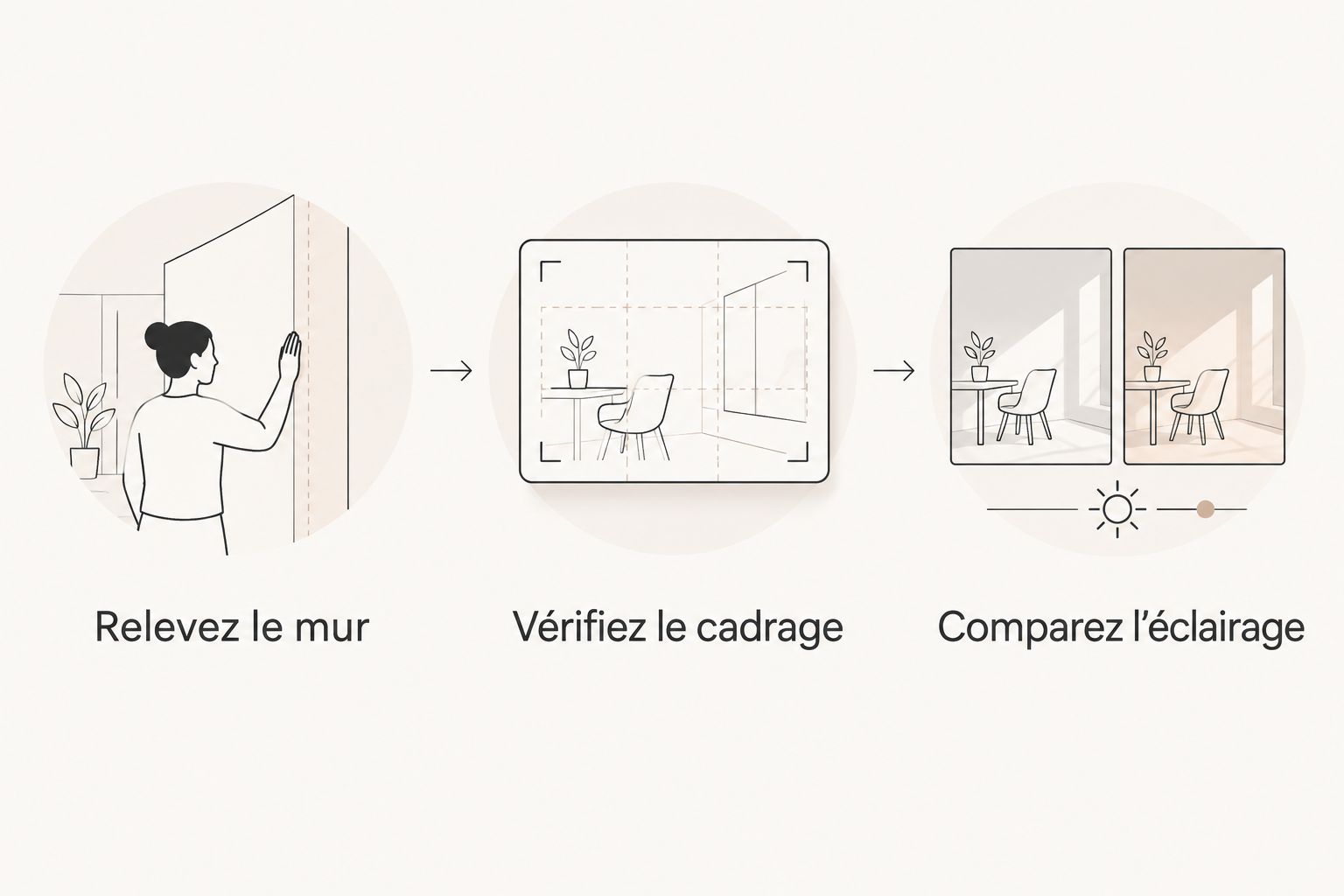
How to choose your pattern in 3 steps
Measure your wall
Take 2 basic measurements: width and height. Also, note any doors, windows, outlets, and furniture that hide part of the design; then follow the measurement instructions for your chosen wall covering.
Check the framing
Look at the visual as if it were already behind your furniture. Identify the main flower, the branches, and the busy areas: the element you love must remain visible.
Compare the lighting
Examine the sample near existing materials, then under the lamps used in the room. Do not expect a small section to show the entire composition: it is primarily for comparing the local rendering of the pattern, color, and texture.
To compare specific options from Décor Imprimé, the Festival of the Flowering Branch and White Flowers & Co. samples measure 8 × 11 in. This format helps to examine a portion of the pattern in your home; it does not replace the overall view necessary for choosing the framing.


How patterns are ranked
This ranking prioritizes usage: coordination, accent wall, romantic ambiance, rustic direction, or vertical composition. It is based on scale, contrast, framing, and palette, without assigning sales or popularity scores to the patterns.
Which floral wallpaper to choose in 2026?
If you are hesitant, start with small, spaced-out flowers. Choose large flowers instead if the wall is meant to be the focal point, or floral branches if your project relies on a vertical composition.
For your floral wallpaper, Décor Imprimé offers custom murals in self-adhesive and traditional versions. Check the characteristics and instructions for the chosen model separately from the aesthetic choice: a beautiful pattern does not exempt you from preparing the installation.
FAQ
Which trendy floral wallpaper should I choose to start?
Small, spaced-out flowers are the versatile choice in this selection. They are suitable if you want to add a pattern while keeping your furniture as the main point of reference.
Is a large floral pattern suitable for a small room?
A large floral pattern is not excluded from a small room. Focus on checking the part of the design visible behind furniture and from the entrance, rather than choosing solely based on square footage.
Which floral pattern should I choose behind a headboard?
Choose a composition where the important elements remain visible above or on either side of the headboard. Check the framing before selecting a large central flower.
How do I choose between a light and a dark background?
Compare each background in your room’s actual lighting. Also, look at how the furniture stands out against the wallpaper and how the colors harmonize with the textiles.
Does a sample show the entire mural?
A sample does not replace the full visual of a mural. Use it to examine a portion of the pattern, the color, and the texture, then check the entire composition separately.
Is self-adhesive floral wallpaper suitable for all walls?
Do not assume that self-adhesive wallpaper is suitable for all walls. Check the product requirements regarding the surface, paint, and preparation before installation.
Can I pair floral wallpaper with a patterned rug?
Yes, provided you compare the patterns together. If both are very detailed, simplify the other textiles and check which one should catch the eye first.
One final tip
Choose the pattern by taking into account what your furniture hides. A spectacular flower placed behind a dresser no longer contributes to the decor as it does in the presentation visual. Before confirming your project with Décor Imprimé, keep a view of the furnished wall next to the chosen composition.