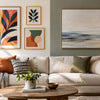
Living room wallpaper: 10 decor trends to adopt in 2026
Best versatile choice: the subtle floral. To structure a classic living room: tartan. For a small wall: monochrome foliage. Here are 10 living room wallpaper ideas to consider in 2026, along with their advantages, limitations, and tips for choosing from Décor Imprimé.
- Living room wallpaper: subtle floral is the recommended choice to complement existing furniture.
- Décor Imprimé offers custom-made wallpaper and murals to personalize your living room.
- Choose the pattern based on the visible wall, lighting, and furniture colors.
- Compare a sample in your room before choosing your wall decor.
Why the choice of wall matters as much as the pattern
Wallpaper draws the eye to the surface it covers. Before choosing flowers, checks, or a forest, decide what you want to highlight: the sofa, a reading nook, or an empty wall.
For your living room in 2026, start with the elements you are keeping. A successful pattern complements the flooring, sofa, and curtains; it shouldn't force you to replace the entire room.
Décor Imprimé is suitable for individuals looking for living room wallpaper or a custom-made mural. The right choice is the one whose composition works on your wall, with your furniture in front of it.
Criteria for good 2026 living room wallpaper
- Pattern scale: look at the size of the flowers, leaves, or checks in the room, not just in a close-up image.
- Contrast: compare the background and the design with existing surfaces.
- Composition: identify what the sofa, shelves, or TV will hide.
- Palette: pick up an existing color rather than adding several new directions.
- Surface: check the requirements for the chosen covering and the condition of your wall before installation.
The 10 styles at a glance
This ranking follows distinct decorative needs. Subtle floral comes out on top for its ease of coordination; the other styles address more targeted projects.
| Rank and style | Best for | Main advantage | Limitation to consider |
|---|---|---|---|
| 1. Subtle floral | Keeping current furniture | Plant pattern easy to repeat in accessories | Check the scale of the flowers |
| 2. Tartan | Structuring a classic living room | Regular geometric grid | Demanding visual alignment |
| 3. Monochrome foliage | Dressing up a small wall | Restricted palette | A dense design remains very present |
| 4. Misty forest | Creating a contemplative reading nook | Landscape print | Composition sensitive to tall furniture |
| 5. Floral on dark background | Accentuating an enveloping living room | Strong decorative contrast | Check lighting balance |
| 6. Artistic landscape | Giving art a central place | Composition to be viewed like a work of art | Crucial cropping |
| 7. Print-style botanical | Complementing antique furniture | Graphic design | Details less readable from a distance |
| 8. Illustrated tropical | Lively family living room | Presence of foliage and birds | Several possible focal points |
| 9. Light and beige floral | Unifying natural materials | Soft palette | Contrast sometimes too weak |
| 10. Scandinavian folk | Personalizing a creative relaxation area | Narrative pattern | Illustrations to be enjoyed daily |
1. Subtle floral: the most versatile living room wallpaper
Subtle floral brings a botanical design without imposing a full scene. Choose it by starting from a color in the sofa or rug, then keep the other major textiles fairly sober.
Best for: renewing the decor without changing furniture.
Subtle floral — strengths:
- Pairs well with solid-colored accessories.
- Introduces soft shapes.
- Allows you to pull a color into the cushions.
Subtle floral — limitations:
- Large flowers significantly change the intended effect.
- A floral rug adds a second pattern to coordinate.
Verdict: adopt as your first choice if you are hesitating between several styles.
2. Tartan: the best choice for a classic living room
Tartan organizes the wall with a grid of intersecting lines. Pair it with a solid-colored sofa and furniture with simple contours: the wall already provides visible structure.
Best for: providing a visual frame for a classic living room.
Tartan — strengths:
- Creates a regular rhythm.
- Complements solid textiles.
- Offers multiple colors to repeat in accessories.
Tartan — limitations:
- The lines make any installation misalignment visible.
- Other checks can complicate the overall look.
Verdict: adopt if you like structured decor and clean lines.
3. Monochrome foliage: the best choice for a small wall
Monochrome foliage narrows the palette while maintaining an identifiable pattern. Look closely at the density of the design, however: monochrome does not mean subtle.
Best for: dressing up a specific area near a chair or console.
Monochrome foliage — strengths:
- Limits the colors to coordinate.
- Introduces a plant theme.
- Complements colorful accessories.
Monochrome foliage — limitations:
- Strong contrast draws a lot of attention.
- A narrow surface can cut through large leaves.
Verdict: adopt on a small wall after checking which elements are cut off at the ends.
4. Misty forest: the best choice for a reading nook
A misty forest installs a landscape rather than just a simple pattern. Reserve it for a surface where the trees and misty areas remain visible from your chair.
Best for: composing a reading nook focused on a contemplative image.
Misty forest — strengths:
- Gives the landscape a place.
- Complements a nature-inspired palette.
- Creates a focal point behind low furniture.
Misty forest — limitations:
- A tall bookshelf will hide the scene.
- Framing matters as much as colors.
Verdict: adopt if the wall allows the composition to breathe.
5. Floral on a dark background: the best choice for an enveloping living room
A dark background makes the flowers pop and turns the wall into a bold accent. Compare this contrast with that of your curtains and sofa, especially when the lamps are on.
Best for: creating an enveloping decor appreciated in the evening.
Dark floral — strengths:
- Highlights the flowers.
- Offers a contrasting background for light furniture.
- Provides a precise decorative direction.
Dark floral — limitations:
- The look requires thoughtful lighting.
- Several dark pieces of furniture can reduce useful contrasts.
Verdict: adopt after observing the sample under your evening lighting.
6. Artistic landscape: the best choice for a feature wall
An artistic landscape is chosen like a large-format piece of art. Identify its main subject, then check its position relative to the sofa back and openings.
Best for: making the wall the central piece of the decor.
Artistic landscape — strengths:
- Presents a complete composition.
- Guides the choice of accent colors.
- Visually replaces a group of framed pictures.
Artistic landscape — limitations:
- Poor cropping cuts out the important subject.
- Additional wall art placed in front can clutter the look.
Verdict: adopt on an open surface once you know its dimensions.
7. Print-style botanical: the best choice with antique furniture
A print-style botanical emphasizes the drawing of the plants. It allows you to introduce a plant motif in a living room where wood, books, or antique objects already occupy a significant place.
Best for: linking antique furniture with botanical decor.
Print-style botanical — strengths:
- Puts the line work in the foreground.
- Complements curated decorative objects.
- Offers an alternative to immersive landscapes.
Print-style botanical — limitations:
- Small details are less readable from a distance.
- Very crowded shelves can compete with the drawing.
Verdict: adopt if you enjoy graphic details up close.
8. Illustrated tropical: the best choice for an expressive family living room
Illustrated tropical brings together foliage and, depending on the drawing, birds or other figurative elements. Give it the leading role rather than multiplying themes in the room.
Best for: creating an expressive and colorful family living room.
Illustrated tropical — strengths:
- Introduces a recognizable subject.
- Provides colors for accessories.
- Personalizes a previously neutral wall.
Illustrated tropical — limitations:
- Illustrations require a bold choice.
- A high sofa can hide interesting elements.
Verdict: adopt if you like the theme as much as the palette.
9. Light and beige floral: the best choice with natural materials
A light and beige floral complements decor where you want to maintain soft contrasts. Place the sample near wood and textiles: different shades of beige do not automatically produce a harmonious ensemble.
Best for: unifying a living room with natural materials.
Light and beige floral — strengths:
- Maintains a restricted palette.
- Adds a design to solid-colored surfaces.
- Leaves visual space for furniture textures.
Light and beige floral — limitations:
- The pattern may lack presence from a distance.
- Undertones require comparison in the room itself.
Verdict: adopt if you are looking for a soft presence, not a dramatic contrast.
10. Scandinavian folk: the best choice for a creative relaxation area
Scandinavian folk combines decorative shapes with illustrated subjects. The "Ramage et plumage dans la forêt" (Boughs and Plumage in the Forest) wallpaper, for example, is depicted with an owl and a decorative peacock.
Best for: personalizing a relaxation nook with a narrative universe.
Scandinavian folk — strengths:
- Introduces figurative details.
- Gives the relaxation nook an identity.
- Offers an alternative to flowers alone.
Scandinavian folk — limitations:
- The illustrated subject must appeal to you in the long term.
- Exposed objects can compete with the pattern.
Verdict: adopt if you truly like the represented world; otherwise, discard.
Verify your choice before ordering
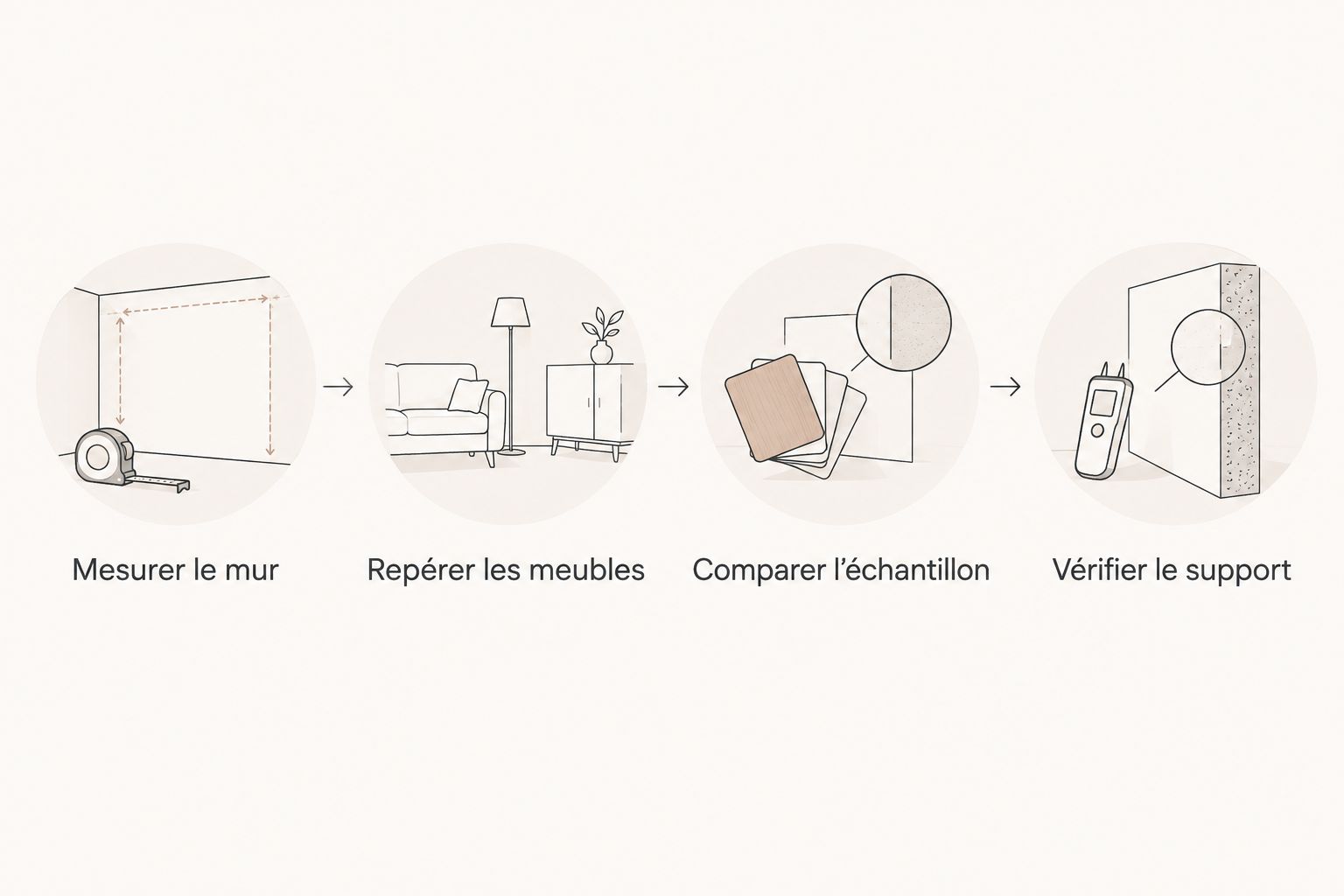
Proceed in this order to avoid choosing based solely on an inspirational photo.
- Measure the wall. Note width, height, openings, and obstacles. A wall 240 cm wide by 250 cm high is an example of a measurement, not a format to order automatically.
- Locate the furniture. Mark the height of the sofa and the position of shelves on a sketch.
- Compare the sample. Observe the colors near textiles, in natural light, and under lamps.
- Check the surface. Follow the instructions applicable to the chosen covering before preparing the surface.
The sketch is used to choose the composition; the sample is used to judge the actual rendering. Neither replaces the other.
Décor Imprimé offers, among others, the "Fleurs blanches et beiges" (White and beige flowers) and "Aquarelle de feuillage tropical" (Tropical foliage watercolor) samples in an 8 × 11 inch format. They allow you to compare two directions from this selection: soft floral and tropical vegetation. Their limitation is clear: a sample shows a portion of the design, not the entire wall framing.


How to read this ranking
This 2026 selection ranks decorative options based on their use: versatility, structure, targeted surface, or artistic composition. The criteria remain the same for each style: scale, contrast, composition, palette, and substrate.
This is not a popularity list. The best rank for your project depends on the wall to be covered and the elements you wish to retain.
Which wallpaper should you choose for your living room?
Without a precise direction, start with subtle floral. Then compare monochrome foliage if you want fewer colors, or artistic landscape if you are looking for an accent wall.
For your 2026 Décor Imprimé living room wallpaper project, first identify the style, then check the framing and the substrate. A beautiful image is not enough if its main subject disappears behind the sofa.
FAQ
Which wallpaper should you choose for a living room in 2026?
Subtle floral is the recommended choice to complement existing furniture. Tartan suits a structured decor, while an artistic landscape is ideal for an accent wall project.
Which wallpaper should you choose for a small living room?
Choose a pattern whose scale and contrast work with the visible surface. Monochrome foliage is an option for a small wall, but a dense design will remain very prominent.
Which wall should be wallpapered behind the sofa?
Choose the wall behind the sofa if its visible portion allows the pattern to be clearly seen. For a mural, check that the back of the sofa does not mask the main subject.
Is dark wallpaper suitable for the living room?
Dark wallpaper is suitable if you are looking for a strong contrast and an enveloping atmosphere. Observe a sample under your lamps before deciding on this direction.
What is the difference between a repeating pattern and a mural?
A repeating pattern uses the same elements across the surface, while a mural presents a composition that must be framed. Therefore, furniture and openings must be taken into account when choosing a mural.
Can wallpaper be applied to a damaged wall?
Do not install a covering before checking its substrate requirements. Repair any defects and follow the instructions for the chosen product; wallpaper is not a substitute for wall preparation.
How do I coordinate wallpaper with curtains?
Pick up a color from the wallpaper for your curtains, or choose a plain, compatible fabric. Compare the materials together in the living room rather than on separate screens.
A final piece of advice
Look at your wall from your usual spot on the sofa, not just from the entrance. It is often from this angle that you will enjoy the decor: the right pattern must also please you while seated, with the furniture in front.