Can a large-format printed canvas be installed on the ceiling?
Yes, a large-format printed canvas can be installed on a ceiling with a system expressly designed for this purpose and suited to the support; a canvas intended for a wall is not automatically compatible. Before ordering, have the manufacturers concerned confirm the ceiling use, mounting method, and maintenance requirements, then have the installation assessed on site.
- Large-format printed ceiling canvas: choose a system confirmed for installation above occupants.
- Décor Imprimé offers canvas prints; have any ceiling use confirmed separately.
- A stretched canvas, a framed canvas, and wallpaper require different installation methods.
- Do not apply a wall mounting method to a ceiling without validation from its manufacturer.
Can a large-format printed canvas be installed on a ceiling?
Yes, but compatibility depends on the combination of the canvas, mounting hardware, and ceiling, not just the printed image. In 2026, your starting point remains the documentation of the chosen product: look for explicit approval for horizontal installation above occupants.
The word "canvas" covers several constructions. A decorative canvas, a canvas integrated into a stretch ceiling system, and adhesive wallpaper are not interchangeable. Their appearance in a photo does not indicate how to install them.
| Proposed solution | Most relevant use | Project benefit | Limitation to check |
|---|---|---|---|
| Framed canvas | To display a piece like a painting | Decorative object separate from the support | Frame, joints, and mounting hardware must be validated for ceiling use |
| Printed stretch ceiling system | To cover a ceiling surface | Designed specifically for this location | Compatibility of the complete system and specialized installation must be confirmed |
| Wallpaper or wall mural | To directly cover a compatible surface | No frame to hang | Ceiling installation approval and condition of the existing finish must be checked |
Are you looking to hang a piece on a vertical surface instead? The guide for hanging a printed canvas without drilling into the wall applies to a different context: its methods do not constitute validation for ceiling use.
Why this distinction matters
On a wall, a painting relies on a specific hanging configuration. On a ceiling, the weight acts differently on the fasteners and joints. A load rating for wall use therefore does not prove that the same accessory is suitable above a bed or table.
Your project also includes the existing surface: paint, plaster, panel, and structure do not serve the same purpose. Smooth paint can hide a poorly adhering finish; it does not, on its own, prove strength.
Decide on the construction before choosing the artwork. You will avoid ordering a piece whose format, frame, or material subsequently requires a different installation than desired.
Framed canvas: have the complete object validated
A framed canvas includes more than just a printed surface. The frame, its joints, how the canvas is attached to it, and the hanging hardware all contribute to the object's stability.
Therefore, do not ask only if an anchor can support its weight. Ask if the complete artwork is intended for this orientation and where the stresses can be supported without damaging the frame. A secure attachment to the building does not correct an unsuitable decorative assembly.
Décor Imprimé is suitable for individuals looking for a printed canvas for their wall decor. For a ceiling project, obtain product-specific confirmation before considering an order: wall use is not sufficient to establish this compatibility.
If confirmation is not obtained, keep the canvas on the wall. It is a design decision, not a compromise to be bypassed with more glue or randomly added fasteners.
Printed stretch ceiling: think in terms of a system
A stretch ceiling canvas belongs to a system comprising a membrane, profiles, and an installation method. The print is one part of the result; it does not replace the technical requirements of the whole.
This family of solutions corresponds to a project specifically targeting the ceiling. Its purpose is this precise destination. Its constraint is the need to coordinate the system with the room, the equipment present, and future interventions.
For your 2026 project, request a proposal that clearly identifies the system manufacturer, the material, and the installation requirements. Do not treat a separately purchased decorative canvas as a stretch ceiling membrane.
An installer must also explain how to access the elements that will remain above or nearby. The result must allow the normal use of the room, without blocking an access panel or improvising around a light fixture.
Wallpaper on the ceiling: check the approved adhesion
Wallpaper and wall murals directly cover their support. Their advantage is the absence of a hanging frame; their limitation is that installation depends notably on the surface condition and the product's compatibility with this location.
Adhesive does not automatically mean compatible with the ceiling. Consult the manufacturer's instructions regarding orientation, approved surfaces, preparation, and ambient conditions. For a traditional version, also check the prescribed adhesive.
A small test can reveal a paint problem or handling difficulty. However, it does not replace approval for ceiling installation and does not, on its own, demonstrate long-term stability.
Do not choose this option solely because it seems easier to install. Working overhead, alignment, and cutting require a different organization than a wall installation.
Why feasibility varies from one room to another
The question is not just "will it stick?". To assess your ceiling, have the following elements examined:
- The actual support: identify what is behind the finish and what will receive the fasteners or coating.
- The artwork's construction: distinguish the weight of the printed material from that of the frame and hardware.
- The surface condition: report peeling paint, cracks, texture, or signs of water infiltration before any installation.
- The room conditions: communicate the presence of steam, moisture, or heat sources to the manufacturer.
- Existing equipment: locate light fixtures, smoke detectors, air vents, and access panels.
- Maintenance and removal: plan how to clean, inspect, and remove the artwork without improvisation.
In 2026, keep this information along with the answers received and the exact product reference. A recommendation given for another room or material does not necessarily apply to your situation.
How to prepare your project before purchasing
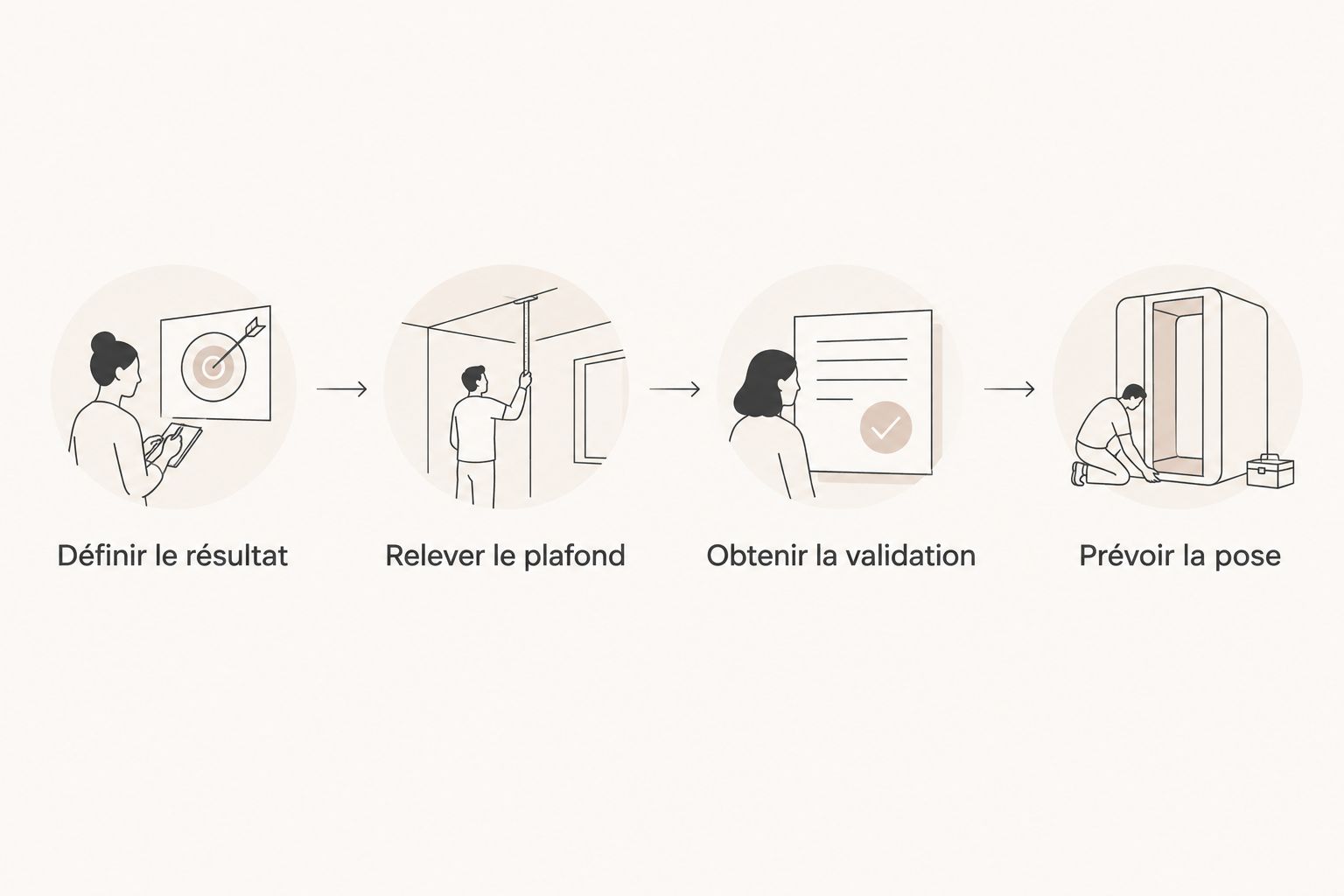
Prepare your request in 4 steps, without starting any drilling or applying adhesive. The goal is to provide the manufacturer and the person responsible for the installation with a clear file.
1. Define the result
Specify whether you want a framed piece above a specific area or a continuous design across the entire surface. Add a general photo of the room and indicate where the design will be viewed from.
This distinction guides the material choice. A painting visible from the sofa and a composition covering the ceiling require different framing and installation methods.
2. Measure the ceiling
Record the length, width, and height of the room in the same unit, for example in centimeters. Draw the obstacles and indicate the areas whose construction still needs to be identified.
Do not assume that the walls are perfectly parallel. Have the necessary manufacturing measurements confirmed by the person who knows the chosen system, rather than adding an arbitrary margin.
3. Obtain validation
Submit the product reference, the target surface, the photos, and the known ceiling characteristics. Request a written response stating the approved use, restrictions, and applicable instructions.
For a Décor Imprimé canvas, use the contact page to ask about the specific product. Confirmation regarding another item is not sufficient.
4. Plan the installation
Have the fasteners and access methods determined by a person qualified for this work. Also plan for room protection, artwork handling, and maintaining access to equipment.
What questions to ask the manufacturer and the installer?
Send a request that is brief but precise. These 3 questions help distinguish decorative intent from technical validation:
- Is the exact product approved for ceiling installation above occupants?
- What installation method is prescribed for the support identified in this room?
- What usage, inspection, and removal conditions must be met?
Attach the received documentation to your 2026 project file. Then ask the installer to confirm that the conditions observed on site match those specified in the instructions.
An answer regarding the printed material's strength does not address the entire issue. You also need answers regarding the fasteners, the support, and, in the case of a frame, its joints.
Can a canvas be glued directly to the ceiling?
Do not glue a canvas to the ceiling without a method expressly approved for the product and the support. A so-called strong adhesive does not provide this validation: you must know its compatibility with the materials and the intended use.
Do not also remove a canvas from its frame to invent an installation method. You would be changing the object's construction without having corresponding instructions.
Can a canvas be installed above a bed?
An installation above a bed requires the same validation of the complete system, with particular attention to the consequences of a fall. The location does not turn a wall accessory into a ceiling mount.
If compatibility remains uncertain, move the artwork to a wall. You keep the desired image without maintaining a suspended object whose purpose is not confirmed.
Is this a do-it-yourself project?
Visual preparation and the initial survey are done at home. However, identifying the structure, choosing a mount above occupants, and organizing work at height require the appropriate skills.
Entrust technical points to a qualified person when you cannot verify them. For a rental or co-owned property, also check the applicable permissions before any modification.
FAQ
Can a large-format printed canvas go on the ceiling?
Yes, if the product and its installation system are expressly suited for the ceiling. Have the compatibility of the material, fasteners, and support confirmed before purchasing.
Is a picture hook suitable for the ceiling?
A picture hook is not automatically suited for the ceiling. Check the orientations approved by its manufacturer and the compatibility with the object to be hung.
Can I use adhesive strips to hang a canvas from the ceiling?
Do not use adhesive strips on the ceiling without explicit approval from their manufacturer for this use and these materials. A stated capacity for a wall does not validate a horizontal installation.
Is self-adhesive wallpaper more suitable than a framed canvas?
Self-adhesive wallpaper avoids a hanging frame, but its use on the ceiling must also be confirmed. The choice depends on the desired result, the support, and the product instructions.
Can I install a canvas on a textured ceiling?
First have the texture identified and check the approved method for the product. Do not sand or drill into an unknown material before having the necessary precautions assessed.
Are Décor Imprimé canvas prints intended for the ceiling?
Do not assume that a canvas intended for wall decor is suitable for the ceiling. Request confirmation for the exact reference and your configuration before ordering.
What measurements should be prepared for a ceiling design?
Prepare the length, width, and height of the room, then locate the equipment and obstacles. Have the manufacturing measurements confirmed by the supplier of the chosen system.
One final piece of advice
Before having your artwork produced in 2026, check its orientation from the places where you will actually be sitting or lying down. A design with a top and bottom will look different from each side of the room.
Confirm the orientation of the image before production, but above all, confirm the installation method. A sketch helps you discuss the framing; it never replaces technical confirmation of the system.